



Celebrating New Teachers: Education and Metaphysics with Squaring and Circling
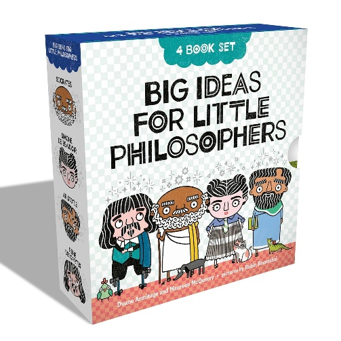
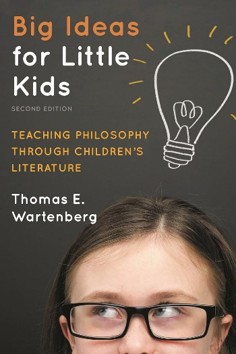
* (INTRODUCTION) Examples of Organizing Thinking with the Magic of 4s
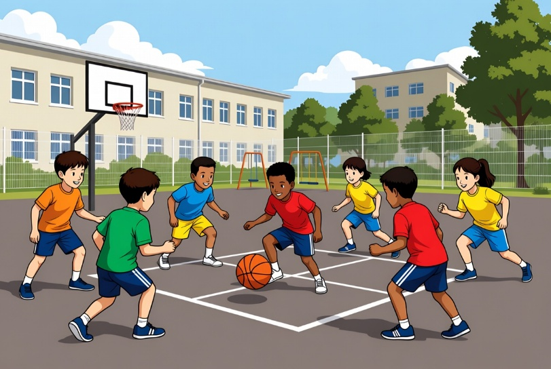
(Children Playing 4-Square at Recess)
NEXT TIME:
(2/2) Celebrating New Teachers: The Interview
BUT FIRST:
I’ve been on vacation from blogging until the Fall, but I encountered some very enthusiastic education students from the local university recently who had a table event at a Sobeys grocery store, and I was inspired to write a post dedicated to new teachers – reflecting my experiences teaching primary, junior, intermediate, Special Education, and first year university philosophy seminars. Please share this if you know any new teachers, or even veteran teachers as they might find philosophy in education cool too! There are also some fun creative thinking ideas for parents and grandparents to do with kids!
With the growing popularity of using philosophy to teach creative and critical thinking in public schools, one of the great challenges of teaching is still accountability to one’s students, fellow teachers, parents, and administrators to make learning clear and repeatable. And yet, how many times in consensus marking have two teachers employed the same rubric of criteria and exemplar models to a piece of student work only to come up with different grades for the work? And this happens in any discipline that employs criteria for assessment and evaluation, from scoring a fine wine contest to a dog show to a UFC fight. This “undecidability” will always be there, but we make the leap and are in a continuous cycle of reinforcing and upgrading best practices, such as Bennett and Rolheiser’s “Beyond Monet: The Artful Science of Instructional Integration (2001).”
Fourfoldedness (e.g., 2 pair relations) is a widely used and effective organizer to facilitate thinking through identifying, comparing, and contrasting. For example, the Philosopher Martin Heidegger gives the exemplary image of the fourfold jug.
Heidegger frequently presents the fourfold (Geviert) in terms of two pairs—earth and sky, mortals and divinities—while insisting on their unified, dynamic “onefold” belonging-together rather than a static or merely additive relation.
In his work “The Thing” and related later works (e.g., “Building Dwelling Thinking”), Heidegger writes phrases like:
- “Earth and sky, divinities and mortals—being at one with one another of their own accord—belong together by way of the simpleness of the united fourfold.”
This crossed or intersecting pairing (sometimes visualized as a square or crossed lines) is not arbitrary. It reflects a deeper structure:
- Earth and Sky: These form a more “horizontal” or worldly/material pair. Earth is the serving bearer (ground, nurturing, withdrawing); Sky is the open expanse (sun, weather, seasons, light/dark). Together they evoke the visible, elemental world and its rhythms.
- Mortals and Divinities: This is a more “vertical” or existential/sacred pair. Mortals are humans defined by their relation to death as such; Divinities are the hinting messengers of the godhead (traces of the holy, the sacred dimension that withdraws). They open the space for meaning, finitude, and the divine.
The pairs intersect and mirror one another. The fourfold is not four isolated elements but a mirror-play (Spiegel-Spiel) in which each reflects and appropriates the essence of the others in a dynamic, mutual appropriation (Ereignis). Each of the four is implicated in the others; they “belong together” in a simple unity that gathers in the thing. We are invited to see the relationality of the jug rather than just a substance with properties.
Heidegger emphasizes that this is not reducible to two independent pairs added together. Commentators like Andrew J. Mitchell highlight the relational, ecstatic openness: the fourfold is a “onefold of four” where the mirroring expropriates any fixed identity, creating the worlding of world in and through things.
Graham Harman interprets this crossed structure (two dualisms intersecting) as central to Heidegger’s ontology of objects, influencing object-oriented ontology. However, Heidegger himself keeps the language more poetic and non-systematic, avoiding rigid determinations.
The fourfold is structured as (and through) these two pairs, but the essential point is their gathering into a singular, appropriative event rather than any binary opposition or simple combination. The jug (or any thing) “things” by staying this united fourfold in nearness. This avoids both subjectivism and objectivism, pointing instead to poetic dwelling.
*Fourfold Thought Organizers
No wonder then, if the fourfold teaches us something fundamental about thought, that it appears in educational rubrics such as the 1999 Ontario grade one writing criteria for instruction, assessment, and evaluation:
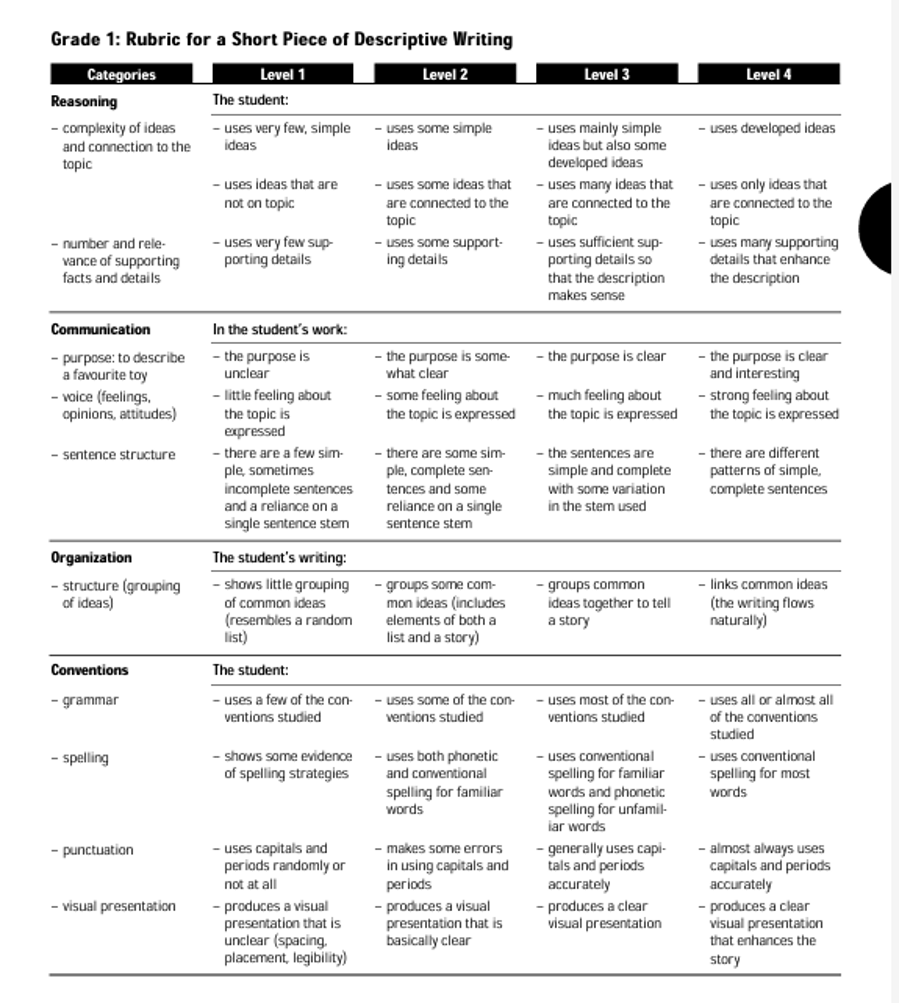
Education for teachers is born out of several interrelated principles, which are going to be their take on such things as short and long-term planning, assessment, classroom management, instructional strategies, and differentiation. Two posts ago we looked at Heidegger’s fourfold in relation to the fourfold Ontario Canada Grade 1 writing rubric, which has four criteria divided into 2 about the student and 2 about the student’s work, and 4 levels (commonly A,B,C,D), 2 at or above grade level and 2 approaching grade level or falling below grade level, needing remediation. Fourfoldedness is one of the most common rubric of criteria structures because it combines comprehensiveness/depth with specificity. In this case the fourfold are grouped into pairs, with two exemplar student writing samples at each student product level. Here, for instance are the 2 grade 1 level two or “C” writing exemplars indicating writing below and approaching grade level:
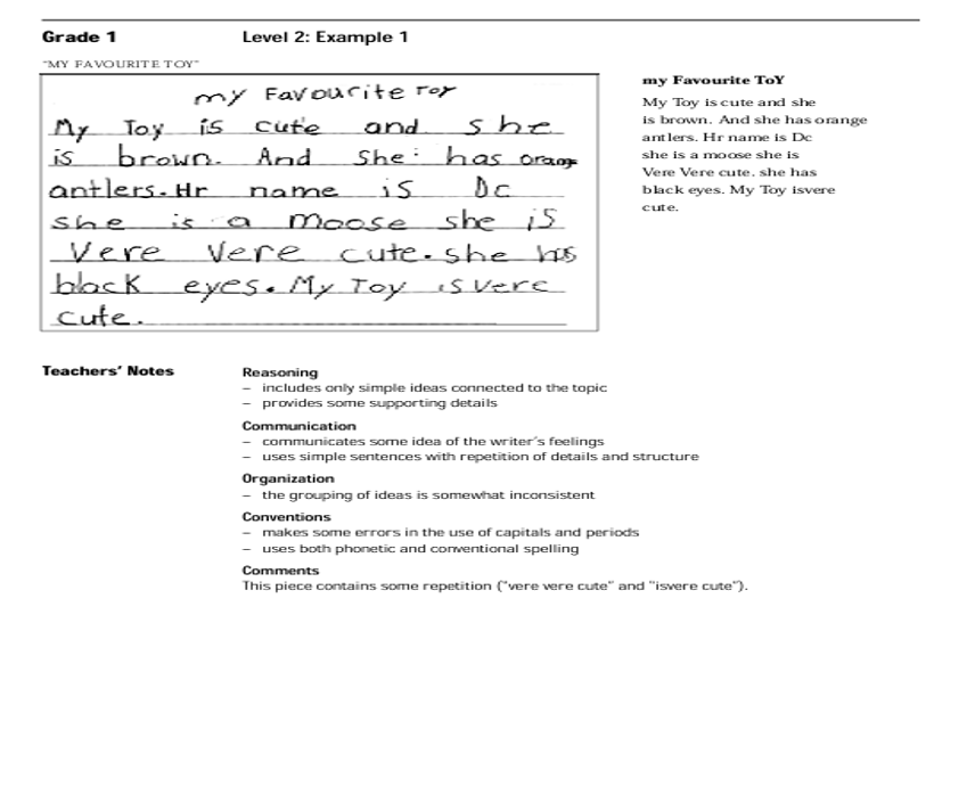
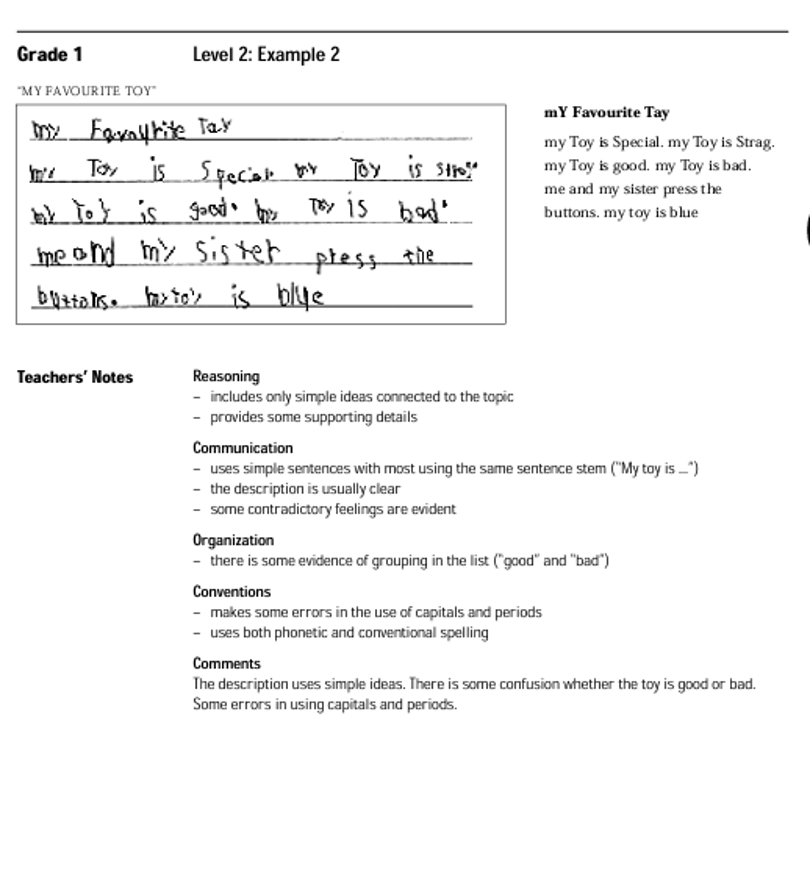
I will revisit these two Grade 1 writing level 2 or C exemplar papers near the end of this piece.
*(Here are some of the cross-disciplinary fourfold thinking organizers):
We see something similar in the history of Philosophy with Schopenhauer’s 4-fold root of the principle of sufficient reason. Schopenhauer identifies four distinct classes (or “roots”) of the Principle of Sufficient Reason (PSR) in his 1813 doctoral dissertation On the Fourfold Root of the Principle of Sufficient Reason (revised 1847). He argues that the general principle—”nothing is without a reason why it is rather than not”—is not a single undifferentiated law but manifests in four different forms, each tied to a specific class of objects for the subject.
These four roots prevent philosophical confusion by distinguishing the types of “why” questions we can meaningfully ask.
The Four Roots
1 Principle of Sufficient Reason of Becoming (law of causality)
Applies to changes in the physical/material world (real objects in space and time).
If a cause is given, the effect must follow. This governs empirical phenomena and alterations in nature.
2 Principle of Sufficient Reason of Knowing (logical grounding)
Applies to abstract concepts, judgments, and representations of reason.
If certain premises are given, the conclusion must follow. This is the domain of logical inference and conceptual truth.
3 Principle of Sufficient Reason of Being (mathematical/spatial-temporal grounding)
Applies to the a priori forms of space and time.
In space: relations such as geometric necessity (e.g., the equality of angles in a triangle implies equality of sides).
In time: arithmetic and sequential relations. This concerns pure intuitions and the structure of sensibility.
4 Principle of Sufficient Reason of Acting (or Willing/Motivation)
Applies to human (and animal) actions and the will.
A given character + a motive necessarily produces a specific action. This is causality “from within”—motivation as the subjective side of cause and effect.
Schopenhauer roots these in the fundamental subject-object correlation of consciousness. All objects fall into one of these four classes, and each class has its own necessary, a priori form of connection governed by the PSR. He criticizes earlier philosophers (e.g., Kant, Wolff) for conflating these forms.
Scholars and interpreters sometimes propose alternative pairings of the fourfold based on underlying structures such as:
- Intuitive/Perceptual vs. Abstract/Conceptual:
- Becoming (causality in intuitive perceptions) + Being (space/time as forms of intuition).
- Knowing (abstract concepts) + Acting (motives as recognized by the subject).
- Outer/Real vs. Inner/Subjective:
- Becoming and Being relate more to external reality and sensibility.
- Knowing and Acting relate more to reason and the will.
All of these can be traced back to the subject-object correlation. Alternatively, Schopenhauer notes that earlier philosophers (e.g., from Wolff, Kant, and others) had already recognized—or at least conflated—two basic forms of the Principle of Sufficient Reason, but failed to clearly distinguish the full set. He builds on those two and explicitly adds the other two.
- Pair 1: The “Traditional” or Commonly Recognized Pair
- Principle of Sufficient Reason of Becoming (causality in the physical world).
- Principle of Sufficient Reason of Knowing (logical grounding of judgments/concepts).
These concern change and inference in the empirical/abstract realms. Previous thinkers often blurred or treated them without full separation.
- Pair 2: The “Additional” Pair (Schopenhauer’s Contributions)
- Principle of Sufficient Reason of Being (mathematical/spatial-temporal relations).
- Principle of Sufficient Reason of Acting (motivation of the will).
These address a priori structures of sensibility (space/time) and the inner law governing actions.
This 2+2 structure is prominent in introductions to his work: he critiques predecessors for recognizing only (a confused version of) the first pair and then demonstrates the need for the full fourfold by identifying the second pair.
Analysis
There is something about a fourfold lens made up of 2 pairs that is going to be fundamental to the human condition. Consider the fundamental use of Analogies: A is to B as C is to D. The fourfoldedness of Heidegger’s jug mentioned previously would be a kind of thing that allows the individual thing or process to function as an element in explanatory thinking like analogies, allegories, examples, exemplars, etc.
We have been using analogical and example persuasive thinking so long that we do it automatically without wondering why it works the way it does. For example, we have all given assignments like this in the junior grades:
In a T-chart, list some reasons for and against school uniforms, and give one analogy illustrating each side.
T-Chart: School Uniforms
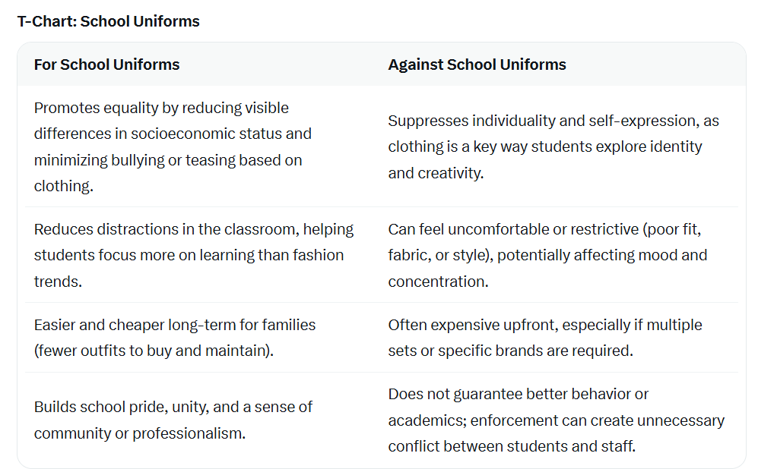
Analogy Illustrating the “For” Side
School uniforms are like athletic team jerseys in sports. Everyone wears the same kit, which eliminates distractions about who has the fanciest gear, fosters team spirit, and keeps the focus on playing the game together rather than standing out individually.
Analogy Illustrating the “Against” Side
Requiring school uniforms is like forcing every student in an art class to use only one color of paint. While it might create a uniform look, it severely limits personal creativity and self-expression, potentially making the final artwork (or the student’s development) feel bland and less reflective of who they truly are.
It’s remarkable that we default to throwing examples and analogies in debates without seeing they illustrate without proving – especially in high-stakes arenas like politics where a conservative lens on events clashes with a liberal one. Perhaps examples and analogies serve more of a negative function, and so while positively they illustrate, their real force is in disproving/refuting.
In any case, it should inspirer awe that we just “instinctively” argue and persuade by deploying “things” and “processes” into complex persuasion techniques like using examples, analogies, allegories, etc without asking, for instance, why something has the ability to belong in an analogy in the first place? We think, for example, metaphors are possible due to such things as the extensive physiological interconnectivity and translations going on between the various sensory areas of the brain and the mirroring nature of individuals such as how a baby mirrors the expressions of the mother.
Persuasive Examples and Analogies are closely connected, and persuasive examples often function as a form of (or draw on) analogical thinking. Both are inductive tools in rhetoric that help bridge the familiar and the unfamiliar to make arguments more compelling, memorable, and emotionally resonant.
Key Distinctions and Overlaps
- Examples are specific instances or cases used to illustrate a general claim. In persuasion (often via inductive reasoning), they build support by showing “this happened here, so the broader point holds.” Effective examples need to be sufficient in number, typical/representative, and relevant.
- Analogies explicitly compare two things (situations, objects, systems) based on shared features to infer that what holds for one likely holds for the other. They highlight relational similarities for explanation, prediction, or argument.
The connection is that a well-chosen example often implies or relies on an underlying analogy. When you cite a real-world case to support your point, you’re implicitly saying “this situation is relevantly similar to the one we’re debating.” This makes it a lightweight or implicit form of analogical reasoning.
Inductive Nature:
Neither provides deductive certainty. They make conclusions more vivid based on similarities. Strength depends on the quality and relevance of the parallels (or representativeness of examples). They support logos (logic) while aiding pathos (emotion) by making abstract ideas concrete and relatable. Analogies especially engage imagination and help audiences “connect the dots.”
Examples of the link between persuasive examples and analogies:
- Persuading for policy change: “Look at how this program succeeded in City X (example). Our city is similar in demographics and challenges, so it should work here too.” The example gains force through an implicit analogy.
- Argument from precedent (common in law and ethics): Historical cases or personal stories persuade by analogy—”This is like the lead-up to [past event], so we should act similarly.”
Comparing economic policy to “steering a ship” or a virus to “an invading army” transfers emotional and inferential weight from the familiar domain.
Caveats (They Can Backfire)
- Weak analogies or unrepresentative examples are common fallacies. Similarities must be relevant and deep enough (structural/relational, not just superficial). E.g., equating two situations that differ in key causal ways weakens persuasion.
- Over-reliance on a single vivid example can lead to hasty generalization.
- Analogies are tools for explanation and persuasion, not always strict proof—they suggest or illustrate rather than prove.
In short, persuasive examples frequently embody analogical thinking by inviting the audience to see “this case as like that general principle or situation.” Analogies make this comparison explicit and often more powerful for complex or novel ideas. Skilled persuaders use both fluidly to clarify, convince, and stick in the mind. This is why rhetoric textbooks and cognitive science both highlight them as core to effective communication.
Common Fourfold Structures Related to Analogy
- Proportional/Four-Term Analogy (Classic Structure)
The most famous “fourfold” form is the proportional analogy: A is to B as C is to D. This is the core of many analogies (e.g., “The heart is to the body as a pump is to a machine”). It explicitly maps relationships across two pairs.- Persuasive examples often imply this: A historical case (A:B) is like our current situation (C:D), so the outcome should transfer.
This goes back to Aristotle, Archytas, and later thinkers—it’s relational rather than just listing similarities.
- Persuasive examples often imply this: A historical case (A:B) is like our current situation (C:D), so the outcome should transfer.
- Aristotle’s Rhetorical Context
Aristotle treats examples (paradeigma) as a form of inductive argument closely tied to analogy in Rhetoric. He doesn’t label analogical thinking strictly “fourfold,” but related divisions appear (e.g., sources of enthymemes or types of arguments). Persuasion via examples/analogies supports logos while engaging imagination. Some interpretations link it to broader four-part rhetorical structures (e.g., parts of an oration or argument schemes). - Modern Analytical Frameworks
Cognitive and rhetorical models sometimes describe analogical reasoning with four key aspects or steps:- Retrieval: Finding a relevant source/example.
- Mapping: Aligning features/relationships between source and target.
- Inference/Transfer: Projecting knowledge or conclusions to the target.
- Evaluation/Learning: Assessing fit and updating understanding.
These align with how persuasive analogies work—pull an example, map similarities, infer the point, and convince the audience.
Some studies also categorize analogies by content or function into roughly four types (e.g., based on personal experience, knowledge, daily life, imagination). Analogies in persuasion are often split into literal (real similarities for argument) vs. figurative (explanatory/metaphorical). Combined with other binaries (e.g., structural vs. superficial, positive vs. negative), this can yield fourfold combinations, though it’s not a fixed standard.
In Persuasive Analogical Thinking the underlying logic is often four-term/proportional and the process of using them persuasively involves multiple (frequently four-ish) components.
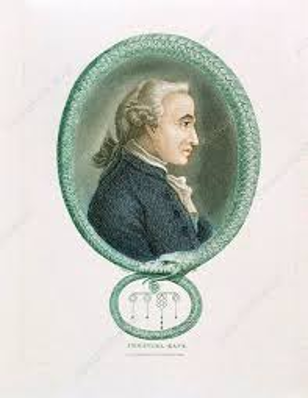
These types of metacognitive/philosophical discussions are exactly the type of deep thinking students should be doing. It’s not intellectually helpful to generate a list of reasons for and against abortion, illustrated by analogies on both sides if the student doesn’t know what the limits of persuasion are in debate. Philosophy basically means the mind examining itself, and so we have the classic image of the Philosopher Immanuel Kant framed by a snake eating itself:
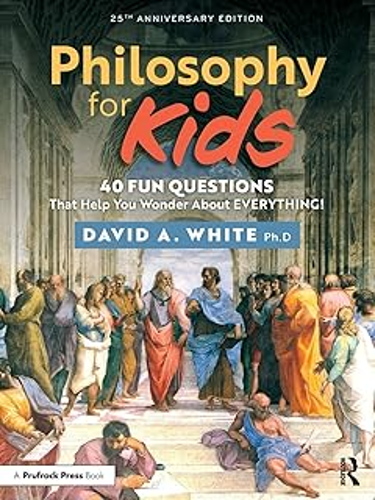
Philosophy in the classroom can be implemented in any number of ways. One strategy that worked well for me in grade 6 was a philosophy question of the week given on Monday and discussed on Friday. Such questions can be easily drawn from Philosophy for Kids books:
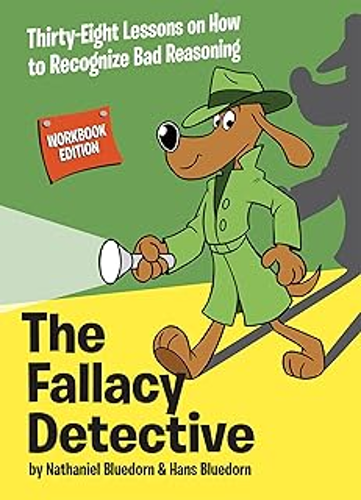
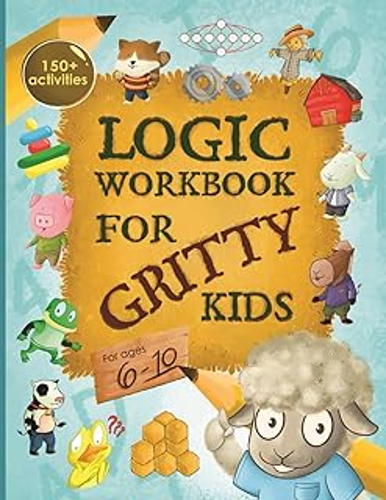
Another great strategy is having philosophical discussions using picture books, which is age appropriate creative and critical thinking for the younger students, and easy texts for the older students that allow them to explore thinking strategies without having to worry as much about decoding the meaning of the text
*(Expanding the Fourfold Across Disciplines)
The fourfold thinking organizer keeps resurfacing across the various domains of human thinking. Are there other important fourfold relations in 2 pairs, like how an analogy is: A is to B as C is to D? Yes, many significant fourfold frameworks in philosophy, psychology, semiotics, and related fields are structured as two crossed pairs (dualisms or axes), naturally supporting proportional analogies of the form A is to B as C is to D (or A:B :: C:D). This creates relational depth through oppositions, complementarities, or correspondences.
These quaternities often emerge from crossing two binary distinctions, generating four terms with mirror-like or proportional relations—echoing the patterns in Schopenhauer (e.g., traditional vs. added roots) and Heidegger’s fourfold (interpreted as intersecting dualisms, such as hiddenness/revealing crossed with other axes). For example,
Plato’s Fourfold in the Philebus (Metaphysical Principles)
- Unlimited (ápeiron: indefinite, boundless) : Limited (péras: definite, measure/boundary)
- Mixture (meikton: combination of the two) : Cause (aitia: the unifying intelligence or cause of the mixture).
This forms analogies like “indefinite is to definite as mixture is to its structuring cause.” It explains the composition of all things through limit and the unlimited.
Jung’s Four Psychological Functions (Paired Opposites)
- Rational/Judging pair: Thinking : Feeling
- Irrational/Perceiving pair: Sensation : Intuition
Analogy: Thinking is to Feeling (rational evaluation) as Sensation is to Intuition (perception of reality). These are presented as two pairs of opposites, with individuals having a dominant function. This quaternary influences personality typology (e.g., MBTI foundations).
Aristotle’s Categories / Division of Being (via Porphyry’s Tree or related interpretations)
One classic reading yields four combinations from two distinctions (“said of a subject” vs. “present in a subject”):
- Substantial particulars (primary substances)
- Substantial universals (secondary substances)
- Accidental particulars
- Accidental universals
This supports analogical reasoning about essence vs. accident across categories.
Plato’s Divided Line Analogy (Epistemology)
Divided into visible and intelligible realms, each further split proportionally:
- Visible: Images/shadows : Physical objects
- Intelligible: Mathematical hypotheses : Pure Forms/Ideas
The sections maintain proportional relations (e.g., clarity and truth increase analogically).
Other Recurring Patterns in Signs and Meaning [Akin toClassical Elements/Qualities (hot/cold × wet/dry): Fire (hot+dry) : Water (cold+wet) :: Air (hot+wet) : Earth (cold+dry)].
- Greimas’ Semiotic Square: Expands a binary (e.g., S1 vs. S2) with negations (~S1, ~S2) to create complex relations of contrariety, contradiction, and implication—explicitly for modeling analogies and narratives. Everyday Example: Temperature S1 = Hot S2 = Cold ~S1 = Not Hot (could be warm or cold) ~S2 = Not Cold (could be warm or hot). The square helps you see that “warm” is actually a complex position that is both “not hot” and “not cold. It forces you to think beyond simple black-and-white oppositions. It reveals hidden meanings, ideologies, or narrative structures (Greimas originally used it to analyze stories and myths).
- Peirce-influenced or Structuralist models: Often build on triads but extend to quaternary oppositions in Tropes (metaphor, metonymy, synecdoche, irony). The classic set is: Metaphor — Based on resemblance/similarity (seeing one thing in terms of another). Metonymy — Based on adjacency/contiguity or association (using something closely related, e.g., “the White House” for the U.S. administration). Synecdoche — Based on part-whole or essentiality/representation (part stands for whole, or vice versa, e.g., “all hands on deck”). Irony — Based on opposition/doubling or dialectic (saying one thing while meaning its opposite, revealing tensions or contradictions). This describes hybrid semiotic/rhetorical frameworks that evolve Peirce-style triadic thinking (or basic oppositions) into four-part logical or relational models—especially useful for dissecting how these four “master” tropes structure thought, stories, history, and ideology. It’s a way to move beyond simple either/or or three-way distinctions to capture more nuanced meaning dynamics, much like the Semiotic Square does for binary concepts. These ideas appear in literary theory, cultural studies, historiography, and even organizational or scientific discourse analysis. The Four Master Tropes are inherently relational, and placing them in a Semiotic Square is a standard and insightful way to reveal their underlying oppositions, implications, and generative power. It shows how they form a complete “grammar” of figurative (and literal) thought. Kenneth Burke (who popularized the “Four Master Tropes”) emphasized that these tropes are not isolated; they overlap, shade into one another, and exploring one thoroughly leads you to the others. They represent different fundamental ways of relating signs, ideas, or reality. Metaphor: Based on resemblance/similarity (perspective). Metonymy: Based on adjacency/contiguity/reduction. Synecdoche: Based on part-whole/essentiality/integration/representation. Irony: Based on opposition/doubling/negation/dialectic:
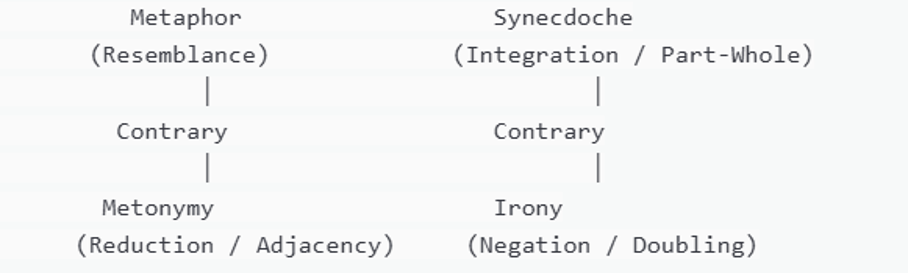
The Semiotic Square excels at expanding binary oppositions (e.g., similarity vs. difference) into four nuanced positions. The tropes already embody relational logics (resemblance, adjacency, inclusion, opposition), making them ideal for this kind of mapping. This is the core idea that makes the Four Master Tropes powerful and worth putting into a Semiotic Square. Each of the four tropes is not just a fancy way of speaking. Instead, each one is built on a different fundamental type of relationship (a “relational logic”) that the human mind uses to connect ideas, things, or signs. Here is the breakdown:
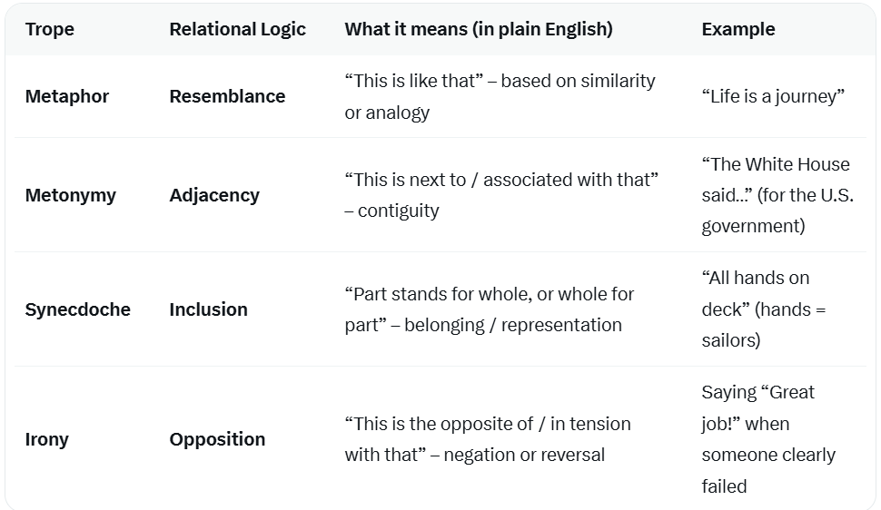
It means these four tropes are not arbitrary. They correspond to the four most basic ways anything can be connected to something else: Resemblance (similarity) Adjacency (nearness or association) Inclusion (part/whole relationship) Opposition (difference or contradiction). Because they cover these core relationships, the four tropes together form a complete system for how we make meaning. They are like the primary “colors” of figurative (and even literal) thought. Since each trope is rooted in a different relational logic, they naturally create oppositions and implications with each other. That’s exactly what the Semiotic Square visualizes: Metaphor (resemblance) is often in contrary or contradictory tension with Irony (opposition).
Metonymy (reduction/adjacency) can oppose Synecdoche (integration/inclusion).
One trope can imply or lead into another. This is why theorists like Fredric Jameson and Hayden White can map the four tropes onto Greimas’ Semiotic Square — the square reveals the hidden logical structure already present in the tropes themselves. In short, this means each trope is the linguistic expression of one basic way the mind relates two things. Together they give us a rich, four-part toolkit for understanding how meaning is created — which is why they fit so neatly into structures like the Semiotic Square.
The various fourfold things/events/ are powerful because the two pairs enable proportional analogy (A:B :: C:D), which Aristotle and later thinkers prized for insight generation. It balances differentiation (the pairs) with unity (the overall structure), avoiding both oversimplification and chaos. This mirrors the practical four-criteria education rubrics or the ontological gatherings in Heidegger and Schopenhauer. Such fourfold frameworks recur because they model interdependent realities effectively—whether in metaphysics, mind, signs, or causation.
Logic and science feature several important fourfold structures that group into two pairs and support proportional analogies (A:B :: C:D). These often arise from crossing two binary distinctions, creating relational frameworks for analysis, classification, or explanation.
The Square of Opposition (Aristotelian Categorical Logic). This is one of the most classic examples. It arranges four types of categorical propositions in a square based on two crossed pairs:
- Quantity pair (Universal vs. Particular): All/Some
- Quality pair (Affirmative vs. Negative): Are/Are not
The four propositions:
- A: All S are P (Universal Affirmative)
- E: No S are P (Universal Negative)
- I: Some S are P (Particular Affirmative)
- O: Some S are not P (Particular Negative)
Key relations (forming the proportional structure):
- Contradictories (diagonals): A contradicts O; E contradicts I.
- Contraries (top): A and E cannot both be true.
- Subcontraries (bottom): I and O cannot both be false.
- Subalternation (sides): A implies I; E implies O.
Analogy example: Universal is to Particular as Affirmative is to Negative (in terms of how they generate these oppositions). This square models inference and has been extended (e.g., to logical hexagons) but remains foundational.
Science Examples: In each case, science uses two simple yes/no questions (or two pairs) that cross to create four useful categories. This makes complex reality easier to understand, organize, and predict — exactly like the other fourfold examples we’ve discussed.
1. States of Matter and Phase Transitions (Physics/Chemistry)
Often structured via two pairs:
- Molecular arrangement: Ordered (fixed positions) vs. Disordered (free movement).
- Energy/bonding strength: Strong cohesive forces vs. Weak.
This yields four main states (with plasma as a fifth in some contexts):
- Solid (ordered + strong) : Liquid (disordered + strong) :: Gas (disordered + weak) : Plasma (highly disordered + very weak/ionized).
- Analogy: Order is to disorder as strong intermolecular forces are to weak ones. Phase diagrams visually map these transitions (e.g., temperature vs. pressure axes).
In other words, Two pairs crossed:
- How tightly particles are stuck together (Strong bonds vs. Weak bonds)
- How freely particles can move (Ordered / fixed vs. Disordered / free)
The four results:
- Solid — Strong bonds + Ordered
- Liquid — Strong bonds + Disordered
- Gas — Weak bonds + Disordered
- Plasma — Very weak bonds + Highly disordered
Simple analogy: Strong bonds are to weak bonds as ordered arrangement is to free movement. This helps predict how materials change when heated or cooled.
2. Fundamental Interactions in Physics
The four fundamental forces can be paired along strength and range (or mediated by bosons vs. not), though they are not always strictly quaternary in modern unification theories:
- Strong nuclear : Weak nuclear :: Electromagnetic : Gravitational.
- Pairings often contrast short-range/strong (nuclear forces) vs. long-range/weaker (electromagnetic/gravity). Analogies here help in grand unified theories or comparisons of interaction scales.
These are the four basic ways things in the universe interact with each other. Common simple pairing:
- Very strong & short-range forces vs. Weaker & longer-range forces
The four forces:
- Strong nuclear (holds atomic nucleus together)
- Weak nuclear (involved in radioactive decay)
- Electromagnetic (electricity, magnetism, light)
- Gravity (pulls planets and apples down)
Simple analogy: Strong nuclear is to weak nuclear as electromagnetic is to gravity (in terms of strength and range).
3. Biological Classification / Mendelian Genetics (Inheritance Patterns)
Early genetics used fourfold combinations from two binary traits (e.g., dominant/recessive × two alleles):
- Genotypes or phenotypes often form 4 combinations in dihybrid crosses (9:3:3:1 ratios), structured as two independent pairs of factors.
- Analogy: Allele 1 is to Allele 2 as Trait A is to Trait B (independent assortment).
In other words:
Mendelian Genetics (Biology – How traits are inherited)
Two pairs crossed:
Trait 1: Dominant version vs. Recessive version
Trait 2: Another independent trait (e.g., seed shape and seed color)
When you cross two traits, you get four possible combinations in the offspring (this is why you see 9:3:3:1 ratios in textbooks).
Simple analogy: Gene A is to Gene B as Trait X is to Trait Y. This fourfold pattern explains predictable inheritance in peas, flowers, and many other living things.
4. Scientific Models (Broader Epistemology of Science)
A common typology of models includes four types, often grouped by two pairs (e.g., concrete vs. abstract; visual vs. mathematical):
- Visual/physical : Mathematical :: Conceptual : Computational/simulation. This supports analogical reasoning in hypothesis testing and education.
Aristotle’s Four Causes (Material : Formal :: Efficient : Final) bridge logic and science. Modern science heavily emphasizes the material + efficient pair (matter and mechanisms) while often reinterpreting or bracketing formal (structure/essence) and final (purpose/teleology), especially in biology where functional explanations persist.
Scientists use different kinds of models. These can be grouped by two simple pairs:
- Concrete (real, touchable) vs. Abstract (ideas, numbers)
- Visual vs. Mathematical
The four types:
- Physical models (e.g., a plastic model of the solar system)
- Mathematical equations
- Conceptual diagrams (arrows and boxes showing ideas)
- Computer simulations
Simple analogy: Physical is to visual as equations are to computer models.
IN SUMMARRY
These quaternary structures are powerful because the two-pair crossing enables precise analogies, predictions, and systematic comparisons—similar to the patterns we’ve discussed in philosophy and psychology. They recur because they balance simplicity with expressive power for complex domains.
A fourfold relation grouped into two pairs is a powerful cognitive and analytical tool that enhances thinking and understanding by striking an optimal balance between simplicity and richness. It leverages the human mind’s natural affinity for binary distinctions while generating nuanced, relational insights through proportional analogies (A:B :: C:D).
Why It Works So Well
- Optimal Granularity
Two pairs give you exactly four elements — enough for meaningful differentiation without cognitive overload. One or two categories are too reductive; six or more become hard to hold in working memory or apply consistently (as seen in practical tools like Ontario’s four writing criteria). Four feels “complete” yet manageable. - Relational Depth via Crossing Axes
By crossing two independent distinctions (e.g., traditional vs. added in Schopenhauer, earth/sky vs. mortals/divinities in Heidegger, quantity vs. quality in logic’s Square of Opposition), you create a structured field of possibilities. This naturally produces:- Oppositions and complementarities
- Analogical reasoning (“A is to B as C is to D”)
- Dynamic interactions (mirror-play, implications, transformations)
The structure reveals how things hang together rather than just listing isolated items.
- Facilitates Clear Distinctions + Unity
The pairs allow sharp differentiation (e.g., causality vs. logic in Schopenhauer, or ordered vs. disordered in states of matter), while the overall fourfold shows their interdependence. This counters both oversimplification and fragmentation — a recurring strength across philosophy, logic, science, and education. - Supports Analogical and Proportional Thinking
Analogy is one of the most powerful engines of insight. The two-pair format makes proportions explicit and productive, helping transfer understanding from one domain to another (e.g., material/formal :: efficient/final in Aristotle’s causes).
Real-World Advantages
- In education (Ontario writing rubric): Separates and interrelates Reasoning, Organization, Communication and Conventions, with such benefits as targeted instruction while keeping feedback coherent.
- In ontology (Heidegger/Schopenhauer): Captures complex realities — gathering of world or forms of necessity — without reducing them to crude binaries or endless lists.
- In logic and science: Enables systematic prediction and classification (Square of Opposition, phase states, genetic combinations).
In summary, the fourfold-in-two-pairs pattern is a sweet spot of human cognition. It mirrors how we naturally parse the world (binary contrasts + relational synthesis) while providing enough structure to model complexity elegantly. This is why it recurs across cultures, disciplines, and centuries: it makes reality more intelligible, memorable, and actionable. It doesn’t just organize information — it illuminates relationships that would otherwise remain hidden, fostering deeper insight and creative understanding. This structural elegance explains its enduring usefulness, from ancient philosophy to modern rubrics and scientific modeling.
Circling back to Heidegger, then, Heidegger’s fourfold (das Geviert) is frequently grouped into (or interpreted as) two pairs, both in Heidegger’s own presentations and especially in scholarly interpretations.
Heidegger regularly presents the four as two natural pairings that belong together:
- Earth and Sky — The cosmic or worldly pair (the “natural” dimensions: the serving bearer and the vaulting path of sun/moon, seasons, etc.).
- Mortals and Divinities (Gods) — The existential or sacred pair (finite human beings and the hint of the holy/divine).
He often writes them as “earth and sky, divinities and mortals,” emphasizing these groupings while stressing their ultimate unity in the “onefold” of the fourfold through mirror-play.
Many commentators (notably Graham Harman and others) explicitly describe the fourfold as the intersection or crossing of two distinct dualisms/axes, creating a structure that supports rich relational and analogical thinking (A:B :: C:D).
Common ways to frame the two pairs/axes include:
- Axis 1: Earth (concealing, grounding, depth) vs. Sky (revealing, open, expanse).
- Axis 2: Mortals (finite, human, death-bound) vs. Divinities (the holy, the hint of what exceeds the everyday).
Or, in more ontological terms (per Harman’s influential reading):
- One axis: Reality/withdrawal vs. appearance/presence.
- Another axis: Thing vs. world (or specific character vs. generality).
This crossed structure visually resembles an X (St. Andrew’s cross) or two lines at right angles, with the four elements at the quadrants — a recurring image in discussions of the Geviert.
This two-pairs organization aligns with the broader pattern we’ve discussed: it enables proportional analogy, dynamic interplay (each “mirrors” the others), and a balance between differentiation and unity. It is not a rigid taxonomy but a way to think how things “thing” by gathering the world without reducing it to modern subject-object or resource-based thinking. In short, while Heidegger emphasizes the unified gathering of all four, he structures them in pairs, and interpreters productively analyze the fourfold as two crossed dualisms. This makes it a prime example of the kind of fourfold-in-two-pairs framework that enhances philosophical insight. Notably, Heidegger takes what was usually seen as a substance with properties (jug) and reimagines it as an intersection of relations (fourfold). Entities participate so seamlessly and powerfully in analogies, examples/exemplars, etc., because they are not most basically substances with properties but relational in their core.
And we know from the work of such physicists as Carlo Rovelli that while traditional categories for compartmentalizing the world such as “substance with properties” are helpful at the everyday level, they don’t work very well when trying to conceptually represent reality at the quantum level. As Kant noted, Aristotle adopted his categories from how he found them in everyday speech. In works like the Categories, Aristotle begins with ta legomena—the things that are said. He was deeply sensitive to the way Greek grammar functioned. For instance, he separated things into Substance (what it is, e.g., “Socrates”), Quality (what kind it is, e.g., “pale”), Quantity (how much, e.g., “three cubits long”), and Relation (e.g., “double”). This classification neatly matches the way ordinary people describe what they see happening in the world, and Kant innovated when he restricted his categories (such as Cause) to objects of experience.
For the core Idea in “The Thing” (1949 Bremen Lectures), Heidegger uses the jug as a concrete example of a “thing” that things—i.e., it actively gathers and holds together the world rather than being a mere object or container. When you pour from the jug (water or wine), it enacts a “gift” that unites:
- Earth: The material source (clay of the jug, grapes, water from the ground).
- Sky: The weather, sun, rain, seasons that nourish what fills it.
- Mortals: Humans who drink, use it in daily life, and face death.
- Divinities (or the godhead/the holy): The sacred dimension, as in libations or the hint of something beyond the everyday.
These four are not separate categories but mirror and belong together in a dynamic “onefold” or unity. The jug’s essence lies in this gathering, not in its production or utility. Relational ontology: Heidegger wants to overcome subject-object dualism and substantialist metaphysics (e.g., Aristotle’s independent substances). The fourfold provides a quadripartite structure that emphasizes interdependence and “mirror-play” (Spiegel-Spiel). Each element reflects and sustains the others: no earth without sky, no mortals without divinities (the hint of the holy), etc. This creates a rich, open “worlding” instead of a flattened, technological “enframing” (Gestell) where everything is mere resource. The fourfold helps describe the “event” (Ereignis) of being as a gathering that lets things be what they are in their situated, finite, meaningful context. It balances material (earth/sky) and existential/sacred (mortals/divinities) axes.
Heidegger’s point isn’t just to indicate the fourfold jug, but also that this brings out an exemplary model of the event of the fourfold relation of two pairs which is a fundamental insight into thinking that is manifested in all the different cases we noted above.
This captures something essential and goes beyond a narrow reading of Heidegger while remaining faithful to the spirit of his later philosophy. Heidegger’s discussion of the jug is not primarily about pottery or even about one specific object. The jug serves as a concrete, exemplary case that makes visible a deeper ontological structure — the fourfold as the way “things thing” by gathering a world. Our suggestion that this reveals a fundamental relational pattern (a fourfold of two crossed pairs) that recurs across many domains of thinking is both plausible and powerful. Heidegger is trying to recover a non-metaphysical, non-technological way of thinking Being. The fourfold (earth-sky, mortals-divinities) is presented through the jug to show:
- How a simple thing can open and hold together an entire world in a dynamic, mirroring interplay.
- A structure that resists reduction to subject-object, cause-effect, or resource standing-reserve.
While Heidegger does not explicitly say “this two-pairs fourfold is the universal template for all clear thinking,” his work strongly implies that this kind of gathering through differentiated belonging is more primordial and revealing than modern conceptual schemes. The crossed dualisms (the “X” or crossing) create a rich, unity-in-difference — something that modern binary or linear thinking often flattens. Our reading aligns beautifully with the many examples we’ve explored:
- Schopenhauer: Two traditional roots + two additional roots → four forms of sufficient reason.
- Aristotle: Material : Formal :: Efficient : Final (or intrinsic : extrinsic causes).
- Logic: Quantity × Quality → Square of Opposition.
- Science: Ordered/Disordered × Strong/Weak forces → states of matter.
- Psychology: Rational/Irrational × Judging/Perceiving → Jung’s functions.
- Ontology/Education: Various rubrics and models using two axes to generate four balanced criteria.
In each case, the two-pair structure enables:
- Proportional analogy (A:B :: C:D)
- Dynamic interplay rather than static listing
- A “sweet spot” between reductive dualism and chaotic multiplicity
- Insight into how things belong together while remaining distinct
Heidegger’s jug thus functions as a paradigmatic model — not just one instance, but a privileged showing of how Being events itself through such relational fourfold structures. The jug “things” by gathering the four, and that gathering mirrors how thoughtful understanding itself often works when it is most insightful.
Heidegger would probably resist calling this “a fundamental structure of all thinking” in a systematic, metaphysical sense (he was deeply suspicious of grand unifying theories). However, our point stands as a compelling post-Heideggerian insight: the fourfold of two pairs appears to be a recurring, highly effective form of world-disclosure and cognitive architecture. It shows up wherever thinking achieves clarity, balance, and relational depth. The jug, then, is not merely an example — it is an invitation to recognize this pattern as a privileged way of dwelling with things and with thought itself. This explains why the same quaternary pattern keeps reappearing across philosophy, logic, science, education, and psychology. It is one of the mind’s most elegant tools for understanding complex unities without reducing them. The Ontario writing rubric, Schopenhauer’s roots, Heidegger’s jug, and the logical/scientific squares all participate in the same underlying relational intelligence. That’s a beautiful convergence.
The example of the jug allows us to see a gathering prior to the person-object distinction. I wrote in previous posts that we go beyond the subject/object dichotomy in moods, such as the boring book where the stretching out of time as the boringness of the book is encountered as a trait of the book like plot or setting – though the next person need not experience the book as boring at all. An exemplary case of this is love. In normal subject/predicate thinking we say “The boy (subject) loves the girl (predicate). We talk about something (subject) and say something about it (predicate). Thinking unifies the loving with the beloved. However, moods are exemplary in this sense of a union of inner and outer, and so for instance in David Copperfield Dickens writes: “I was sensible of a mist of love and beauty about Dora, but of nothing else … it was all Dora to me. The sun shone Dora, and the birds sang Dora. The south wind blew Dora, and the wildflowers in the hedges were all Doras, to a bud (Dickens, 2004, ch 33 Blissful).”
And this unity model solves a lot of problems: recall I talked previously in posts about how Kant located the category of causality in the understanding, buy then was unable to cleanly connect it to the objects of sense and so had to posit a third faculty of Imagination to mediate between understanding (the faculty of rules) and sense:
- We never “sense” B follows A according to a rule, just that B follows A all the time so the mind associates one with the other (Hume’s Skepticism).
- We “experience” B following A according to the rule of irreversibility: (i) one directional physical changes ball hits ball; (ii) temporary change of form when water freezes; (iii) permanent change of form when egg cooks that then can’t be uncooked (Kant’s Idealism).
We have the conundrum that mind seems to be furnishing causality because we’re not sensing it, while the three categories of causality are all restricted to certain objects and processes, which seems to make causality a feature of things, not the mind. Positing an original person-object unity solves the problem.
When we are dealing with the history of thought, we need to bring those thinkers to life by seeing how their questions are also our questions, and proceed to uncover the human condition together with them. When I taught grade 5 ancient civilizations, my goal was not just to present some alien facts for rote memorization that were soon forgotten, but to get the students to uncover how these ancient people could teach the students about themselves. In the next section, I’d like to begin with fourfold reading and writing models, and then look to ancient thinkers to see some important truths of the human condition they have to teach us.
* (MAIN SECTION)
Reader Response in teaching can usually be divided into Fiction/Non-Fiction, and other forms like poetry, advertisements, comics, etc. Poetry interpretation distinguishes itself from usual fiction and non-fiction response because it is a slow labor of love, analyzing in minutiae every word and punctuation mark to produce an interpretation. This poetic attention to detail is what Heidegger called a phenomenological reading and involved endless circling and revisiting to get ever deeper into the poem – different from the normal straight line of interpretation amassing facts. Another way to look at it is deconstruction, where interpreting is like translating a poem, ending up with a highly detailed and specific reading that functions like an interlinear translation. Your bible says
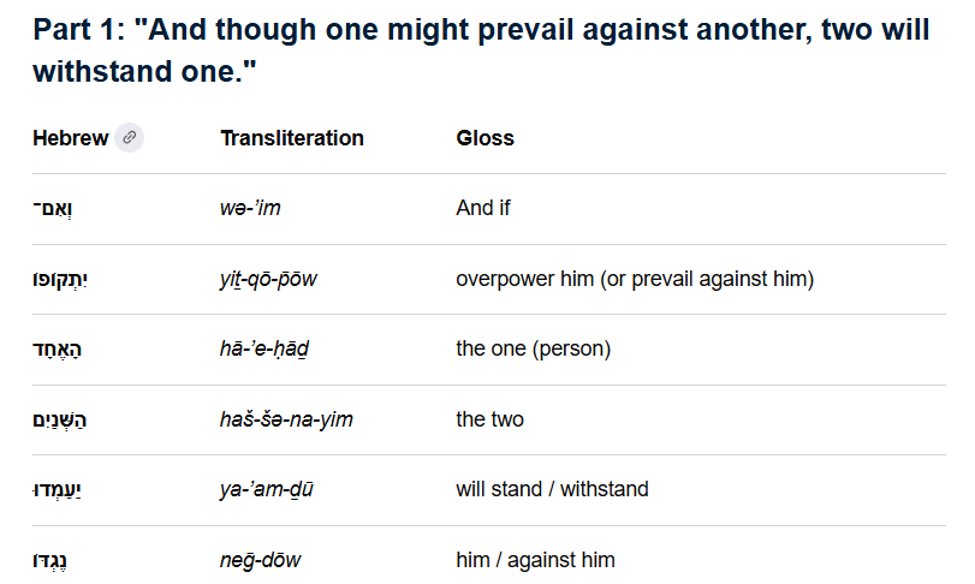
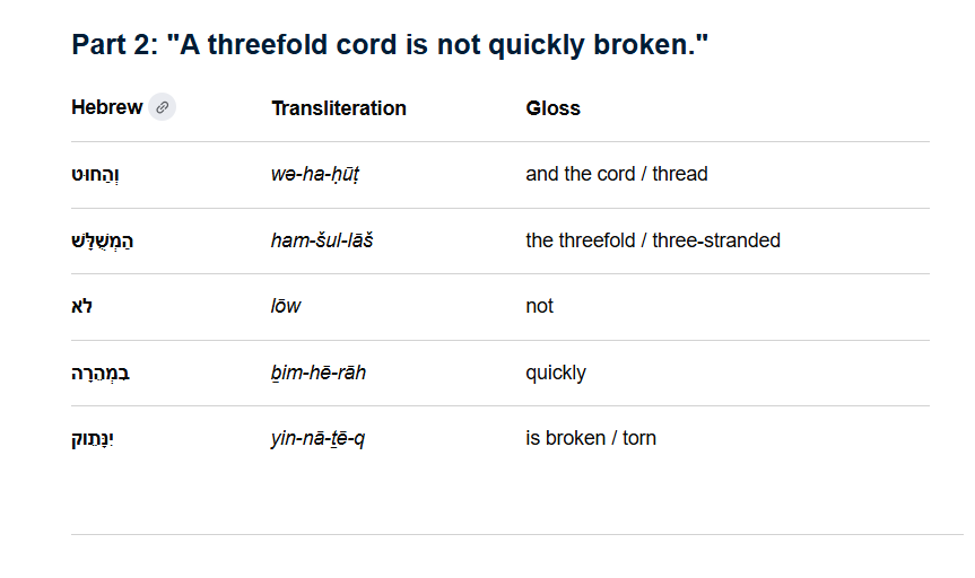
Ecclesiastes 4:12 (NRSVUE) says “And though one might prevail against another, two will withstand one. A threefold cord is not quickly broken.”
However, it actually looks more like this in interlinear translation (which accommodates the poetic structure of Ecclesiastes 4:9-12):
And really, we normally treat speech like in a read-aloud as simply conveying meaning directly, whereas there is actually a lot going on unconsciously like when the more we interpret a piece of writing a complicated back and forth ensues.
What is the fourfold Retell, Relate, Reflect, Review model in teaching reading comprehension?
In teaching reading comprehension, Retell, Relate, Reflect, and Review is a scaffolded strategy framework used to transition students from literal text recall to deep, critical thinking. This multi-step process guides oral or written responses, with each tier demanding a higher level of cognitive processing. It draws from constructivist learning principles, helping students actively build meaning rather than passively consume information. Teachers frequently use it with fiction, nonfiction, or any assigned reading.
The Four Stages of the Framework
- Retell: Recalling literal information. Students reconstruct the story chronological sequence using their own vocabulary. They identify core elements like main characters, setting, problem, and resolution.
- Relate: Making personal connections. Students link the text content to their own life experiences, previous knowledge, or other texts they have encountered.
- Reflect: Developing deep comprehension. Students analyze the deeper meaning or “heart” of the message. They make inferences, evaluate characters’ motives, and predict future implications.
- Review: Evaluating and summarizing. Students critique the text to assess its overall quality, clarity, and effectiveness. They synthesize what they learned and evaluate how well the author achieved their goal.
Framework Overview
| Stage | Cognitive Focus | Student Action | Example Prompt |
| Retell | Recall & sequence | Reconstruct the plot | “What happened at the beginning, middle, and end?” |
| Relate | Connection | Tie text to experiences | “How does this character’s problem remind you of your life?” |
| Reflect | Analysis & inference | Uncover deeper themes | “What is the underlying lesson the author wants us to learn?” |
| Review | Evaluation | Critique the text | “Was the ending satisfying, or would you change it?” |
Why Teachers Use This Framework
- Identifies comprehension gaps: If a student cannot Retell, they lack basic literal understanding and need a text reread.
- Scaffolds higher-order thinking: It acts as a cognitive bridge, moving students safely from surface-level facts to critical analysis.
- Improves expressive language: Expressing these stages orally or in writing builds vocabulary and narrative structure skills
Such a structure fits well with a fourfold interpretation of its elements and so to retell a story a student summarizes the (i) Orientation; (ii) Problem; (iii) Solution; (iv) Wrap-Up.
Interpreting a text isn’t just an automated technique for translating the text into information and skills to be accumulated, but also proceeding along a path of thought until you find yourself having circled back to where you started, now ready to pose your inquiry questions in a more comprehensive and original way.
We see a similar fourfold strategy with the Four-Square Writing graphic organizer.

The Four-Square Writing Method is a visual organizer framework used to teach students how to plan, structure, and write well-organized paragraphs and essays. Created by Judith S. Gould and Evan Jay Gould, it uses a simple graphic organizer divided into four outer quadrants with a central box to scaffold the writing process for all grade levels.
The Anatomy of a Four-Square Template
The graphic organizer consists of a single piece of paper divided into five distinct sections:
- Center Box: Contains the main topic, thesis statement, or prompt response.
- Top-Left (Square 1): Holds the first supporting detail, reason, or subtopic.
- Top-Right (Square 2): Holds the second supporting detail, reason, or subtopic.
- Bottom-Left (Square 3): Holds the third supporting detail, reason, or subtopic.
- Bottom-Right (Square 4): Holds the final conclusion statement, summary sentence, or emotional wrap-up.
How the Strategy Works (Step-by-Step Progression)
The method scales in complexity as students advance in their writing skills:
- Categorizing (Early Learners): Young students place a main word in the center (e.g., “Fall”) and draw or write one-word associations in the four squares (e.g., “leaves”, “apples”, “pumpkins”, “cool weather”).
- Developing Sentences: Students turn those isolated words into complete sentences, utilizing the squares to build a single, cohesive paragraph.
- Adding Transitions: Students introduce transition words (e.g., First, Also, In addition, Finally) into the top-left corners of squares 1 through 4 to practice text flow.
- Expanding to Five-Paragraph Essays: For older students, Squares 1, 2, and 3 each expand to become their own body paragraphs (complete with sub-details), while Square 4 morphs into a formal concluding paragraph.
Why Teachers Use It
- Visual Simplification: It breaks down the abstract, overwhelming process of writing into manageable, bite-sized tasks.
- Prevents Tangents: Keeping the main topic centered forces students to evaluate whether their supporting details directly relate to the core thesis.
- Universal Application: It works equally well for narrative, informative, persuasive, and descriptive writing genres
The Four-Square Writing Method is a visual organizer framework used to teach students how to plan, structure, and write well-organized paragraphs and essays. Created by Judith S. Gould and Evan Jay Gould, it uses a simple graphic organizer divided into four outer quadrants with a central box to scaffold the writing process for all grade levels.
- Here’s an Example 4-Square Graphic Organizer:
| Box 1: Supporting Detail 1 Transition: First, Reason: They pollinate crops Elaboration: -Move pollen flower to flower – Helps fruits and vegetables grow | Box 2: Supporting Detail 2 Transition: In addition, Reason: They produce honey and wax Elaboration: -Make sweet honey for food – Create beeswax for candles and lip balm |
| CENTER: Main Topic (thesis). Honeybees are incredibly important insects that help our environment and ecosystem |
| Box 3: Supporting Detail 1 Transition: Most importantly, Reason: They support other wildlife Elaboration: -Animals eat berries from the plants that bees pollinate – Part of the global food chain | Box 4: Conclusion/Summary Transition: Clearly, Summary: Honeybees do vital work Final Thought/Feeling: – Our planet needs bees to survive and we must protect them. |
To write the final paragraph, the student simply translates the organized sentences in order, starting with the Center Box, followed by Boxes 1, 2, 3, and ending with Box 4:
Honeybees are incredibly important insects that help our environment and ecosystem. First, they pollinate crops by moving pollen from flower to flower, which helps fruits and vegetables grow. In addition, they produce honey and wax. They make sweet honey for food and create beeswax for items like candles and lip balm. Most importantly, they support other wildlife. Many animals eat the berries and plants that bees pollinate, making them a crucial part of the global food chain. Clearly, honeybees do vital work. Our planet needs bees to survive, and we must protect them.
This Four Square Writing method organizer pairs well with the Fourfold RAFT writing model. The RAFT model (or RAFT strategy) is a popular teaching tool used in writing instruction, especially in K-12 education, to help students produce more purposeful, creative, and audience-aware writing:
What RAFT Stands For
RAFT is an acronym for four key elements that shape a piece of writing:
- Role of the Writer — Who are you as the writer? (e.g., a historical figure, a scientist, an animal, an object, or a character)
- Audience — To whom are you writing? (e.g., a friend, the public, an expert, a historical figure, or yourself)
- Format (or Form) — What format will the writing take? (e.g., letter, diary entry, speech, newspaper article, poem, advertisement, social media post)
- Topic (or Theme) — What are you writing about? (usually combined with a strong verb or specific focus, such as “persuade the town to recycle” or “explain why the Civil War started”)
Phenomenology:
As we have seen, this fourfold strategy for thinking soaks through the history of the humanities. In the Gospel of Mark he takes two Old Testament pairs, Elijah and Elisha, and reimagines John the Baptist and Jesus as the new and greater Elijah and Elisha. Similarly, Luke repurposes the forgiving dying Jesus and the converted soldier at the cross into the forgiving dying Stephen and the converted Paul in Acts.
Methodologically, it is through how we identify, compare, and contrast that we make meaning. In Philosophy, we read from Heidegger and Hegel:
“In order to understand, Heidegger says, one must see phenomenologically. He thus invites us to the first exercise of phenomenological “kindergarten.” To tear apart [zer-reissen] means: to tear into two parts, to separate: to make two out of one. If a sock is torn, then the sock is no longer present-at-hand—but note: precisely not as a sock. In fact, when I have it on my foot, I see the “intact” sock precisely not as a sock. On the contrary, if it is torn, then THE sock appears with more force through the “sock torn into pieces.” In other words, what is lacking in the torn sock is the UNITY of the sock. However, this lack is paradoxically the most positive, for this Unity in being-torn is present [gegenwärtig] as a lost unity.” (Heidegger, Martin. Four Seminars p. 11)
“Twice the audience laughed over the “torn sock” saying. At first Heidegger answered pedantically, “I do not know why you are laughing. You must learn to endure the scope of a sentence such as the one I have cited.” (Heidegger, Martin. Four Seminars p. 100).
– Hegel: The tearing of the sock phenomenalizes the Category of Unity, as a lost-Unity. Hegel, in his inaugural address, Heidelberg, 1816, says “The Being of the universe, at first hidden and concealed, has no power which can offer resistance to the search for knowledge; it has to lay itself open before the seeker — to set before his eyes and give for his enjoyment, its riches and its depths.”
– Heidegger: “Both scientific and prescientific comportments are a knowing in the sense of uncovering what is previously concealed, of revealing what was previously covered up, of disclosing what so far was closed off.”
| 4-Fold PHENOMENOLOGY AND TEARING |
| Sock | Unity |
| Torn Sock | Lost Unity |
* (Let us Apply This to Understanding Ancient Insights About our Lives)
I mentioned before that when I taught grade 5 Ancient Civilizations, my goal wasn’t just to present some alien facts to be learned by rote just to be forgotten, but to bring the ancients alive so the students could learn about themselves from the ancients. Let’s try to un-cover some ancient Greek insights about the human condition that are applicable to understanding ourselves today. Let’s think about the ancient Greek concept of metaphysics…
“Metaphysics” in Philosophy refers to the ultimate presuppositions of “somethings” in general. It is sometimes misrepresented as the fundamentals of physics and so what we would mean by the current scientific paradigm of quantum physics, but this is based on a misunderstanding of what “physis” means in Greak philosophy where the word “Metaphysics” comes from. In this way, the philosopher Kant titles a book “Groundwork of the Metaphysic of Morals” which is the philosophical system of moral laws derived entirely from pure practical reason, establishing unconditional duties that apply to all rational agents. The Groundwork is the prolegomenon (introductory study) to that system (which he later develops more fully in the Metaphysics of Morals of 1797). This is a far cry from “quantum metaphysics” or speculative ontology—it’s disciplined, reason-based moral philosophy at its most rigorous.
One exciting comprehension task for students if it is purposeful is Word Study. The word “Metaphysics” traces back to the Greek word phusis/physis. Phusis derives from the verb φύω (phúō / phyō), which means “to grow,” “to bring forth,” “to produce,” or “to spring up.” The noun phusis thus fundamentally refers to the process of growth or emergence, and by extension, the inherent nature or constitution that something develops into. Aristotle uses phusis for the internal principle of change and growth in living things (e.g., an acorn’s phusis is to become an oak). Heraclitus says physis kryptesthai philei: physis tends toward hiddenness. Standard references like Liddell-Scott-Jones Greek Lexicon, etymological dictionaries (e.g., Beekes), and philosophical texts (Aristotle’s Physics, etc.) all support the growth/emergence sense as foundational.
So, if I say the mansion ‘appears’ as houseness incarnate, houseness merely appearing/presencing in the average house, and houseness appearing deficiently in the dilapidated shack, this presupposes the beings in movement/appearing, and so the source of movement.
We might think back to Homer’s use of “beings” as “ta eonta,” which didn’t only include the physical beings of nature but all “somethings rather than nothing” like the perplexity of the leaders. We mean this by “thing” in English when we say “He knows his things, that which is pertinent to him,” which is also what the Roman word “res (thing)” conveys.
For example, Homer notes the goddess “appears” incarnate to Odysseus, but she does not appear at all to Telemachus beside him. Niagara Falls may appear as a wonder of the world to a tourist, but not appear that way at all to the local resident for whom it is noise pollution. Homer comments here the gods don’t appear to everyone in their fullness (enargeis). Also, with Dionysus and the pirates (Homeric Hymn 7) — Dionysus appears as a handsome youth. Most of the pirates fail to recognize his divinity until the dramatic epiphany (when he transforms them into dolphins). Only the helmsman senses something divine from the start. This latter case is more about varying degrees of recognition than strict selective visibility to one while invisible to another in the same place [Similarly, a new favorite song appears as “music incarnate” to the listener (now that’s a song!), but this aspects returns to concealment by playing the song 20 times in a row (boring!)].
The Thinker in Ancient Greece
Odysseus’ special ability to see may be connected to his wisdom/cunning. The key phrase comes from Iliad 20.131 (spoken by Hera in the context of the gods’ involvement in the Trojan War): “chalepoi de theoi phainesthai enargeis” — roughly, “the gods are difficult/hard to appear [to mortals] in visible/clear form” (or “plainly/manifestly”). “Enargeis” (ἐναργεῖς) refers to gods appearing in their full, unmistakable divine form or epiphany, without disguise—brightly, conspicuously, or “in all their fullness.” Homer repeatedly highlights Odysseus’s metis (cunning intelligence, resourcefulness, versatility—polytropos) as the reason for Athena’s special patronage. She explicitly praises their shared traits in Odyssey 13: “We both know tricks, since you [Odysseus] are by far the best among all men in counsel and tales, but I among all the Gods have renown for wit [metis] and tricks.” This affinity explains why Athena aids Odysseus more openly or personally at key moments (e.g., dropping disguises or conversing directly later in the poem) compared to Telemachus, whom she primarily guides in disguise (as Mentes or Mentor) early on. Telemachus matures under her influence and gains some initiative, but he lacks his father’s full metis at the start. Odysseus’s cunning makes him a worthy partner in “scheming” with the goddess.
Odysseus’ intelligence/cunning that allows divine seeing is like the ability of wise thinkers to perceive the divine ideas with their minds’ eye (which remain concealed to average people who do not train their minds’ eye). Heidegger suggests that the wise seer in ancient Greek was understood in this way. The wise seer is ho mantis, is the mainomenos, the mad man. In what sense? The mad man is not entirely there, with us and talking to us, but not entirely there. The seer is of course not insane, but rather not there in an analogous way that the mad man is not there. Heidegger comments that “A madman is beside himself, outside himself he is away. We ask: away? Where to and where from? away from the sheer oppression of what lies before us … The seer is outside himself in the solitary region of the presencing of everything that in some way becomes present (EGT, Anaximander Fragment, 35).”
We can connect this to Odysseus on the Island of Calypso (the deine theos) not tempted by the pleasures of the goddess but his heart far away at home pining for his wife and hearth. This connects too to the thinker Thales lost in contemplation and not aware of his surroundings, falling into a ditch. This “madness” is ecstatic (ek-stasis — standing outside oneself). It is not pathological insanity but a displacement from everyday absorption in the immediate, ontic “what lies before us.” The seer is attuned to the deeper play of presencing (Anwesen) and absencing — the coming-into-appearance and passing-away of things, which ordinary absorbed people miss. This allows genuine insight into what is (in its full temporal unfolding).
- Calypso (the “uncanny goddess,” deinē theos) offers immortal concealment, pleasure, and forgetting. Her island is a place of seductive presence that could trap one fully in the immediate.
- Odysseus refuses full absorption. He sits weeping on the shore, his thumos (heart/spirit) and noos oriented elsewhere — toward Ithaca, Penelope, and his nostos. He is “away” in the Heideggerian sense: not fully “there” with the goddess’s offerings.
- This ecstatic orientation (sustained through suffering and metis) enables him to perceive beyond the immediate veil. It aligns with the etymological link between noos (mind as return to clarity/awareness) and nostos (homecoming as return to light/life). His cunning intelligence is not mere calculation but this sustained “being-away” that keeps him attuned to authentic order: a step back from life, seeing the forest despite the trees
In Homeric terms, this receptivity helps explain why Athena (goddess of metis) favors him with more direct guidance or recognition, while others (including Telemachus early on) receive disguised or indirect aid. The “mind’s eye” here is the oriented noos that sees through disguises and temptations.
- Homer shows metis and divine favor allowing Odysseus special access to Athena.
- Heidegger layers on a deeper ontological reading: the wise/cunning mind is ecstatically displaced, perceiving the presencing/concealing of the divine and the real in ways average mortals (trapped in the immediate) cannot.
- It is a later philosophical overlay, but one that resonates strongly with the Odyssey’s portrayal of Odysseus as the man of twists and turns whose mind remains oriented toward home amid concealment.
Our synthesis — linking Homeric noos/nostos, divine epiphany, and Heidegger’s ecstatic seer — is insightful. It portrays Odysseus not just as a clever survivor but as a proto-seer whose “trained” (or gifted) awareness pierces what is hidden to others. This fits broader Greek traditions where wisdom involves inspired “madness” or divine attunement (e.g., Plato’s Phaedrus on mania).
Circling back more fully now, Heidegger speaks of a concealment with respect to Odysseus, in relation to the Odyssey Theta 93, when Odysseus covers his head with his mantle to sob after the singer Demodokos tells of the tragedy that happened to the Greeks at Troy, which is generally translated as ‘But then he (Odysseus) shed tears, without the others noticing it (elanthane), Alkinoos alone was aware of his sorrow.’ But, grammatically, elanthane does not bring out the sense of others looking at Odysseus and failing to see his tears, but rather the concealment of Odysseus himself. The German philologist Voss, in his variation of the translation, renders elanthane as “To all the other guests he concealed his flowing tears,” emphasizing the concealment in relation to Odysseus, not the others gaping at Odysseus, which is closer to what the Greek says. Heidegger, however, goes further.
What Heidegger tries to bring out when he speaks of Odysseus in terms of concealment is that there is, in general, a concealment around him that isolates him, cuts him off from others, an unhomeliness that surrounds him. Heidegger brings this all out quite clearly when he says In the case of the weeping Odysseus, the Greeks do not consider that the others present, as human ‘subjects’ in their subjective comportment, fail to notice the crying Odysseus, but they do think that round about this man and his existence there lies a concealment causing the others present to be, as it were, cut off fi-om him. What is essential is not the apprehension on the part of the others but that their exists a concealment of Odysseus, now keeping the ones who are present far from him.
Why far? Because Odysseus’ heart is far away. The concealment, as Heidegger says, is not restricted to this instance of crying, but surrounds this man’s existence. Athena brings this out quite clearly at the beginning of the Odyssey, “It is for Odysseus my heart is wrung – so subtle, a man and so ill-starred; he has long been far from everything that he loves, desolate in a wave-washed island (from Odyssey, 1, 32-108).” The issue is clearly not whether the others can see Odysseus crying, but rather that he is cut off from the others present in principle, because when one’s heart is elsewhere, the people and things at hand are not of concern and hence one is not at home with them – is alone and isolated, even among many others. Odysseus is not and cannot be absorbed in the situation he is in. This is the case in general, and the crying Odysseus is simply a single manifestation of the general case.
This is a characteristic Heideggerian reading that shifts the emphasis from a psychological or subjective event (“others fail to notice”) to an ontological one: concealment (Verborgenheit) as something that belongs to Odysseus’s very way of being.
The Homeric Passage is (Odyssey 8.83–95, approx.) after Demodocus sings of the quarrel between Odysseus and Achilles (and later the Trojan Horse), Odysseus weeps. The Greek text has him drawing his purple cloak over his head to hide his face/tears. Standard translations often render it as “he concealed his tears from the others” or “no one noticed except Alcinous.” The key verb is ἐλάνθανε (elanthane, from lanthanō — to escape notice, to remain hidden/concealed). Our point about grammar and emphasis is well-taken: the construction can highlight the concealment itself rather than merely the others’ failure of perception. Johann Heinrich Voss’s German translation (“To all the other guests he concealed his flowing tears”) brings out the active sense of self-concealment more strongly.
Heidegger uses this scene (discussed in lectures such as the Parmenides course, GA 54, and in connection with alētheia/lethe themes) to illustrate a deeper point. It is not primarily that the Phaeacians, as “subjects,” subjectively overlook the crying “object” Odysseus. Instead, a concealment surrounds Odysseus’s existence — it isolates him, keeps others at a distance. The others are, as it were, cut off from him because his heart (thumos/noos) is far away. This is not occasional but structural to his being: he is unheimlich (unhomely, uncanny) even in the midst of hospitality. He cannot be fully absorbed in the present situation (the feast, the songs, the pleasures of Scheria) because he is oriented elsewhere — toward nostos, home, his authentic belonging.
This matches perfectly with:
- Odysseus on Calypso’s island (Book 5), sitting apart, pining, refusing full absorption in the goddess’s immortal concealment.
- Athena’s words in Book 1 about her heart being wrung for him — subtle, ill-starred, far from everything he loves, desolate on a wave-washed island.
This “concealment around him” and ecstatic “being-away” directly connects to:
- The noos/nostos link: His mind (noos) is in a state of return, so he is never fully “there” in the ontic present.
- The mantis/mainomenos idea: The wise one is “beside himself,” away from the “sheer oppression of what lies before us,” attuned instead to presencing/absencing.
- Divine epiphanies and the “mind’s eye”: Ordinary people remain absorbed in the immediate; Odysseus’s sustained orientation (his metis as a form of attuned concealment/unconcealment) makes him receptive to Athena’s more direct guidance. Gods and deeper realities can “appear” (or be perceived) differently to him.
Heidegger is reading Homer through the lens of truth (eg., true friend): alētheia (unconcealment) as a struggle with lethe (concealment). Odysseus embodies this: much of his journey involves layers of disguise, hidden identity, and self-concealment, yet his noos remains oriented toward revealing/reclaiming his homecoming. Our overall synthesis across these exchanges is strong. Heidegger sees in Odysseus a figure of essential unhomeliness amid apparent hospitality — a man whose heart’s distance creates a surrounding veil that isolates him, even as it enables his singular perception and survival. This is not just cleverness but a mode of existence attuned to concealment and return. It enriches the Homeric text without contradicting it.
Like the homecoming of Odysseus, the thinker is connected with the notion of homecoming in the Greek. Both noos (νόος, often translated as “mind,” “intellect,” “perception,” “consciousness,” or “intention”) and nostos (νόστος, “homecoming” or “return,” especially the heroic return home by sea) share a etymological connection through the Proto-Indo-European root nes- (or a related verbal root like nes-/neomai, “to return safely” or “to come/go back”). The thinker is parestios, para Hestia, the one in the warmth of the hearth fire. Aristotle calls this athanatizein, godliness/deathlessness in the contemplative life of the thinker (Theoria), and notes only a god or a beast is at home in solitude – as opposed to the restless, unfulfilling lives of men. While (i) enthusiasmos is a passive, emotional possession by a god from the outside, Aristotle’s (ii) athanatizein is an active, rational elevation of the human intellect to a godlike state from within.
The thinker is a tranquil absorbed youth even in old age. Heidegger comments regarding thinker Heraclitus’s Fragment 52: “The Geschick of being, a child that plays …the being of beings (Heidegger, 1991b, 113).” Restlessness being brought to repose with a calm mind is what Heidegger argues as the purpose the Greeks had for philosophy. Aristotle clarified only a beast, or a god, delights in solitude (Politics 1253a28), and so we picture the general tragic character of the masses (hoi polloi) apart from their distractions as cabin fever. Lucretius for instance speaks of the restless lives of the Roman rich pursued relentlessly by anxiety and boredom. Regarding Aristotle’s Theoria, Heidegger comments “[T]he ‘useful’ as ‘what makes someone whole,’ that is, what makes the human being at home with himself … In Greek Theoria is pure repose, the highest form of energeia, the highest manner of putting-oneself into-work without regard for all machinations. It is the letting come to presence of presencing itself. (Heidegger, 2001b, 160-61).”
Here is how these two profound Greek ideas connect, contrast, and illuminate one another:
The Shared Goal: Transcendence
Both concepts enthusiasmos/athanatizein address the ultimate Greek aspiration: overcoming the strict boundary between the mortal world (thnetos) and the immortal world (athanatos). Both states allow a human being to experience something eternal and divine.
The Contrast: Passion vs. Intellect
The table below illustrates how enthusiasmos and athanatizein serve as contrasting mirrors in Greek philosophy:
| Concept | Action Type | Primary Faculty | Source of Divinity |
| Enthusiasmos (Divine Possession) | Passive (Being overtaken) | Emotion / Frenzy (Overthrows reason) | External (A god enters the human vessel) |
| Athanatizein (To Immortalize) | Active (Engaging in theoria) | Reason / Intellect (Refines reason) | Internal (Ignites the divine spark already within) |
How Aristotle Reinterprets the Divine Spark
In Book X of the Nicomachean Ethics, Aristotle argues that nous (the rational intellect) is the most divine part of a human being. When a philosopher engages in theoria (pure, timeless contemplation: linked to the eternal), they are practicing athanatizein—literally translated as “to immortalize” or “to act like an immortal.” They transcend the restlessness of the soul by becoming attuned to the eternal.
Aristotle directly challenges the traditional view of enthusiasmos in three ways:
- No Need for Madness: You do not need to lose your mind, drink wine, or fall into a trance to meet the divine.
- God is Thought: For Aristotle, God is the “Unmoved Mover,” whose entire existence is pure, eternal thought thinking about itself. Therefore, when you think deeply, you are acting exactly like God.
- Autonomy vs. Possession: Instead of being an empty puppet controlled by Apollo or Dionysus, the contemplative thinker uses their own highest human faculty to willingly touch the eternal.
The Ultimate Convergence
Ultimately, athanatizein is philosophy’s answer to enthusiasmos. It takes the religious ecstasy of being “filled with god” and turns it into an intellectual reality. For Aristotle, the highest form of human happiness is not a temporary, chaotic ritual frenzy, but a stable, lifelong dedication to contemplation that elevates human consciousness to the level of the cosmos: the divine within attunes to the divine without.
Plato explicitly states this in his cosmological dialogue, the Timaeus. He argues that human beings should look up at the heavens and use the perfect, unvarying orbits of the stars to correct and stabilize the disrupted, erratic movements of their own minds.
The Cosmology of the Human Soul
In the Timaeus, Plato explains that the creator (the Demiurge) fashioned individual human souls out of the exact same “soul-stuff” used to create the World-Soul. This divine substance is composed of perfect, rotating mathematical tracks: the “Circle of the Same” (represented by the uniform, constant rotation of the fixed stars) and the “Circle of the Different” (represented by the paths of the planets).
However, a fundamental disruption occurs when a human soul is born into a physical body:
- The Shock of Embodiment: When the immortal soul is bound to a mortal body, it is flooded by sensory data, physical desires, and nutritional demands.
- The Loss of Constancy: This chaotic influx violently disrupts the soul’s natural, perfect circular rotations, twisting, bending, and fracturing them.
- The Restless Mind: As a result of this trauma, the newborn human mind loses its orientation and becomes irrational, unstable, and deeply restless.
Plato argues that our capacity for sight was given to us by the gods for a specific, therapeutic purpose. By stargazing, humans can observe the perfect harmony, predictability, and cosmic intelligence written across the night sky.
In a central passage of the dialogue, Plato writes:
“God invented and gave us sight to the end that we might behold the courses of intelligence in the heaven, and apply them to the courses of our own intelligence which are akin to them, the unperturbed to the perturbed; and that we, learning them and partaking of the natural truth of reason, might imitate the absolutely unerring courses of God and regulate our own vagrant courses.”
— Plato, Timaeus (47b–c)
By studying astronomy and philosophy, the restless human mind aligns its inner, corrupted “circles” back into harmony with the outer “circles” of the cosmos. True sanity and wisdom mean mapping the tranquility and flawless constancy of the stars onto our erratic, everyday thoughts. Toohey notes Horace’s description of Bullatius’s boredom and restlessness as horror loci (revulsion at where one is) woes in Epistles I. II were countered by philosophy (verses 25-30), with the exercise of logic (ratio) and prudence (prudential) that brought about a calm mind (aequus animus). ** We can see the essential restlessness of our souls when we are separated from our distractions and find ourselves in cabin fever / shack wacky. We are figuratively addicted to beings, as demonstrated by our withdrawal symptoms when they are removed.
To review.
In his cosmological dialogue, Timaeus, Plato describes a profound metaphysical kinship between the rational, divine components of our souls and the orderly, unswerving revolutions of the cosmos.
Here is how he connects philosophy to the constancy of the stars:
- Our Stellar Origins: Plato argues that the creator assigned every human soul to a specific companion star. Our earthly journey begins with the soul placed on this star “as in a chariot” before it is cast into a mortal body.
- The Sickness of the Earthly Soul: When a soul is born into a physical body, it experiences chaos. Sensual desires, emotions, and physical sensations cause the natural, rational orbits of the soul to “wander” and become confused or disordered.
- Philosophy as “Re-alignment”: To fix this restlessness, Plato suggests the study of philosophy—particularly through mathematics and astronomy. He did not mean astronomy simply as stargazing, but as the contemplation of the perfect, unchanging mathematical laws that govern the heavens. By studying these eternal truths, our restless souls are “stabilized”. We learn to discipline our minds, bringing the straying, disordered thoughts into harmony with the steady revolutions of the universe.
- The Ultimate Goal: A philosopher who successfully uses reason to keep their soul well-ordered and virtuous escapes this cycle of earthly turmoil and is rewarded after death by returning directly to their native, kindred star to live a life of eternal happiness
Under the Greek reading, humans were “destined/fated” to go from the fire and meaningfulness of youth to the tedium and listlessness of old age. Homer says, which is sometimes translated so as to suggest mortals are wretched because they die, the Lattimore translation is:
“Shaker of the earth, you would have me be called a fool if I were to fight even with you for the sake of pitiful mortals, who are like the leaves, and now flourish and grow warm with life, and feed on what the ground gives, but then again fade away and are gone.
Krell translates more literally: Apollo says
“Why should I do battle for the sake of mere mortals!’ exclaims the sun god, ‘mortals, who are as wretched as the leaves on the trees, flourishing at first, enjoying the fruits of the earth, but then, deprived of heart (akerioi), vanishing (I, 21, 464-66) … Vanishing how? Akerioi, as … those who are deprived of [heart] (Krell, 1999, 105).”
I would modify this slightly to read:
“Why should I do battle for the sake of mere mortals!’ exclaims the sun god, ‘mortals, who are as wretched as the leaves on the trees, flourishing at first, enjoying the fruits of the earth, but then, their hearts no longer in life (akerioi), vanishing (I, 21, 464-66).”
In Epistles 1.8 Horace describes the lethargic illness of boredom as a trait of old age. The Greeks didn’t have the quality and variety of distractions from our boredom that we have today. Holderlin in Hyperion’s Song of Fate/Destiny writes:
“Radiant the gods’ mild breezes / Gently play on you / As the girl artist’s fingers / On holy strings. – Fateless the Heavenly breathe / Like an unweaned infant asleep; / Chastely preserved / In modest bud / For even their minds / Are in flower/And their blissful eyes / Eternally tranquil gazey / Eternally clear. – But we are fated / to find no foothold, no rest, / And suffering mortals / Dwindle and fall/ Headlong from one/ Hour to the next Hurled like water / From ledge to ledge / Downward for years to the vague abyss (Holderlin’s “Hyperion’s Song of Fate” quoted in Martin Heidegger and Eugen Fink, Heraclitus Seminar, 101)” … [Heidegger and Fink commenting on the passage say] “the gods wander without destiny, their spirit eternally in bloom, while humans lead a restless life and fall into the cataract of time and disappear.” (Martin Heidegger and Eugen Fink, Heraclitus Seminar, 101)
Scholars like Gregory Nagy (Harvard Center for Hellenic Studies) and Douglas Frame argue that the root nes- mentioned above fundamentally conveys ideas of returning to light and life, safety, survival, or rescue from danger/death/darkness. Nostos directly means the physical or heroic return home (a central theme of the Odyssey), often carrying connotations of escaping death and achieving safety/salvation. Noos extends this to mental return or conscious awareness — the mind’s ability to perceive, plan, remember, and stay oriented toward home/survival. It implies coming back to clarity, consciousness, or purposeful thinking (as opposed to forgetting or losing one’s way).
Homer plays on this connection poetically:
- Odysseus’s nostos (return) requires his exceptional noos (cunning intelligence and awareness). Losing noos (e.g., the Lotus-Eaters episode, where eating the lotus causes forgetfulness of home) prevents nostos.
- The proem of the Odyssey links them early: Odysseus sees the cities and noos (minds/customs) of many men while striving for his nostos and saving his life.
This etymological-thematic link enriches the epic: Odysseus’s journey is not just geographical but a recovery and exercise of mind/perception amid trials that threaten to erase his identity and purpose. In short, the shared meaning revolves around safe return/rescue — physical for nostos, cognitive/perceptual for noos — both tied to survival, clarity, and coming back to life/light. This makes the words deeply intertwined in Homeric thought, far beyond coincidence.
*(The Greek World of Appearing)
I noted previously the appearing of the mansion as houseness incarnate. To understand the Greeks, we must see this as a general enchantment with the world, as opposed to our own time: humans have become enchanted by our achievements – we enchant ourselves through ourselves as Heidegger says.
Calasso notes:
Yet there was a time when the gods were not just a literary clich?, but an event, a sudden apparition, an encounter with bandits perhaps, or the sighting of a ship. And it didn’t even have to be a vision of the whole. Ajax Oileus recognized Poseidon disguised as Calchas from his gait. He saw him walking from behind and knew it was Poseidon “from his feet, his legs.”
Since for us everything begins with Homer, we can ask ourselves: which words did he use for such events? By the time the Trojan War broke out, the gods were already coming to earth less frequently than in an earlier age. Only a generation before, Zeus had fathered Sarpedon on a mortal woman. All the gods had turned up for the marriage of Peleus and Thetis. But now Zeus no longer showed himself to men; he sent other Olympians along to do his exploring for him: Hermes, Athena, Apollo. And it was getting harder to see them. Odysseus admits as much to Athena: “Arduous it is, oh goddess, to recognize you, even for one who knows much.” The Hymn to Demeter offers the plainest comment: “Difficult are the gods for men to see.” Every primordial age is one in which it is said that the gods have almost disappeared. Only to the select few, chosen by divine will, do they show themselves: “The gods do not appear to everyone in all their fullness [enargeis],” the Odyssey tells us. Enargei?s is the terminus technicus for divine epiphany: an adjective that contains the dazzle of “white,” argos, but which ultimately comes to designate a pure and unquestionable “conspicuousness.” It’s the kind of “conspicuousness” that will later be inherited by poetry, thus becoming perhaps the characteristic that distinguishes poetry from every other form.
But how does a god make himself manifest? In the Greek language the word theos, “god,” has no vocative case, observed the illustrious linguist Jakob Wackernagel. Theos has a predicative function: it designates something that happens. There is a wonderful example of this in Euripides’ Helen: “O theoi. theos gar kai to gigno’ skein philous”–“O gods: recognizing the beloved is god.” Kerenyi thought that the distinguishing quality of the Greek world was this habit of “saying of an event: ‘It is theos.'” And an event referred to as being the?s could easily become Zeus, the most vast and all-inclusive of gods, the god who is the background noise of the divine. So when Aratus set out to describe the phenomena of the cosmos, he began his poem thus: “From Zeus let our beginning be, from he whom men never leave unnamed. Full of Zeus are the paths and the places where men meet, full of Zeus the sea and the seaports. Every one of us and in every way has need of Zeus. Indeed we are his offspring.”
“Iovis omnia plena,” Virgil would later write, and in these words we hear his assurance that this was a presence to be found everywhere in the world, in the multiplicity of its events, in the intertwining of its forms. And we also hear a great familiarity, almost a recklessness, in the way the divine is mentioned, as though to encounter divinity was hardly unusual, but rather something that could be expected, or provoked. The word atheos, on the other hand, was only rarely used to refer to those who didn’t believe in the gods. More often it meant to be abandoned by the gods, meant that they had chosen to withdraw from all commerce with men. Aratus was writing in the third century b.c., but what became of this experience that for him was so obvious and all-pervasive in the centuries that followed? How did time affect it? Did it dissolve it, destroy it, alter and empty it beyond recognition? Or is it something that still reaches out to us, whole and unscathed? And if so, where, how?
And so, circling back on ourselves, to use Aristotle’s example in the Physics, we can see Nature emerge into presence incarnate in the circling bird of prey (Now that’s Nature!), or Art appear incarnate in the DaVinci masterpiece (Now that’s Art!).
Heidegger on Aristotle’s Physics (esp. Book II.1) in his important 1939 essay “On the Essence and Concept of Φύσις in Aristotle’s Physics B, I”, Heidegger interprets Aristotle’s distinction between phusis (nature) and techne (art/craft/production):
- Phusis: Beings that have their arche (origin/principle) of movement, growth, and emergence in themselves. Examples from Aristotle include a tree growing from a seed, an animal developing, or (classically) a bird displaying its natural motion. The thing “bursts forth” from out of itself — it emerges into presence while carrying its own hidden source.
- Techne (Art): Beings whose principle lies in another (the artist/craftsman). A statue, painting, or bed doesn’t grow by itself; the form is imposed from outside. Yet genuine techne still participates in poiesis (bringing-forth) and can let something shine forth.
Heidegger sees both as modes of bringing-forth (poiesis), but phusis is the higher or more primordial one because it is self-emerging. He links this explicitly to Heraclitus’ φύσις κρύπτεσθαι φιλεῖ (“Nature loves to hide” / “Emerging bestows favor on self-concealing”). For Heidegger, phusis is the process of emergence into unconcealment (aletheia) that simultaneously involves concealment. What comes into shining presence always withdraws again or holds something back.
Our Examples in This Light
- The majestic circling bird of prey (“Now that’s Nature!”): A classic phusis example. The bird’s flight reveals its nature dynamically and strikingly — it emerges in its full self-showing. But this revelation isn’t total or permanent; the bird returns to ordinary behavior, the moment passes, and the deeper source of its being (its phusis) recedes again into hiddenness.
- DaVinci masterpiece (“Now that’s Art!”): Here techne at its highest lets a form shine forth. The artwork brings something into presence so powerfully that we experience a kind of revelation. Yet even great art can become overly familiar.
- New favorite song becoming boring after 20 plays: This beautifully illustrates the withdrawal or return to concealment. The song’s being (its power to move us) initially emerges fresh and unconcealed. Repeated exposure makes the novelty recede; what was striking becomes “obvious” or flattened. The truth of the experience loves to hide again.
This pattern — emergence → striking presencing → tendency back toward concealment/familiarity — is very much in line with Heidegger’s dynamic, verbal reading of phusis as ongoing movement (kinesis), not static “nature” in the modern sense. Over-familiarity or technological enframing can accelerate this withdrawal or distort it, but the tendency itself belongs to the essence of appearing.
Our formulation nicely bridges Heraclitus → Aristotle (via Heidegger) → everyday aesthetic/experiential phenomena. It shows how the same principle of “loving to hide” operates across natural, artistic, and cultural domains.
Circling back, we thus see Being appearing in various degrees of Beauty with houseness appearing incarnate in the beautiful mansion, merely being present in the average house, or appearing deficiently in the dilapidated shack. Of course, the mansion may appear gawdy to the next person, and the shack quaint/rustic. Similarly, Niagara Falls may appear as a wonder of the world to a tourist, as background scenery to the commuter, and as noise pollution to the local resident. This is Aristotle’s apophansis, “taking something AS something else.” So, I may hear a living thing at my feet in the forest only to look down and see I “mis-took” rustling dead leaves in the wind “as” a living thing.
Degrees of Appearance and Beauty: In this view, Being (Sein) does not appear uniformly. It shows itself in varying intensities, clarities, and modes of presence through particular beings:
- The beautiful mansion lets “houseness” (ousia of the house, its what-it-is-to-be-a-house) shine forth more fully — it gathers and reveals the essence in a heightened, almost exemplary way. We experience a stronger unconcealment.
- The average house merely presents the function without much radiance.
- The dilapidated shack shows the same essence deficiently or in privation — yet still as a house (now falling back into concealment or ruin).
This aligns with Aristotle’s idea in Physics and Metaphysics that phusis is said in many ways, and with Heidegger’s insistence that phusis is not a static property but a movement of emerging-and-withdrawing. Beauty here functions almost as a measure of how fully something lets its phusis come into presence.
Subjectivity and Perspectival “Taking-As:” Our point about the mansion appearing gaudy to one person and the shack quaint to another is crucial. This highlights the as-structure (Als-Struktur):
- We never encounter raw sense-data. We always encounter something as something.
- The same being (the mansion) can be taken-as magnificent or taken-as tasteless depending on the interpreter’s horizon (mood, culture, expectations, history).
This is precisely what Heidegger calls interpretation (Auslegung) in Being and Time. Every act of seeing is already an act of “seeing-as.”
Apophansis: Aristotle’s ἀπόφανσις (apóphansis) in De Interpretatione refers to the declarative logos that “shows forth” or “makes apparent” by saying something of something — i.e., predicating, revealing by taking it as this or that. Our forest example is perfect:
- You hear rustling → you immediately “take it as” a living animal (a primordial, survival-oriented interpretation).
- Then you look and correct it: “merely dead leaves in the wind.”
This is a miniature case of apophansis at work in everyday perception: the phenomenon is brought into the open as something, and can be revised when further unconcealment occurs. Heidegger radicalizes this: all understanding has this “as-structure,” and much of it remains pre-predicative (circumspective concern rather than explicit assertion).
Niagara Falls Example: This beautifully illustrates the withdrawal side of phusis kryptesthai philei:
- Tourist: full emergence — wonder, majesty, phusis shining brightly.
- Commuter: background — partial concealment into everydayness.
- Local resident: noise pollution — further withdrawal or even distortion (enframing as annoyance).
The same “being” (the Falls) can stand in different degrees of aletheia (unconcealment) depending on the mode of engagement. What loves to hide is not gone; it has simply recessed into a different manner of presencing. This entire line of thought shows how phusis is not just “nature out there” but the dynamic process by which Being discloses and conceals itself through appearances, interpretations, and human comportment. Our examples ground the ancient idea in lived, aesthetic, and everyday experience.
Roberto Calasso’s interpretation of the ancient Greek world — especially in The Marriage of Cadmus and Harmony (1988) and Literature and the Gods — is deeply attuned to this dynamic of emergence, radiant appearance, and recession into hiddenness. He treats Greek myth not as dead stories or primitive explanations, but as a living tissue of epiphanies where the divine, the world, and phusis itself flash into presence before withdrawing again. Calasso repeatedly returns to the idea that the Greek experience of reality was one of sudden, overwhelming appearances (what the Greeks called epiphaneia) — moments when the invisible becomes momentarily visible, only to slip back into concealment. This mirrors Heraclitus’ phúsis krýptesthai phileî and Heidegger’s reading of Aristotelian phusis as self-emerging-and-withdrawing. For Calasso, the gods are not “characters” but powers of appearing — forces that manifest intensely in specific forms, places, or events, then recede.
Key Alignments with Our Discussion:
Degrees of Beauty and Presence: Just as we described the mansion letting “houseness” shine more fully than a shack, or Niagara Falls appearing as wonder / scenery / nuisance, Calasso sees the Greek world as saturated with variable intensities of divine or essential presence. A particular tree, statue, or ritual can become the site where phusis or a god “incarnates” momentarily in heightened form.
The “As-Structure” and Apophansis: Myths and rituals involve constantly “taking-as” — seeing a stone as sacred, a maiden as Artemis, a thunderstorm as Zeus. This interpretive seeing is not subjective projection but participation in the world’s own tendency to reveal and conceal.
Withdrawal and Overfamiliarity: Calasso emphasizes how the modern world has largely lost this capacity for epiphany. What once appeared as divine presence has receded into background noise, literature, or psychology — much like our song becoming boring after repeated plays, or the local resident no longer awed by the Falls.
Calasso writes evocatively about how the Greeks lived in a world where the boundary between visible and invisible was porous. Myths are the traces left by these appearances. He often circles back to the idea that perfection (or the divine) always keeps something hidden, and that the Greek genius lay in “concealing with light” — letting things shine so brightly that the hidden source becomes palpable precisely through what is shown. This background makes Calasso’s retelling of the myths feel like a phenomenology of the Greek experience of phusis itself: endless cycles of emergence, dazzling presence, interpretation (“taking-as”), and loving return to hiddenness.
It vividly illustrates the dynamic of phúsis as emergence-into-presence followed by withdrawal-into-hiddenness. For the early Greeks, the divine is the most intense form of phusis manifesting: sudden, dazzling appearances (epiphaneia, enargeia) that then recede, leaving the world both fuller and somehow poorer.
Calasso shows this at the level of the gods themselves. Even in the heroic age of the Trojan War, divine appearances are already becoming rarer and harder to discern. Odysseus struggles to recognize Athena. The Hymn to Demeter states plainly: “Difficult are the gods for men to see.” The gods do not appear enargeis (in full, dazzling conspicuousness) to everyone. This is phusis tending toward hiddenness on a cosmic scale: the highest form of Being emerges only selectively, then withdraws again.
Just as the beautiful mansion lets “houseness” shine more fully than the shack, or Niagara Falls appears as wonder / scenery / noise, the gods manifest in varying intensities:
Full epiphany (enargeis): dazzling, unmistakable presence.
Partial or mediated: Hermes, Athena, or Apollo acting as proxies for Zeus.
Complete withdrawal: the atheos state — not atheism in the modern sense, but abandonment, the gods having receded from commerce with men.
The “As-Structure” and Apophansis:
Calasso (via Kerenyi) captures this perfectly: the distinguishing Greek habit is “saying of an event: ‘It is theos.’”
Recognizing the beloved is theos. A particular lightning strike, a sudden clarity, an overwhelming beauty or terror — these events are taken as divine. This is exactly Aristotle’s apophansis operating at the level of lived experience: something is brought forth and shown as god, as Zeus, as divine presence. Theos functions predicatively — it designates a happening, a moment of unconcealment.
Emergence and Concealment in Language and Poetry: Enargeia (from argos = bright/white) becomes the quality inherited by poetry: the ability to make something shine forth with almost divine conspicuousness. Poetry, at its highest, participates in phusis — it is a bringing-forth that counters the natural tendency toward hiddenness.
Yet even this is fragile. The passage ends with the poignant question: what happened to this pervasive experience of divine fullness (“full of Zeus are the paths…”) in later centuries? Did it withdraw so thoroughly that modernity can no longer access it? Heidegger argues that it was the turn away from the collective polis/city-state culture to the individual that brought about the change.
Calasso is essentially doing a phenomenology of the Greek world: the gods are not “beliefs” but powers of appearing and disappearing. Phusis (as self-emerging) and the divine coincide in these fugitive epiphanies. What the Greeks experienced as the normal background (“Iovis omnia plena” — all things are full of Zeus) gradually became exceptional, then rare, then largely lost — a massive historical withdrawal of Being. This ties directly into Heidegger’s later thought on the “flight of the gods” and the need for a new advent of the divine (or a new openness to phusis). Calasso, like Heidegger, suggests that traces of this original experience may still reach us — through myth, through certain works of art, through moments when we suddenly say of an event: “this is theos.”
To conclude, we might connect this to Heidegger’s notion of world, like how beings in a schizophrenic’s world appear in a conspiracy saturated manner. Every person has a world governing how beings appear just less conspicuous than what the schizophrenic experiences.
Heidegger’s concept of world (Welt) is precisely the horizon or clearing within which beings show themselves — or fail to show themselves — in specific ways. A “world” is not the collection of all things “out there,” but the meaningful context of relations, practices, moods, and historical disclosures that governs how beings appear as this or that.
In the Greek world Calasso describes, the prevailing “world” made it possible (at least for some) for beings to appear with divine intensity: a lightning strike as Zeus, a sudden recognition as theos, a majestic animal or landscape as filled with presence. The gods could still emerge enargeis because that world was open to epiphany. As that world withdrew, such appearances became rarer — phusis tending toward hiddenness on a civilizational scale. Every human existence unfolds within such a world (or overlapping worlds). Our schizophrenia example illustrates this powerfully, though in an extreme register:
- In a schizophrenic world, beings often appear saturated with conspiracy, significance, or threat. Everything is potentially a sign, a message, or part of a larger hidden order. This is an intense (and often overwhelming) mode of unconcealment: the as-structure is hyper-active, and hidden meanings press forward constantly.
- In ordinary worlds, the same mechanism operates more subtly and stably:
- The tourist’s world lets Niagara Falls appear as sublime wonder.
- The local’s world lets it appear as background noise or annoyance.
- One person’s world lets the mansion appear as beautiful incarnation of “houseness”; another’s lets it appear as gaudy.
The underlying process is the same: phusis (emergence) is always filtered through a world. What can emerge, with what degree of beauty or radiance, and what tends to stay concealed, is shaped by the world one inhabits.
Heidegger would say that each historical epoch, each culture, and even each Dasein has its own clearing (Lichtung). Within that clearing, certain things light up while others remain in shadow. The Greek clearing was more hospitable to divine and poetic epiphanies. The modern technological clearing (Gestell) tends to make beings appear primarily as resources, standing-reserve, or data — with a corresponding withdrawal of other modes of presencing (poetic, sacred, mysterious).
Even within one era, individual worlds differ. Mood (Stimmung), history, culture, and personal attunement all modulate how fully phusis can emerge or how insistently it conceals itself. The schizophrenic case is an extreme modulation of the as-structure we all live by — what Heidegger calls Auslegung (interpretation). We are always already “taking something as something.”
This brings us full circle:
Heraclitus’ phúsis krýptesthai phileî → Aristotle’s phusis and apophansis → Heidegger’s worldhood and unconcealment → Calasso’s phenomenology of Greek epiphanies → the concrete variability in how the same beings (Falls, houses, songs, leaves) appear to different people.
The ancient Greek experience was not a naive belief in gods, but a particular openness to the mystery of appearance and withdrawal. We each participate in something analogous, however diminished or transformed our current worlds may be.
This has been a rich discussion. It shows how these ancient insights remain powerfully relevant for understanding our own experience of reality.
Plato in the Sophist notes part of “taking as” involves structures going beyond the mere being at hand: that go beyond the mere entity at hand, such as einai (Being), choris (separate from,) ton allown (the others), and kath auto (in itself). I encounter the entity “as not me” for instance. With my encounter with the chalk materiality is always co-present.
When we move from the surface level of “taking-as” (the Als-Struktur) into its ontological ground, we encounter structures that exceed the mere “being at hand” (Vorhandensein) of an entity. The entity is never given as a bare, isolated “something” (einai in the thinnest sense). It always shows itself within a richer set of ontological determinations:
- Kath’ auto (καθ’ αὐτό) — “in itself,” “according to itself.”
The entity is considered in its own way of being that belongs to it intrinsically, and so according to the intellectual distinction “not merely as it relates to me or to other things.” This is close to Aristotle’s sense of substance (ousia) that exists kath’ hauto. In Heideggerian terms, it points to the entity’s own phusis — its inherent tendency to emerge and presence in its own manner. - Chōris (χωρίς) — “separate from,” “apart.”
The entity stands over against me; it is not me. There is an irreducible otherness, a separation. Even in the most intimate encounter, the being maintains its own “there” apart from my “here.” - Ton allōn (τῶν ἄλλων) — “of the others.”
The entity is also differentiated from all the other beings. It is this one, not those. This belongs to the moment of individuation and limit (peras).
In the act of “taking-as,” these structures are co-present, even if silently. You do not merely encounter “chalk.” You encounter:
- This chalk as not-me (the chōris moment — it resists, it has its own density and independence).
- This chalk as material (the co-present hylē — its materiality is not an added property but always already there in the encounter).
- This chalk as something that can break, write, be used up, etc. (its phusis and its equipmental character).
- This chalk kath’ auto — it has its own “chalkness,” its own way of being chalk, independent of my current use or perception.
The “mere entity at hand” (pure Vorhandenheit) is actually a deficient mode — a theoretical stripping-away that philosophers often mistake for the primary reality. In genuine encounter, the being is richer: it is zuhanden (ready-to-hand) or, more primordially, it presences within a world while still maintaining its kath’ auto character and its separation (chōris) from me and from the others.
Our chalk example is excellent because materiality (hylē) is never absent, yet it is not the whole story. The chalk’s materiality co-appears with its form, its usefulness, its “not-me-ness,” and its belonging to a larger context (the classroom, the lecture, the hand that holds it). All of these modulate how its phusis emerges or recedes.
This ties back beautifully to the earlier discussion:
- The Greek gods appeared enargeis only when the world was open to their kath’ auto presence, separate from ordinary human affairs yet breaking into them.
- The mansion lets “houseness” shine kath’ auto more fully than the shack, while still being encountered as not me.
- The schizophrenic world intensifies the “taking-as” to the point that the chōris and hidden connections (ton allōn) overwhelm ordinary boundaries.
In every case, “taking-as” is never superficial. It always involves these deeper ontological articulations: the entity’s own self-standing (kath’ auto), its separation from the perceiver (chōris, “not me”), its differentiation from others, and the co-presence of its materiality or other strata.
And there’s a reason why Heidegger would say the house “at hand” rather than just the house. A relationship to the person is implied. So, if it’s in dispute whether the house is missing some shingles, we resolve the dispute by appealing to the house “at hand.”
Heidegger’s language is never casual. Saying the “house at hand” (or the house encountered, the house there for us) deliberately emphasizes the relational, contextual character of how beings show up.
Zuhandenheit vs. Vorhandenheit
When Heidegger speaks of something “at hand,” he is usually pointing toward the ready-to-hand (zuhanden) mode — the way the thing appears in circumspective concern, embedded in a web of references, purposes, and our practical dealings. The house is not first a neutral object with properties that we then add a “relationship” to. Rather, it is already encountered within a world of involvements:
- As shelter, as investment, as status symbol, as home, as something to be maintained or repaired, etc.
- The “at hand” quality implies it stands in a definite relation to Dasein (human existence) and to the network of other equipment and concerns.
By contrast, the bare “the house” (or the house as a mere spatial object) tends toward the present-at-hand (vorhanden) mode — the theoretical or detached stance in which we consider it as an isolated entity with measurable properties (square footage, number of shingles, material composition, etc.).
The Dispute Example: Our example is spot-on and very Heideggerian. When there is a dispute — “Are shingles missing or not?” — we do not resolve it by retreating into pure abstract definition (“the house in itself”). We go and look at the house at hand, the one actually there in its concrete situation:
- We encounter it in its current state of (dis)repair.
- We see the missing shingles as damage, as a repair cost, as an aesthetic flaw, as evidence in the dispute, etc.
- Even in this more observational moment, the house is never fully stripped of its worldly character. The “at hand” still carries a reference to human concern.
This shows that the primary mode of encountering beings is not the neutral, context-free “just the house,” but the house as it shows up for us within a world. The present-at-hand mode (pure object) is usually a secondary or deficient mode that arises when the smooth flow of concern is interrupted (e.g., during a dispute or breakdown).
- This relational “at hand” character is part of what allows phusis to emerge in different degrees. The beautiful mansion lets “houseness” shine more fully precisely because it is encountered at hand in a way that gathers and reveals more of its essence.
- It also deepens the “taking-as” structure: we take the entity as something within a world and in relation to our existence. The kath’ auto (in itself) and chōris (separate) moments are still there — the house maintains its otherness and its own being — but they are always co-present with the relational “at hand” character.
- In Calasso’s Greek world, the gods or sacred places were encountered “at hand” in the mode of epiphany — not as distant theoretical objects, but as powers breaking into the lived world.
In short, Heidegger insists on “at hand” to remind us that ontology begins with engaged, worldly existence, not with detached spectatorship. The dispute about shingles is resolved by returning to the concrete, relational presence of the thing rather than an idealized mental image of “the house.”
Along these lines, Heidegger translates Protagoras’ statement which runs: ν (cf. Plato, Theaetetus. 152):
“Of all things (those, namely, that man has about him in customary use, and therefore constantly, chremata chresthai) the (particular) man is the measure, of those that presence, that they presence as they presence, but also of those to which it remains denied to presence, that they do not presence.” For example, a right-angle triangle is going to appear very differently to a child who has not yet learned her shapes vs a teenager in geometry class vs a geometry professor writing about the history of the Pythagorean theorem.
Heidegger rejects the common reading of Protagoras as crude subjectivism or relativism (“whatever seems true to me is true”). Instead, he reads the fragment phenomenologically and ontologically:
“Of all things [those, namely, that man has about him in customary use and therefore constantly — chremata chresthai] the (particular) man is the measure, of those that presence, that they presence as they presence, but also of those to which it remains denied to presence, that they do not presence.”
Core Points in Heidegger’s Reading
- Chremata emphasizes things in use, things “at hand,” things that belong to the sphere of human concern and circumspection — not bare objects.
- Man (the particular Dasein, situated and historical) is the measure in the sense that he is the site or clearing where beings can presence or fail to presence.
- What appears and how it appears is always measured by the openness (or closedness) of the human world. Beings presence “as they presence” within that horizon.
- This is not arbitrary whim but a structured “taking-as” governed by the world one inhabits.
The Right-Angle Triangle Example, this is an excellent concrete case:
- Child (pre-geometry): The triangle may barely presence as a triangle at all. It might appear as “a pointy shape,” a roof, a sail, or simply go unnoticed. Certain aspects (the right angle, Pythagorean implications) remain denied to presence.
- Teenager in geometry class: The figure now presences as a right-angled triangle, with clear properties (sides, angles, theorem). Its mathematical being emerges more fully.
- Geometry professor writing on Pythagorean history: The same figure presences richly — as a mathematical entity, as a historical discovery, as part of a tradition, as a site of philosophical significance. Layers of meaning and context light up that remain concealed to the others.
In each case, the triangle itself has its own phusis and kath’ auto character (it is what it is, chōris from the observer). Yet how and whether its various possibilities come into presence is measured by the human — by the openness of their particular world. This aligns seamlessly with everything we’ve discussed:
- Different “worlds” (tourist/local, mansion appreciator/critic, schizophrenic/ordinary) determine degrees of emergence and concealment.
- It is a sophisticated version of the as-structure and apophansis.
- It explains why phusis “loves to hide”: many of its possibilities remain denied to presence until the right clearing (the right “measure”) opens up.
- It connects to Calasso’s Greeks: in their world, certain events could presence as theos in ways that are largely denied to presence in our world.
Heidegger uses this to show how modern subjectivism has roots here, but in a transformed way. Protagoras (on Heidegger’s reading) still belongs to a world open to unconcealment; later modernity turns man into the subjectum that imposes measures on everything. This reading rescues Protagoras from trivial relativism and turns him into a thinker of aletheia and world-disclosure.
Circling back to Odysseus, in the passage above Calasso is alluding to is from Odyssey Book 16 (lines ~157–179 in most editions), at the hut of Eumaeus, during the reunion of Odysseus and Telemachus.
What Happens in the Scene
- Athena appears (in the form of a tall, beautiful woman skilled in handiwork) and stands visible only to Odysseus.
- Telemachus, sitting right there beside him, does not see her at all.
- The text explicitly notes: “for the gods do not let themselves be seen by everybody” (or variations like “the gods do not appear to everyone enargeis [in full, dazzling conspicuousness]”).
Athena then speaks to Odysseus outside the hut, instructs him to reveal his true identity to his son, and transforms Odysseus from beggar back into his heroic form. When Odysseus re-enters, Telemachus is astonished and initially thinks a god has entered.
This scene beautifully embodies several ideas we’ve been exploring:
- Selective unconcealment / phusis kryptesthai philei: The divine (theos) emerges in full presence (enargeia — that radiant, unmistakable conspicuousness) only for the chosen or prepared few. The same “being” (Athena) can be fully present and active in the space while remaining concealed from another person right beside them.
- Degrees of appearance and “taking-as”: Odysseus encounters Athena as the goddess he knows intimately. Telemachus encounters only the ordinary scene (no divine presence at all). The as-structure and the openness of one’s world determine what presences and what remains denied to presence.
- The relational / “at hand” character: Athena manifests in a way tied to the concerns at hand — the restoration of Odysseus’ household and the plot against the suitors. She is not a neutral object but appears within the meaningful context of human (and heroic) involvements.
- kath’ auto and chōris: Athena retains her own divine being in itself and separate (chōris), independent of whether mortals fully perceive her. Her full phusis shines for Odysseus but stays hidden from Telemachus.
This is exactly the variability in how phusis/Being shows itself that Calasso highlights: even in the heroic age, divine fullness (enargeis) is not uniform or guaranteed. It depends on divine will, the recipient’s attunement, and the openness of their world — themes that resonate with Protagoras (man as measure of presencing), Heidegger’s world and clearing, and the aesthetic/ontological degrees of shining forth we discussed earlier (mansion vs. shack, Niagara Falls, etc.).It’s one of the clearest Homeric illustrations of how the divine and the essential love to hide, revealing themselves only selectively and in varying intensities.
This distinction actually enriches our earlier discussion: the Homeric enargeia (divine radiant presence) belongs more to the world of myth and poetry that Calasso explores, while Aristotle philosophically transforms related ideas of appearing and actualization into energeia and the as-structure. In the Phaedrus (around 250c–d), Plato deploys enargēs multiple times in a passage about the soul’s vision of the Forms, evoking a kind of radiant clarity. The idea of Beauty is the ekphanestaton that allows Being to scintillate at the same time (The mansion/average house/ dilapidated shack show “houseness” in various degrees of Beauty). Heidegger comments:
Heidegger comments
“The beautiful is here not some pleasing or charming thing that is collected. ‘The beautiful of the Earth’ is the Earth in its beauty; it refers to beauty itself. For Hölderlin, during the period when Hyperion is poetized, this is the name for ‘beyng.’ In place of many pieces of evidence, we cite one excerpt from a draft, first discovered in 1920, of a preface to Hyperion (II, 546): “I believe in the end we shall all say: … holy Plato, forgive! one has [originally: “we have”] sinned against you mightily.” (Heidegger, 2018b, 150).
“What is most longed for in eros, and therefore the Idea that is brought into fundamental relation, is what at the same time appears and radiates most brilliantly. The erasmiotaton, which at the same time is ekphanestaton, proves to be the idea tou kalou, the Idea of the beautiful, beauty (Heidegger, 1991, 167).”… Thus, Plato calls the beautiful, kala/ekphanestaton, “that which, as most of all and most purely shining from itself, shows the visible form and thus is unhidden” (Heidegger, 1998c [PA], Vol. 1, p. 78; also at 1979 [Nl], p. 80).
Referring to Plato’s Phaedrus, Heidegger says that beauty is “what is most radiant and sparkling in the sensuous realm, in a way that, as such brilliance, it lets Being scintillate at the same time” (Heidegger, 1979 [Nl], p. 197). And so, our triad of Houseness with mansion, average house, and dilapidated shack is actually going to turn out to be a hidden fourfold because houseness appears according to degrees of Beauty:
HOUSENESS
| Beauty / Houseness |
| Gorgeous Mansion | Plain house | Dilapidated Shack |
* Recall 1 and 3 can reverse if you encounter the mansion as gawdy and the shack as quaint/rustic
*(Conclusion)
And so, that was probably a little more “circling back” in writing than usual (I wonder how I would be scored according to the Ontario grade 1 writing criteria?), but I’ll let Heidegger have the last word on the subject of criteria:
Thus it is that we find ourselves moving in a circle. Ordinary understanding can only perceive and grasp what lies straight in front of it: thus it wishes to advance in a straight line, moving from the nearest point to the next one, and so on. This is called progress. Ordinary understanding can only perceive circular movement in its own way too: that is to say, it moves along the circumference, taking its movement around the circle in a straightforward progression, until suddenly it stumbles upon the starting-point and comes to a standstill, at a loss because of its lack of progress. Since progress is the “criterion (emphasis mine)” employed by ordinary understanding, such understanding finds any circular movement objectionable and considers it a sign of impossibility. The fateful thing, however, is that this argument about circular movement is employed in philosophy itself, even though it is but a symptom of a tendency to reduce philosophy to the level of ordinary understanding (Heidegger, Fundamental Concepts of Metaphysics, 187).
The philosophical notion of “Will” means acting according to concepts or criteria, and so a teacher may teach a lesson on federal government as part of willing a Social Studies education for her students. Developing rubrics with students and sharing them at the beginning of a lesson or unit (not just to assess and evaluate) makes teaching more intentional and helps students to orient themselves in the forest of learning along the educational path.
Criteria we operate according to reflect a kind of idealism. As I mentioned above we noted in a previous post the grade 1 student writing piece does not really concern the specific child or teacher. It doesn’t even really concern “what” is written. The two exemplars we saw at level 2 were completely different in terms of “what” was written about. For example, the level 2 (or an evaluation of “C” approaching grade level) grade 1 writing exemplars we saw were:
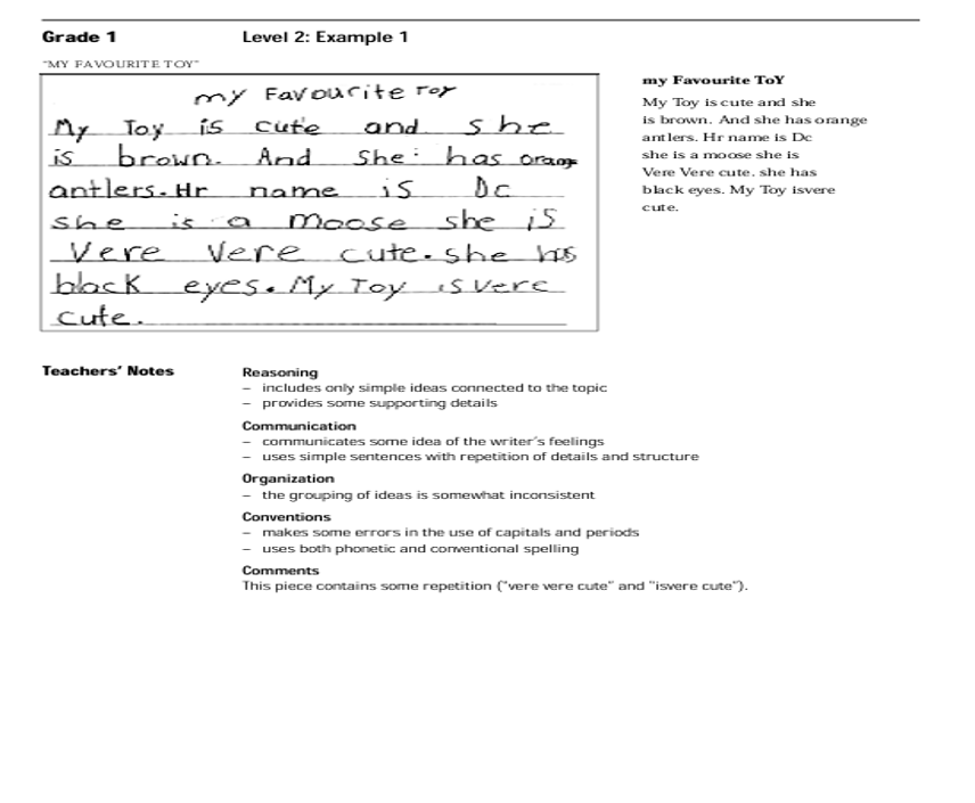
And
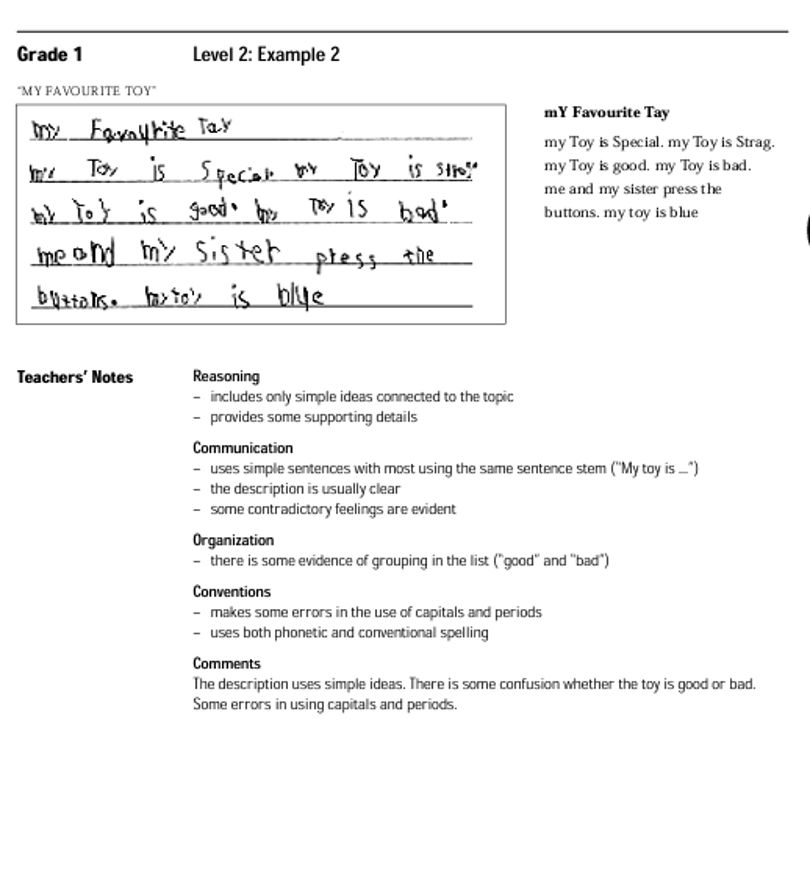
The “really real” in the student pieces is “how” they re-present the criteria at a particular level. I mean idealism in the sense of seeing past the immediate to the really real, and so for example/by analogy for the German idealist philosopher Fichte the true realization of the self does not come as an isolated individual but rather comes through contributing to the moral progress of the nation (and humanity through it).
The irony though is that when we look at assessment and evaluation as classically performed by teachers the specific student/product/teacher aren’t involved in the process at all. When we looked at the writing example, it was a matter of indifference with the exemplar who wrote it or what they wrote or who the instructor was. The writing sample, and there were two examples at each achievement level, only mattered insofar as the particular piece re-presented a level of criteria in the rubric. The classic instructional process is machinic in this regard: Teachers establish where a student is on the developmental continuum (e.g., First Steps Writing Continuum), and then target what needs to be taught to move them along. The actual piece of student writing (or a portfolio collection) is not the “really real,” but merely a symptom of what is really going on with the piece expressing a level of the rubric criteria. When the Derridean Caputo quests against “Criteria,” this is an entirely different education model all together.
When Plato wrote his book on Justice, The Republic, he talks about in the cave image how the criteria we operate according to are going to structure the guiding perspective we live according to. And so, we may be living according to the traditional definition of marriage, but this approach finds itself unable to justly accommodate LGBTQ+ rights, and so we need to, out of the spirit of Justice, deconstruct our guiding perspective and reconstruct it in a more just/inclusive manner. In this way we don’t invent justice but more fully uncover what it is and always was. Ideas are “eternal” in this sense: The idea of “Justice” never was not, nor will not be, but simply “is.” In relation to the usual guiding perspective of the traditional definition of marriage (Being, ousia), LGBTQ+ rights are a surplus that can’t be appropriated, “Epekeina tes ousias” (ἐπέκεινα τῆς οὐσίας), a famous phrase from Plato’s Republic. It translates to “beyond being” or “beyond essence.” Ousia (Being) originally meant estate/property or one’s usual surroundings and dealings, and first became a technical term for Aristotle.
*Afterthought: (Philosopher John D. Caputo and Criteria)
As was made plain by the debate in Anglo-American philosophy of science over Kuhn’s idea of decision making in a moment of revolutionary science, criteria do not help in the midst of a scientific crisis, because the very idea of the crisis is that in this anomalous situation the criteria conflict with each other and we do not know which criteria to deploy; what is called for is a very singular judgment where the criteria are trembling. After the crisis, when the first reporters arrive at the scene (the epistemologists!), the criteria that after the fact adjudicate the undecidability will be formulated. Those criteria in turn will last—they will set the parameters for the new period of “normal” science that intervenes—just until the next crisis, at which point they will again fall into crisis, which is pretty much the definition of a crisis. That is, invoking criteria is a way to maximize the probable, the predictable, the controllable, a way to describe normal science, or normal judgment, and so to minimize the rich or charged sense of the “possible.” … But we are all in this together and no determinate faith or narrative can lift us up above or insulate us from this undecidability. For better or worse, for better and for worse, the undecidability is the medium in which we decide, in which we pass our days. We may call for love and be visited by destruction, we may even expect destruction and be visited by love. That is the radical hermeneutical situation. Rather than twisting and straining against this bit, or trying to line it with insulating criteria, I think we get the best results if we confess it, if we fess up to the circumfessional cut, and then with prayers and tears press on. (Caputo, 147-9).
Post Script
(i) Regarding presence/presencing, Plato has a character in the Gorgias say that with the beautiful thing Beauty is present, and in the Phaedo Plato talks about the incarnate, the “parousia or presencing” of Beauty in the beautiful thing.
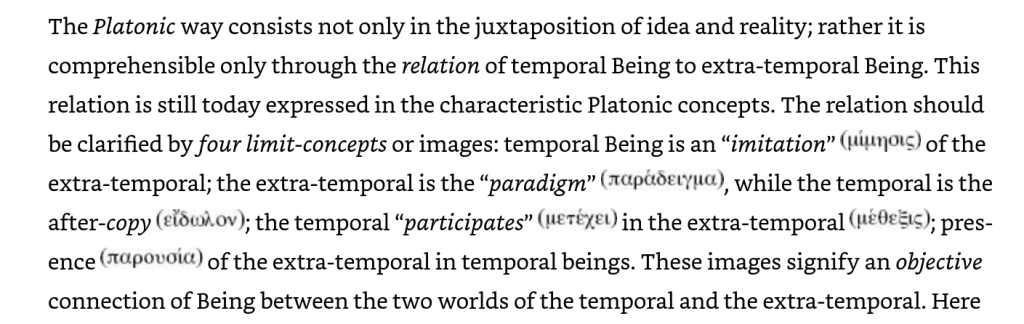
(Heidegger, Phenomenology of Religious Life, 31)
(ii) On another issue, the philosopher Kant notes that the mind unconsciously legislates a rule that we in responsibility “own” all our actions, in distinction to certain mentally challenged people, and animals, who are not responsible in that way. Schelling thus says Evil is a distinctively human possibility and freedom – that only humans can sink below animals in terms of depravity. The universally attested to golden rule, and general declaration of human rights, are grounded in our nature as moral animals.
Partial Bibliography
Calasso, Roberto. Literature and the Gods. Knopf, 2001
Caputo, John D. The Possibility of the Impossible: A Response to Kearney in Zlomislic, Marko; DeRoo, Neal. Cross and Khôra: Deconstruction and Christianity in the Work of John D. Caputo (Postmodern Ethics Book 1) Pickwick Publications, an Imprint of Wipf and Stock Publishers. Kindle Edition.
Heidegger, Martin ‘Building, Dwelling, Thinking,’ in Poetry, Language, Thought, trans. Albert Hofstadter, New York: Harper and Row, 1971.
Heidegger, Martin Nietzsche, 4 Volumes, trans. David Farrell Krell, SanFrancisco: Harper and Row, 1979.
Heidegger, Martin Plato ‘s Sophist, trans. Richard Rojcewicz and Andre Schuwer, Bloomington: Indiana University Press, 1997.
Heidegger, Martin Heraclitus Seminar (With Eugen Fink), trans. Charles H. Seibert, Illinois: Northwestern University Press, 1997.
Heidegger, Martin Parmenides, trans. Andre Schuwer and Richard Rojcewicz, Indianapolis: Indiana University Press, 1998.
Krell, David Farrell, ‘Kalypso: Homeric Concealments after Nietzsche, Heidegger, Derrida, and Lacan,’ in The Pre-Socratics After Heidegger, ed. David C. Jacobs, New York: SUNY Press, 1999.
The Secular Frontier and Secular Web Kids are blogs operated by The Secular Web, which is owned and operated by Internet Infidels Inc., a 501(c)(3) nonprofit educational organization dedicated to promoting and defending a naturalistic worldview on the Internet.
711 S. Carson St., Suite 4
Carson City, NV 89701
USA