



(4) New Insights into the Hebrew Bible Conference 2026 – Lectures by Kenton Sparks and David Carr
Binding of Isaac: Why Abraham’s Test Changed Everything
By Dr. Kenton Sparks
Throughout the ancient world, child sacrifice was a grim reality, a desperate transaction to bribe the gods for rain, victory, or protection. But in the shadow of Mount Moriah, the narrative shifted forever. The Akedah, often referred to as the “Binding of Isaac,” is frequently read as a simple story of faith, yet it stands as a radical and subversive break from the religious norms of its time. Why did the author of Genesis recast a horrific ritual as a divine test of devotion? Kenton Sparks peels back the layers of this haunting text. He explores its mysterious origins, the historical reasoning behind its unique theology, and how this single story has echoed through centuries of Jewish and Christian thought.
Sparks argues the chronology of the history of Abraham is different from the history of the chronology of the bible. Abraham is actually a later figure. The Abraham story began during the exile and post exilic period to encourage Jews to return home from the comforts of Babylon. The story dramatizes the idea from Exodus that the first born males belong to God, and so presupposed rather than initiates the substitutionary atonement rite. It suggests devotion to God was more important than devotion to family.
Commentary
Regarding the monstrosity of what Abraham is doing, ancient commenter Rabbi Aha (56:8) noted that the Hebrew doesn’t literally have God telling Abraham to sacrifice Isaac, but to “bring him up.”
In Bereshit Rabbah (Genesis Rabbah) 56:8, Rabbi Aḥa (also rendered Acha or Aha) presents a midrashic dialogue in which God explains that the original command was not to slaughter Isaac.
Abraham expresses bewilderment at the apparent contradictions in God’s statements: the earlier promise that “through Isaac will your descendants be called” (Genesis 21:12), the command to “take your son” and offer him up (Genesis 22:2), and then the order not to harm the boy (Genesis 22:12). God responds by citing Psalms 89:35 (“I will not violate My covenant, nor alter the utterance of My lips”) and clarifying:
When I said to you: “Take you your son,” I did not say: “Slaughter him,” but rather, “take him up” [or “bring him up” / ve-ha‘alehu]. I said this to you in affection. You have taken him up and fulfilled My words, now take him down.
A variant in the same passage includes a parable of a king who invites a friend’s son to his table out of affection; the friend arrives with a knife, and the king clarifies that he never intended for the boy to be eaten.
This interpretation is also cited by Rashi on Genesis 22:2 and 22:12 (sometimes attributing a similar statement to Rabbi Abba). It plays on the Hebrew wording of the command (ha‘alehu sham le‘olah, “bring him up there as a burnt offering”), emphasizing “bring up” rather than an explicit order to slaughter.
This is a classic midrashic reading that resolves the tension in the Akedah narrative by arguing that God never commanded the actual sacrifice.
Man, then, is mistaken about the notion of sacrifice. If the binding story is in fact later, it may fit in with the idea that sacrifices are helpful for the running of a society, but what God really wants is obedience, reverence and a contrite heart, which is what the sacrifice is supposed to stand for. What good is Jesus as an atoning sacrifice if you remain wicked? How is it just for a serial killer to have the get out of jail free card of repenting and accepting Christ on his death bed while a noble atheist is lost just because they struggled and failed to come to faith?
The Bible presents animal sacrifices (and related rituals) as having a legitimate function under the Mosaic covenant—for atonement, worship, thanksgiving, and covenant maintenance—but repeatedly emphasizes that God prioritizes a right heart attitude: obedience, reverence/fear of the Lord, steadfast love/mercy, justice, humility, and a broken/contrite spirit over empty or hypocritical burnt offerings.
Key passages include:
1 Samuel 15:22: After King Saul partially obeyed a command and tried to justify keeping the best livestock for sacrifice, the prophet Samuel said, “Does the Lord delight in burnt offerings and sacrifices as much as in obeying the Lord? To obey is better than sacrifice, and to heed is better than the fat of rams.” Disobedience is equated with rebellion and idolatry.
Psalm 51:16-17 (David’s prayer of repentance after his sin with Bathsheba): “You do not delight in sacrifice, or I would bring it; you do not take pleasure in burnt offerings. My sacrifice, O God, is a broken spirit; a broken and contrite heart you, God, will not despise.” A contrite (crushed/repentant) heart is presented as the true sacrifice God accepts.
Hosea 6:6: “For I desire mercy [or steadfast love/loyalty], not sacrifice, and acknowledgment of God rather than burnt offerings.” This addresses Israel’s superficial religious observance without genuine knowledge of or faithfulness to God. Jesus quotes it (in Matthew 9:13 and 12:7) against the Pharisees to highlight mercy and compassion over rigid ritualism.
Related texts reinforce the same theme:
Proverbs 21:3: “To do what is right and just is more acceptable to the Lord than sacrifice.”
Micah 6:6-8: God does not require endless offerings or extreme sacrifices; instead, “He has shown you, O mortal, what is good. And what does the Lord require of you? To act justly and to love mercy and to walk humbly with your God.”
Isaiah 1:11-17 and similar prophetic critiques reject sacrifices offered amid injustice, oppression, and empty formalism, calling instead for justice, defending the vulnerable, and genuine repentance.
Isaiah 66:2 links God’s favor to the one who is “humble and contrite in spirit, and trembles at my word” (reverence).
In context, the sacrificial system itself was God-ordained and pointed forward (in a certain Christian interpretation) to Christ’s ultimate sacrifice. The prophets and psalmists do not abolish it but insist that rituals without the corresponding inner reality—obedience, humility, love for God and neighbor, and sincere repentance—are worthless or even offensive. External religion cannot substitute for a transformed heart. This principle carries into the New Testament emphasis on living faith expressed in love and obedience rather than mere external forms.
Rethinking Eden: How Genesis Can Help Us Reimagine Power, Godlikeness and Our Relations with All Species
By Dr. David Carr
Genesis is often read as a story about human dominance, with people placed “in charge” of the world. But what if Genesis is doing something more complicated and more unsettling? In this lecture, David Carr draws on recent scholarship in Genesis and human–animal studies to reexamine the primeval stories. Rather than celebrating mastery, he shows how Genesis portrays human rule as a departure from an earlier vision of kinship shared by all living beings, and why that shift still matters today.
The original view of Genesis was for humans to dominate all beings. Viewing humans as unique or special makes sense in the context of power where one arbitrarily created life form subjugates all others. This includes the idealizing of some animals as pets. We are also so ingrained in structure of domestication in our own lives over thousands of years that we barely see the categories, like the regulation of our spatial movement, sexuality, domination of women by men, slavery, etc. I’ll expand on this below in the commentary. Human subjugation is intertwined with that of other species. Culture determines our worth and livelihood. We have grown to accommodate our divine and secular domesticators, like the dog to its collar.
God is the ultimate shepherd, creating all for God’s purposes, like the human domesticators for his animals as provider and judge. This makes sense in an ancient domesticated agricultural world ruled by farmers and Kings. Not all people view God as a dominating domesticator, like Native Americans: There is a non-personal power that permeates the world, not standing above it. We dominate rather than interrelate to life on the planet. We see this with the multitude of species that has become extinct because we have no need for them, or are in our way of developing, etc. We have turned our world into a techno farmyard and are dominated by emails, social media, etc.
Commentary
I highlighted above that we suffer from hidden structures of domestication that date back thousands of years. With Hegel and Heidegger, we saw previously in my posts that pre-scientific and scientific method is disclosure from hiddenness. This ties very closely to the nature of the person. A Question: Is there an idea in the history of philosophy or literature of “How this person must have suffered to see so clearly”? – suggesting the hidden structures of the human condition are revealed through suffering?
The sentiment—that profound clarity, insight, or unflinching vision of reality (especially its harder truths) often comes at the cost of deep personal suffering—is a recurring idea in philosophy and literature.
Classical roots: pathei mathos
The most direct classical expression is in Aeschylus’s Agamemnon (the “Hymn to Zeus” in the parodos, roughly lines 175–183). Zeus is said to have established the law that “wisdom comes through suffering” (or “learning through suffering”: páthei máthos / pathei mathos). Trouble and the memory of pain drip upon the heart even in sleep, and people learn moderation or wisdom against their will, by the “awful grace” of the gods.
This is not mere punishment but a hard-won form of understanding. Related Greek tragic ideas include anagnorisis (recognition or insight arising from catastrophe) and the broader pattern in which suffering reveals truths about justice, mortality, and the human condition. The seer or prophet figure (e.g., Tiresias, often blind; Cassandra) frequently embodies a painful clarity that ordinary people lack.
Philosophy
Schopenhauer: His philosophy centers on the Will as the source of endless striving and suffering. He presents a starkly clear-eyed pessimism: suffering is the positive, fundamental character of existence; pleasure is mostly the temporary absence of pain. This unflinching diagnosis itself reflects a kind of hard-won clarity about the world’s nature.
Nietzsche: He repeatedly links depth of insight and strength of spirit to the capacity to endure truth and suffering. In Beyond Good and Evil and elsewhere, he measures a spirit by “how much of the ‘truth’ one could still barely endure” (or how little it needs the truth thinned, sweetened, or falsified). Suffering disciplines the soul, grants profundity, and can produce knowledge of “distant, terrifying worlds” unavailable to those who have not suffered deeply. Great pain is described as a liberator of the spirit that makes one more profound (even if not necessarily “better”).
Related threads appear in Simone Weil and Iris Murdoch (attention and clear moral vision often require a form of self-emptying or “decreation” that is costly) and in broader traditions that treat suffering as a teacher of value, limits, and self-knowledge.
Literature:
The motif appears widely: characters or artists whose sharp perception of human frailty, injustice, or existential reality is inseparable from their own wounds (Dostoevsky’s explorations of suffering and insight, many Romantic and modernist figures, tragic heroes).
Buddhist traditions similarly link the confrontation with dukkha (suffering/unsatisfactoriness) to the path toward clear seeing and enlightenment. Proverbs and cultural sayings (“we suffer our way to wisdom”) echo the same intuition.
The exact phrasing “how this person must have suffered to see so clearly” is more a natural human response to encountering someone of unusual lucidity about painful realities than a famous fixed quotation. It captures the widespread recognition that ordinary comfort and illusion often obscure what suffering forces into view—whether the world’s cruelty, one’s own limitations, or deeper metaphysical truths. Of course, suffering does not guarantee wisdom (it can also embitter or break people), but the historical and literary record treats the connection as real and significant.
Example
The conspicuous extreme is going to show what the normal cases also is in an inconspicuous way. I talked previously about beings in the world of the schizophrenic appearing as such and as a whole in a conspiracy saturated way. Beings in our worlds always subtly appear as such and as a whole, though this is usually subtle and inconspicuous. For example, ancient historians speak of the restless world of the wealthy always going from city to country and back again looking for something to do.
In De Rerum Natura (Book 3), Lucretius depicts a rich man driven by restlessness from Rome to his country villa, only to grow bored almost immediately and order his carriage back to the city. The same dissatisfaction plagues him in both settings; the problem is internal, not a matter of location. Later writers paraphrase this as “Restlessness drives a man from Rome to his country villa. Boredom drives him back.”
Horace echoes and adapts the idea. In Satires 2.7 he writes (roughly): “in Rome you long for the country; in the country—oh inconstant!—you praise the distant city to the stars.” Elsewhere he notes the same fickleness regarding Tibur (a nearby resort area): at Rome he yearns for Tibur, then at Tibur he longs for Rome again (Epistles or related verse). Horace also uses the town mouse/country mouse fable and other passages to explore the theme of restless preference for whichever place one is not currently in.
Artists like Edgar Degas and Édouard Manet frequently painted wealthy bourgeois or bohemian subjects sitting in cafes (such as Degas’s L’Absinthe) staring blankly into space, looking profoundly disconnected and restless despite their leisure. John Singer Sargent’s portraits of wealthy aristocrats often hint at a subtle, underlying melancholy or restless dissatisfaction beneath the silks and expensive jewels.
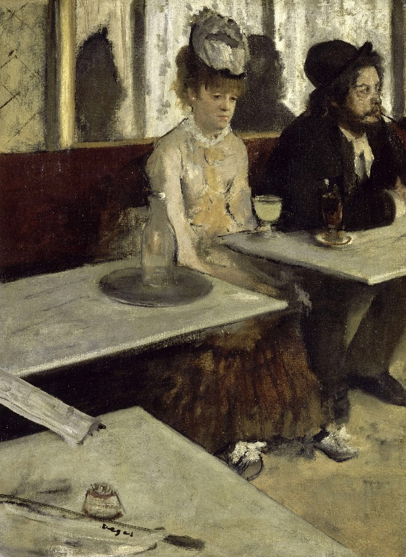
Degas’s L’Absinthe (wiki)
By contrast, we speak of a world of abject poverty where people are close to the land and one another.
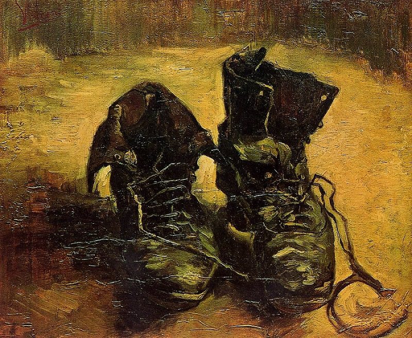
A Pair of Shoes (Vincent van Gogh) wiki
In “The Origin of the Work of Art” (Der Ursprung des Kunstwerkes), Heidegger uses a painting by Vincent van Gogh of a pair of peasant shoes to show how a work of art discloses the truth of beings—specifically, the equipmental being (Zeugsein) of equipment—rather than merely representing or copying an object.
He begins by considering ordinary equipment (a pair of peasant shoes) to grasp what equipment truly is. Mere conceptual thinking about shoes in general, or simply looking at unused shoes (whether real ones or those depicted as empty and standing alone in the painting against an undefined space, with no surrounding context or clinging soil to indicate use), does not reveal their essence. From the painting itself one cannot even tell where the shoes stand or to whom they belong.
Yet the work of art makes something further manifest. In a well-known passage, Heidegger writes (in standard English translations):
From the dark opening of the worn insides of the shoes the toilsome tread of the worker stares forth. In the stiffly rugged heaviness of the shoes there is the accumulated tenacity of her slow trudge through the far-spreading and ever-uniform furrows of the field swept by a raw wind. On the leather lie the dampness and richness of the soil. Under the soles slides the loneliness of the field-path as evening falls. In the shoes vibrates the silent call of the earth, its quiet gift of the ripening grain and its unexplained self-refusal in the fallow desolation of the wintry field. This equipment is pervaded by uncomplaining anxiety as to the certainty of bread, the wordless joy of having once more withstood want, the trembling before the impending childbed and shivering at the surrounding menace of death. This equipment belongs to the earth, and it is protected in the world of the peasant woman. From out of this protected belonging the equipment itself rises to its resting-within-itself.
Through the painting, the equipmental character of the shoes comes into the open as reliability (Verlässlichkeit). Usefulness rests in this deeper reliability, by which the peasant woman is admitted into the silent call of the earth and is certain of her world. The shoes do not merely serve a purpose; in reliable use they withdraw into inconspicuousness while belonging to the earth and finding shelter in a world.
Heidegger often portrays traditional peasant (rural, agrarian) life—especially that of the Black Forest farmers and neighbors he knew—as more rooted (bodenständig), closer to the earth, and more attuned to genuine dwelling and neighboring than the uprooted, technological, or urban existence of modern “regular people.”
Key expressions of this view
- In the 1934 radio address “Why Do I Stay in the Provinces?” Heidegger describes his own philosophical work as belonging “right in the middle of the peasants’ work.” He compares it to a farm boy hauling a sled of beech logs, a herdsman driving cattle, or a farmer preparing roof shingles. His thinking is “intimately rooted in and related to the life of the peasants,” sustained by “a centuries-long and irreplaceable rootedness in the Alemannian-Swabian soil.” He contrasts this with the city-dweller, who at best gets “stimulated” by a country stay and whose noisy, fashionable “concern” for peasant life is destructive. True respect, he says, means leaving peasants to their own law and taking their “simple, rough existence” seriously. Evening companionship with them often involves shared silence rather than chatter.
- In “The Origin of the Work of Art,” the peasant woman’s shoes and world illustrate equipment’s reliability (Verlässlichkeit) and belonging: the equipment “belongs to the earth” and is “protected in the world of the peasant woman.” Her life discloses a relation to soil, seasons, toil, birth, death, and the silent call of the earth that ordinary theoretical or casual looking misses. This is presented as a more original disclosure than modern, decontextualized experience.
- In later texts such as “Building Dwelling Thinking,” a Black Forest farmhouse built by peasants exemplifies authentic dwelling in the fourfold (earth, sky, divinities, mortals). The house is ordered by the “self-sufficiency of the power to let earth and heaven, divinities and mortals enter in simple oneness into things.” Peasant dwelling lets things be in their nearness; modern technology, by contrast, challenges and uproots the earth (as in “The Question Concerning Technology,” where the old peasant’s careful cultivation of the field is contrasted with modern challenging-forth of nature as standing-reserve).
Neighbors and nearness
Heidegger links neighboring (Nachbarschaft) to dwelling. In “Building Dwelling Thinking” he etymologically connects Nachbar to the “near-dweller”—one who dwells nearby. Genuine nearness is not mere spatial proximity or social chatter but the kind of belonging that arises in rooted dwelling. Traditional peasant communities, living in long continuity with place, dialect, and shared work, exemplify this more readily than the anonymous, accelerated relations of modern urban or technological life (the “They”/das Man of Being and Time, or the uprootedness diagnosed later).
Heidegger does not claim every individual peasant is “authentic” in the resolute, existential sense of Being and Time, nor that peasants are immune to inauthenticity or the “They.” His praise is for a form of life and a relation to earth/world that remains closer to an original belonging and less dominated by modern technological enframing (Gestell) or urban superficiality. He warns against romanticizing or interfering with peasant existence through urban “folk” chatter. His idealization of rural rootedness also intersects with his political and cultural critiques of modernity (and, in the 1930s, with völkisch themes), though the philosophical core concerns the ontological difference between rooted dwelling and modern uprootedness.
In short, Heidegger consistently presents traditional peasants as often nearer to the earth, to a meaningful world, and to genuine neighboring than the typical modern person whose existence is shaped by technology, cities, and loss of autochthony. I can relate this to the Canadian Nova Scotia mainland such as Halifax in contrast to the unique down-home culture of historically poor Cape Breton Island Nova Scotia:
The traditional Cape Breton industries that were hard labor like steel and coal are gone, yet remembered in song. The Men of the Deeps are a famous male choral ensemble made up of active and retired coal miners from Cape Breton Island, Nova Scotia. Formed in 1966 for Canada’s Centennial celebrations, the group preserves the rich folklore, history, and working-class spirit of Atlantic Canada’s coal-mining communities through powerful song and storytelling. Cape Breton’s economy has transitioned to things like education, tourism and medical. One of the great lamentations among young adults is they have to leave the island, their home, to find work.
Analogously, Heidegger analyzes river cities that grew among a river and so developed and adapted to that environment, with strong ties and meanings related to the land like an animal adapts to its environment. Cape Breton has strong ties to the Atlantic Ocean, Bra D’or lakes and Mira river, with songs and industry like Lobster and Crab. Human societies adapt to their environment. A dominant local feature like a major river supplies resources and constraints that structure economy, settlement form, work skills, and storytelling/folklore. Not every riverside settlement develops equally rich or unique river folklore/industry (size, other resources, cultural substrate, and later technology matter), and some cities later reorient away from the water. The pattern is nevertheless strong and well-documented across continents and eras: rivers leave clear economic and imaginative imprints on the places that grow up along them. Likewise, we spoke earlier of Carr and the point that it makes sense the biblical God was imagined as a domesticator/shepherd as the caregiver and controller of reality since it was an ancient agricultural context that birthed Him.
Reflections
Regarding extremes, an extreme case of anxiety and doubt/uncertainty might manifest as the sufferer desperately holding up a driver’s license to the mirror because their reflection alone doesn’t suffice for them to believe they are who they think they are. A similar person might lose confidence that they are where they are supposed to be in a driving lane and so with the figurative training wheels off reverts to the unsure state of when they first learned to drive years ago. This phenomenon occurs in a subtle way when the stress of going on a trip makes you leave the car and go back into the house to make sure you didn’t leave the stove on.
Similarly, a severe case of PTSD can reveal the radical freedom of human life. My favorite example are triplets raised in an abusive home: One develops severe PTSD, a second is unaffected, a third stronger for it – Nietzsche’s that which does not kill me makes me stronger.
So, suffering does disclose hidden forces controlling our lives. Heidegger gives the example of a headache/stomachache causing beings as such and as a whole to appear in an irritating manner: thus disclosing the phenomenon of world. Boredom does something similar.
What is exemplary discloses that which isn’t, and so a circling bird of prey discloses “Now that is Nature!,” but also what nature in an average sense is.