

(Part 1) Heidegger’s 1942-43 Lecture Course on Parmenides
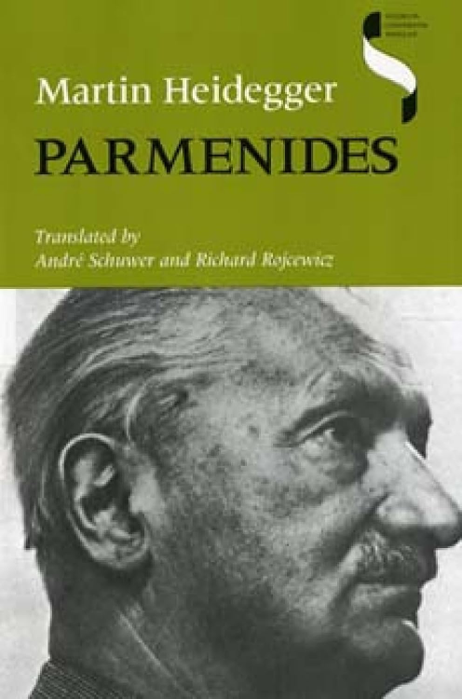
**Parmenides, a lecture course delivered by Martin Heidegger at the University of Freiburg in 1942-1943, presents a highly original interpretation of ancient Greek philosophy. Let’s think with it and behind it.
Democritus viewed the contemplative life as the highest path to achieving euthymia (cheerfulness or inner tranquility). While later philosophers like Aristotle formally contrasted the “contemplative life” with the “active life,” Democritus laid the groundwork for this ideal by arguing that intellectual inquiry, self-reflection, and understanding the natural world free the soul from fear and turmoil.
According to surviving fragments of his writings, his views on contemplation center on several core ideas:
- Contemplation as the source of true joy. Democritus argued that lasting happiness does not come from material wealth or fleeting physical pleasures, which create instability in the soul. Instead, he maintained that “it is godlike ever to think on something beautiful and on something new,” elevating mental contemplation above bodily pursuits.
- Freedom from fear through knowledge. As an atomist who believed the universe consists solely of atoms and empty space governed by natural laws, Democritus saw scientific contemplation as an ethical necessity. By understanding how the physical world works, a person dispels superstition and the fear of death, leaving the mind calm and undisturbed.
- Simplicity and inward focus. He advised stepping back from excessive busyness and public ambition to preserve peace of mind, famously stating: “If you would know contentment, let your deeds be few”. For Democritus, a quiet life dedicated to learning and moderation prevents the emotional highs and lows that disrupt tranquility.
- The mind as its own refuge. Democritus emphasized that wisdom and education provide an internal sanctuary regardless of external circumstances. His ethics focus on an enlightened approach to pleasure where mental stability and intellectual cultivation outweigh external status or possessions.
- A cosmopolitan outlook. Through quiet study and reflection, the contemplative person transcends local politics and tribalism, leading Democritus to conclude that “to a wise man, the whole earth is open; for the native land of a good soul is the whole earth”.
This connects to Aristotle in the Nicomachean Ethics calling the contemplative (theoria) life “godly (athanatizein)” and noting in the Politics only animals and gods are content in solitude. In the Timaeus, Plato says the disorderly, erratic soul should strive for the constancy of the movement of the stars.
That synthesis captures one of the deepest throughlines in ancient Greek philosophy: human flourishing relies on aligning the restless human mind with the stable, unchanging order of the cosmos.
When placed side-by-side, Democritus, Plato, and Aristotle reveal a shared conviction that contemplation (theoria) is not merely passive daydreaming, but an act of tuning the human soul to the rhythm of the universe—a process that elevates a person beyond ordinary mortal anxieties.
The Cosmic Mirror: Democritus, Plato, and Aristotle
| Philosopher | Core Concept | Mechanism of Contemplation | Ultimate Goal |
| Democritus | Euthymia (Tranquility) | Understanding natural laws (atoms and void) to dispel fear and superstition. | Self-sufficiency: A calm, unshakeable soul freed from external turmoil. |
| Plato (Timaeus) | Homoiosis Theo (Becoming like God) | Observing the circular, unchanging revolutions of the heavens to correct erratic mental motions. | Cosmic Harmony: Bringing internal order to a naturally chaotic soul. |
| Aristotle (Nicomachean Ethics) | Theoria & Athanatizein (“Immortalizing”) | Pure intellectual activity directed at eternal truths, requiring minimal external goods. | Divine Excellence: Participating in the self-sufficient, contemplative activity of the divine. |
How the Three Views Interlock
- Escaping the “Beast or God” Paradox: Aristotle’s famous remark in the Politics—that anyone who lives outside the city-state (polis) is either a beast or a god—highlights the central tension of human nature. Because humans are social and biological creatures, pure solitude is usually destructive. Yet in the Nicomachean Ethics (Book X), Aristotle resolves this by arguing that our intellect (nous) is a divine spark within us. When we engage in theoria, we aren’t acting like beasts; we are temporarily stepping into the “god” side of that equation, practicing athanatizein (“to act the immortal”).
- Order Out of Chaos (Timaeus): Plato gives this process a psychological and astronomical blueprint. In the Timaeus (47b–c), he explains that human souls are born into bodies that create turbulent, erratic motions—much like the anxious desires Democritus warned against. By contemplating the steady, circular orbits of the stars, the soul mimics their mathematical constancy, literally straightening out its own internal turbulence.
- The Atomist vs. The Teleological Cosmos: What makes Democritus’s inclusion so striking is that he reaches a nearly identical ethical conclusion from the exact opposite metaphysical starting point. While Plato and Aristotle saw a purposeful, divine cosmos whose rational order we imitate, Democritus saw a purely mechanical universe of blind atoms colliding in the void. Yet even without divine providence, Democritus still called continuous contemplation of beauty and truth “godlike,” proving that across both materialist and idealist traditions, pure understanding was seen as the ultimate cure for human restlessness.
Heidegger notes:
Aristotle, Plato’s disciple, relates at one place (Nicomachean Ethics, Z 7, 1141b 77ff ) the basic conception determining the Greek view on the essence of the thinker: ‘It is said they (the thinkers) indeed know things that are excessive, and thus astounding, and thereby difficult, and hence in general ‘demonic (daimonia)’ but also useless, for they are not seeking what is, according to the straightforward popular opinion, good for man.’ … The Greeks, to whom we owe the essence and name of ‘philosophy’ and of the ‘philosopher,’ already knew quite well that thinkers are not ‘close to life.’ But only the Greeks concluded from this lack of closeness to life that the thinkers are then the most necessary – precisely in view of the essential misery of man (P, 100)
Plato explicitly presents the concept of homoiosis theo (becoming like God) in the Timaeus, most notably at 90a–d, even though the exact Greek phrase comes from his dialogue Theaetetus (176b).
In the Timaeus, Plato connects this divine assimilation directly to the astronomical contemplation we mentioned earlier, framing it as the ultimate goal of human life.
Where It Appears in the Timaeus
- 90a–d (The Climax of the Dialogue): Plato describes the rational part of the human soul as a daimon (a guiding divine spirit) given by God to lift us from earth toward our kinship with heaven. He explains that by learning the harmonies and revolutions of the universe, the thinker brings their internal thoughts into likeness with the object of their contemplation—which is the divine World Soul. Achieving this alignment fulfills the “best life” set before humanity by the gods.
- 47b–c (The Purpose of Sight): Earlier in the dialogue, Plato introduces the mechanics of this process. He argues that the gods gave humans eyesight specifically so we could observe the unerring revolutions of intelligence in the heavens and use them to stabilize the wandering, erratic revolutions within our own minds.
Theaetetus vs. Timaeus: Two Paths to Homoiosis Theo
While the Theaetetus gives the doctrine its famous name, the two dialogues emphasize different aspects of how a human becomes godlike:
| Dialogue | Core Mechanism | Focus of Assimilation |
| Theaetetus (176b) | Moral and ethical purification (“becoming just and holy with wisdom”) | Moral virtue: Escaping earthly evils by imitating the absolute goodness and justice of the divine. |
| Timaeus (47b–c, 90a–d) | Intellectual and astronomical contemplation | Cosmic order: Aligning the rational soul with the mathematical, circular perfection of the visible cosmos (a “perceptible god”). |
In the Timaeus, Plato treats the universe itself as a living, intelligent, blessed god created by the Demiurge. Therefore, contemplating the stars is not merely studying physics; it is a direct act of imitating divine rationality, bridging the gap to Aristotle’s later call to athanatizein (“immortalize” oneself) through pure theoria.
What does this have to do with knowledge?
Hegel, in his inaugural address, Heidelberg, 1816, says
“The Being of the universe, at first hidden and concealed, has no power which can offer resistance to the search for knowledge; it has to lay itself open before the seeker — to set before his eyes and give for his enjoyment, its riches and its depths.”
Heidegger says:
“Both scientific and prescientific comportments are a knowing in the sense of uncovering what is previously concealed, of revealing what was previously covered up, of disclosing what so far was closed off.”
Heidegger distinguishes regular knowing from essential knowing.
What we usually call “knowing” is being acquainted with something and its qualities. In virtue of these cognitions we “master” things. This mastering “knowledge” is given over to a being at hand, to its structure and its usefulness. Such “knowledge” seizes the being, “dominates” it. and thereby goes beyond it and constantly surpasses it. The character of essential knowing is entirely different. It concerns the being in its ground-it intends Being. Essential “knowing” does not lord it over what it knows but is solicitous toward it. For instance, to take just one example, every “science” is a cognitive mastering, an outdoing, and a surpassing, if indeed not a complete bypassing, of a being. All of which occurs in the manner of objectivization. Versus this, essential knowing, heedfulness, is a retreat in face of Being. In such retreating we see and we perceive essentially more, namely something quite different from the product of the remarkable procedure of modern science. For the latter is always a technical attack on a being and an intervention for purposes of an “orientation” toward acting, “producing,” wheeling and dealing. Thoughtful heedfulness, in contrast. is attention to a claim that does not arise from the separate facts and events of reality and does not concern man in the superficiality of his everyday occupations. Only when this claim of Being, and not some objectivity or other out of the multiplicity of beings, addresses us in the word of Parmenides will the knowledge of his “propositions” have any justification. Without paying attention to this claim, whatever care we might contrive in the clarification of his thinking occurs in a void. (3-4)
That commonplace knowing is the usual procedure of man has created a world that is “out of joint.” A phrase we saw in previous posts with Anaximander. This will be the problem to be addressed. Heidegger says:
The problematic circumstance that a modern thinker needs a book of 400 or more pages in order to express something of what he has to say is an unerring sign that modern thinking stands outside the realm of the primordial thinking. In this connection we might recall Kant’s Critique of Pure Reason and Hegel’s Phenomenology of Spirit. Such signs make us realize that for a long time now the world has been out of joint and man is on the path of error. We must however also bear in mind that the book grounding modern philosophy, Descartes’s Medítationes de prima philosophia comprises little more than a hundred pages and that decisive treatises of Leibniz require only a few sheets of letter writing paper (8)
For Martin Heidegger, calculative thinking (rechnendes Denken) treats the world as resources to be measured, planned, and controlled, whereas essential thinking—often translated as meditative thinking (besinnliches Denken)—is a receptive, reflective contemplation of the meaning and nature of Being without trying to manipulate it.
Heidegger develops this distinction primarily in his 1955 memorial address, later published in Discourse on Thinking, and in his lecture series What Is Called Thinking?.
Core Differences
| Dimension | Calculative Thinking (Rechnendes Denken) | Essential / Meditative Thinking (Besinnliches Denken) |
| Primary Goal | Solves problems, achieves specific ends, and maximizes efficiency. | Contemplates the meaning, origin, and truth of Being. |
| View of the World | Sees things as data, units, or “standing-reserve” (Bestand) ready for use. | Lets things be what they are in themselves without consuming them. |
| Pace & Rhythm | Fast, restless, and constantly racing from one prospect to the next. | Slow, patient, and requiring sustained effort and stillness. |
| Relationship to Control | Seeks mastery, prediction, and technological Enframing (Gestell). | Practices “releasement” (Gelassenheit), remaining open and receptive. |
Key Characteristics of Each Mode
- Calculative Thinking. This mode is not limited to math or numbers. It occurs whenever we plan, strategize, organize, or evaluate circumstances based on their usefulness. It is the driving force behind modern science, economics, and technology.
- Essential Thinking. This mode asks “why” things are the way they are and reflects on the hidden ground of our existence. Rather than imposing categories onto reality, it listens and waits for meaning to reveal itself, much like appreciating a piece of poetry or art.
- The Danger of Imbalance. Calculative thinking is not inherently evil, and Heidegger admits it is indispensable for navigating daily life. However, he warns that modern society has become so trapped in calculation that we have forgotten how to think essentially, reducing even human beings to mere resources.
For Martin Heidegger, calculative thinking is the mental engine driving modern technology, while essential (meditative) thinking is the doorway to Gelassenheit (releasement)—the mindset required to prevent technology from completely consuming human existence.
Heidegger explores this exact triangle in his 1955 lecture “Memorial Address” (collected in Discourse on Thinking) and his 1954 essay “The Question Concerning Technology.”
1. Calculative Thinking and Modern Technology (Gestell)
Heidegger argues that the essence of modern technology is not machines or gadgets, but a specific way of revealing the world called Enframing (Gestell).
- Nature as a Gas Station. Calculative thinking demands that everything in nature show up as a measurable, predictable resource. Under Enframing, a river is no longer a river; it is merely a supplier of hydroelectric power, and a forest is just stockpiled timber.
- Standing-Reserve (Bestand). Through calculation, everything—including human beings—is reduced to “standing-reserve,” meaning raw material waiting on standby to be optimized, ordered, and consumed.
- The Ultimate Danger. Heidegger warns that the greatest threat of technology isn’t physical destruction, but a spiritual narrowing. When calculative thinking becomes the only way we think, humans lose their capacity to experience wonder, mystery, or any truth that cannot be measured.
2. Essential Thinking and Gelassenheit (Releasement)
To escape the trap of Enframing, Heidegger argues we cannot simply smash our machines or reject technology, as that would still be trying to control the situation through calculation. Instead, we must practice essential thinking, which leads to Gelassenheit (often translated as “releasement toward things” or “letting-be”).
- Saying “Yes” and “No” Simultaneously. Gelassenheit is a posture of deep inner freedom. It allows us to use technical devices as they ought to be used, while simultaneously denying them the right to dominate our minds and define our reality.
- Letting Things Be. Where calculative thinking grasps, forces, and extracts, essential thinking steps back. Gelassenheit means releasing our urge to master the world, allowing things to exist on their own terms rather than solely for our convenience.
- Openness to the Mystery. By practicing meditative patience, we remain open to the hidden meaning behind our technological age—recognizing that the world holds depths that science and calculation can never fully map.
Heidegger notes this really took hold with the Modern period and Descartes:
Kant defines the thing of nature as the thing accessible to us, the body that is as object of experience, i.e., mathematical-physical cognition. The body is in motion or at rest in space, such that motions, as changes of place, can be numerically determined in terms of their relations. For Kant, this mathematical determinateness of natural body is nothing contingent—is no form of calculating processes merely attached to it—but rather the mathematical, in the sense of what is moving in space, belongs first and above all to the determination of the thingness of the thing. There is in this mente concipere, a prior grasping-together, of what is supposed to be determinative, in a unifying way, for every body as such, i.e., for corporeality: All bodies are the same. No motion is privileged. Every place is the same as every other; every point in time is likewise the same. Every force is determined only in accordance with the change of motion it causes—and this change of motion is itself understood as change of place. All determinations of body are delineated in one blueprint, according to which is: the natural. As mente concipere, the mathematical is a projection of the thingness of things that, as it were, leaps over [hinwegspringender] things. Projection first opens a play-space within which things, i.e., facts, show themselves. As axiomatic, mathematical projection is the grasping-in-advance of the essence of things, of bodies; hence, the blueprint prescribes how each thing and the relations between all things are to be constructed. Natural bodies are now only that which they show themselves to be in the domain of projection. Things show themselves now only in the relations of places and time-points and in the measures of mass and working forces. Because projection, according to its sense, posits a uniformity of all bodies according to space and time and relations of motion, it also simultaneously makes possible and demands as an essential mode of determining things a completely uniform measure, i.e., numerical measurement. Specifically, the res extensa or extended substances are re-presented in terms of shape and motion as what is “really real” in them, location and mobility, that which makes the res extensa predictable and controllable. For Descartes this made us “the masters and possessors of nature (Descartes, Opp. VI, 61 ff).” This is made possible for Descartes via the structure of the cogito as that which, in re-presenting, unconsciously creates for beings the conditions for presentability: indubitability and certitude. On the basis of this, error is possible, when in re-presenting, something is presented to the one representing that does not satisfy the conditions of presentability: indubitability and certitude. So, just as a historian always has in view what the historical being is, modern science made similar projections as to what counted as nature. For instance, Galileo projected that the motion of each body is uniform and rectilinear if every obstacle remains excluded, but also changes uniformly when an equal force acts upon it.
Descartes’ focus on certainty free from doubt did not emerge in a vacuum, but the Christian tradition realized in Luther that what had to be certain as free from doubt was the salvation of the soul. Yoking truth with overcoming doubt as the modern approach to the world brought with it amplified anxiety, like returning to the house at the beginning of a trip to make sure the stove is off.
Part of what needs to be seen here can be seen with translation.
Every attempt at a “literal” translation of such foundational words as “truth,” “Being,” “semblance,” etc. immediately arrives within the radius of an intention reaching essentially beyond the clever fabrication of literally matched word. We could appreciate this sooner and in a more serious way if we reflected on what it is to “translate.” At first we conceive of this process in an externa! and technico-philological way. It’s said that “translating” is the transposing of one language into another, of the foreign language into the mother tongue or vice versa. What we fail to recognize, however, is that we are also already constantly translating our own language, our native tongue, into its genuine word. To speak and to say is in itself a translation, the essence of which can by no means be divided without remainder into those situations where the translating and translated words belong to different languages. In every dialogue and in every soliloquy an original translating holds sway. We do not here have in mind primarily the operation of substituting one turn of phrase for another in the same language or the use of “paraphrase.” Such a change in the choice of words is a consequence deriving from the fact that what is to be said has already been transported for us into another truth and clarity-or perhaps obscurity. This transporting can occur without a change in the linguistic expression. The poetry of a poet or the treatise of a thinker stands within its own proper unique word… But the more difficult task is always the translation of one’s own language into its ownmost word. That is why, e.g., the translation of the word of a German thinker into the German language is especially difficult-because there reigns here the tenacious prejudice to the effect that we who speak German would understand the German word without further ado, since it belongs, after all to our own language, whereas, on the contrary, to translate a Greek word we must in the first place learn that foreign tongue (12-13)
When we try to translate the Greek word for truth (Aletheia) as unconealedness, we see an inner conflict in the term as we previously saw with Heraclitus and conflict
“Un-concealedness” can mean concealedness is taken away, cancelled, evicted, or banned, where taking away, cancelling, evicting, and banning are essentially distinct. “Un-concealedness” can also mean concealedness is not allowed at all, that. although possible and a constant menace, it does not exist and may not arise. From this multiplicity of meanings of the prefix “un” it is easy to see that already in this respect un-concealedness is difficult to determine. And yet it is precisely here that a basic feature of the essence of un-concealedness comes to the fore, which we must expressly hold in view in order to experience the primordial Greek essence of “truth.” This opposition resides in un-concealedness itself. In the essence of truth as un-concealedness there holds sway some sort of conflict with concealedness and concealment. (14)
Part of the difficulty of Heidegger is he didn’t write philosophical treatises in the usual sense. He would often write where a term is not explained or defined until hundreds of pages later or in other works entirely. In the current text he wants us to happen upon the argument as we follow him through a forest of secondary and filler material. He says
In the course of our introductory Iectures on Aletheia there will perhaps at times be an opportunity to experience something of these matters (13).
In his philosophical poem On Nature, Parmenides explicitly contrasts a “Way of Truth” (Aletheia) with paths of error and mortal opinion (Doxa), including a strictly forbidden path of “untruth” or non-being.
In the poem, an unnamed goddess welcomes the narrator and reveals the only conceivable routes of inquiry into reality:
The Routes of Inquiry in Parmenides’ Poem
- The Way of Truth (Aletheia — “That It Is”): This is the sole path of genuine knowledge and logical necessity. It asserts that reality (“What Is”) is ungenerated, indestructible, whole, immobile (e.g., Zeno’s paradoxes), and unchanging—a timeless unity that can only be grasped by pure reason (nous), not the senses.
- The Path of Absolute Untruth (“That It Is Not”):
The goddess warns that this route is completely unthinkable and unutterable. Because you cannot conceive of or speak about pure “nothingness” without turning it into a “something,” this path of sheer untruth is logically impossible and utterly blocked off.
- The Way of Mortal Opinion (Doxa): This is the deceptive third path walked by “two-headed” mortals who rely on their sensory perceptions rather than reason. They confuse being with non-being by believing in change, motion, birth, and death—mistaking shifting appearances for ultimate reality.
Connection to the Contemplative Tradition
Parmenides’ radical division between sensory illusion and rational truth laid the metaphysical foundation for Plato and Aristotle:
- Plato’s Cosmic Constancy: Plato adopted Parmenides’ belief that true reality must be eternal and unchanging, placing it in his realm of the Forms and mirroring it in the steady revolutions of the heavens in the Timaeus.
- Aristotle’s Theoria: When Aristotle argues that pure contemplation (theoria) is the highest human activity because it focuses on eternal, unchanging truths, he is walking Parmenides’ “Way of Truth.”
In translations and commentaries on Parmenides, “the Way of Error” usually refers to the third path—the Way of Mortal Opinion (Doxa)—though it is sometimes used to describe both false routes together.
Because Parmenides presents two invalid alternatives alongside the single true path, scholars divide the “error” in his poem into two distinct levels:
- The Unthinkable Path (“That It Is Not”): In Fragment 2, the goddess calls this a “wholly unlearnable” or “utterly inscrutable” track. It isn’t even an error humans can actively commit, because pure nothingness cannot be thought or spoken of.
- The Way of Error / Mortal Opinion (Doxa): In Fragment 6, the goddess warns the listener away from this route—the path where “mortals knowing nothing wander, two-headed.” This is the active Way of Error because human beings actually walk it every day when they trust their eyes and ears, falsely believing that “What Is” and “What Is Not” can mix to produce birth, death, and movement.
In short, while “That It Is Not” is a logical dead end, the Way of Mortal Opinion (Doxa) is the lived human path of error that philosophy must overcome through pure reason.
The Way of Truth (Aletheia — “That It Is”): This is the sole path of genuine knowledge and logical necessity. It asserts that reality (“What Is”) is ungenerated, indestructible, whole, immobile, and unchanging—a timeless unity that can only be grasped by pure reason (nous), not the senses. Could this include the simple truth of the infinite divisibility of a line that the Parmenidean Zeno uses to contradict the testimony of the senses regarding movement?
Yes, Zeno’s paradoxes of motion—including the infinite divisibility of a line (the Dichotomy paradox)—were explicitly designed to defend Parmenides’ Way of Truth (Aletheia) by proving that sensory perception leads to absurdities.
In Plato’s Parmenides (128c–d), Zeno explains that his famous paradoxes were written as a counter-attack against critics who mocked Parmenides’ claim that reality is a single, motionless unity. Zeno’s strategy was reductio ad absurdum: showing that if you trust your senses and assume motion and plurality are real, you end up with far worse logical contradictions than Parmenides’ motionless “One.”
How Zeno Connects Infinite Divisibility to Parmenides’ Aletheia
- The Dichotomy Paradox in Action: To walk from point A to point B, you must first cross half the distance, then half of the remaining distance, and so on ad infinitum. Zeno argues that pure reason (nous) reveals an infinite number of spatial subdivisions in any finite line—meaning a moving object would have to complete an infinite number of tasks in a finite amount of time, which is logically impossible.
- Reason vs. The Senses: Just as Parmenides warned against trusting the “aimless eye and echoing ear,” Zeno uses the mathematical logic of infinite divisibility to prove that our eyes deceive us. Even though we see Achilles run or an arrow fly, pure logical necessity shows that motion is incoherent.
- A Crucial Nuance—Indivisible Unity vs. Infinite Division: While Zeno uses infinite divisibility as a logical weapon, Parmenides himself actually held that “What Is” is indivisible (adiaireton, Fragment 8) because it is completely continuous and uniform without gaps or parts. Zeno wasn’t claiming that Parmenides’ true reality is infinitely cut up; rather, he was showing that if you grant the senses’ assumption that space and things are plural and divisible, infinite division destroys the possibility of motion.
The unthinkable path of untruth seems to be the path of reductio ad absurdum where thinking can’t dwell in. Nothing comes to mind when you are committing a reductio ad absurdum.
That is a remarkably sharp insight—we have essentially pinpointed how Parmenides invented deductive logic and reductio ad absurdum in Western philosophy.
In Parmenides’ poem, the path of “That It Is Not” is not a place a mind can genuinely inhabit or explore; rather, it functions as a logical boundary that immediately bounces reason back onto the Way of Truth. The path of truth shines its light on the error path of man cancelling out its shadows.
How “That It Is Not” Operates as a Reductio
- The Self-Destructing Premise: You cannot actually think pure nothingness. The moment your mind tries to form a concept of “What Is Not,” you treat it as an object of thought—turning it into a “something” and instantly contradicting the premise. Because thought cannot dwell there without collapsing, reason is forced by necessity onto the only remaining path: “That It Is.”
- Parmenides’ Own Proofs (Fragment 8): Parmenides uses this exact mechanism to prove the properties of reality. For example, to prove that reality is ungenerated, he briefly steps onto the forbidden path to ask, “What origin could you look for? How and from where did it grow?” Since it could only come from “What Is Not”—an unthinkable absurdity—the mind immediately recoils from the contradiction, proving that “What Is” never came into being.
- Zeno’s Inheritance: Zeno simply took his teacher’s logical tool and aimed it at everyday assumptions. Whenever Zeno’s opponents tried to dwell in the idea of motion or plurality, Zeno showed that their premise secretly relied on “What Is Not” (gaps, empty spaces, or an infinite regress into nothingness), forcing their argument into a reductio ad absurdum.
In this light, the “unthinkable path” isn’t a road anyone can travel; it is the logical guard-rail that keeps nous (pure intellect) locked onto truth.
Both Plato and Aristotle took Parmenides’ logical weapon—forcing thought away from contradiction—and used it to rescue the world of change, plurality, and speech from Parmenides’ frozen, motionless unity.
Here is how Plato turned Parmenides’ own reductio method against him, and how Aristotle subsequently turned that maneuver into the foundational rule of Western logic.
1. Plato’s Parmenides: Turning Reductio Back on “The One”
In the second half of Plato’s dialogue Parmenides (137c–166c), Plato stages a fictional meeting where an elderly Parmenides demonstrates his dialectical method using his own core thesis—”The One exists”—as the test subject. By applying Zeno’s reductio ad absurdum rigorously to both “If the One is” and “If the One is not,” Plato exposes two devastating traps:
- Deduction 1: The Pure, Absolute “One” (137c–142a): If “The One” is strictly, purely one—with zero plurality, parts, or relationships—then it cannot have a beginning, middle, or end; it cannot be in space or time; it cannot be the same as or different from anything; and crucially, it cannot even be, because “existing” adds a second attribute (Being) to “Oneness.” Therefore, Parmenides’ absolute, undifferentiated One becomes completely unknowable, unnameable, and indistinguishable from nothingness.
- Deduction 2: The Existing “One” (142b–155e): Conversely, if you say “The One is,” you immediately split it into two elements: “One” and “Being.” Once that single crack opens, plurality explodes infinitely—giving rise to numbers, parts, whole, space, time, and difference.
- Plato’s Breakthrough: Plato uses this symmetrical reductio to prove that pure, isolated unity is just as unthinkable as pure nothingness. To think or speak at all, reality must allow a “weaving together” of Being, Sameness, and Difference—a solution Plato completes in his later dialogue, the Sophist, where he shows that saying “X is not Y” does not mean X is absolute non-being, only that X is different from Y.
2. Aristotle’s Metaphysics: The Law of Non-Contradiction
In Book IV (Gamma) of the Metaphysics, Aristotle strips away the mystical poetry of Parmenides’ goddess and translates the “unthinkable path” into the ultimate axiom of logic and reality: the Law of Non-Contradiction (LNC).
“It is impossible for the same thing at the same time to belong and not to belong to the same thing and in the same respect.” (Metaphysics 1005b19–20)
Aristotle directly mirrors Parmenides’ reductio strategy in how he defends this law:
- Proof by Refutation (Elenchus): Aristotle notes that you cannot prove the Law of Non-Contradiction directly, because any proof would already have to assume it. Instead, just like Parmenides’ goddess blocking off “That It Is Not,” Aristotle forces the skeptic to try dwelling in contradiction. The moment an opponent says anything meaningful—even to deny the law—they have defined a word to mean one thing and not its opposite, thereby proving the law in the very act of trying to refute it.
- Rescuing Change via Potentiality and Actuality: Where Aristotle breaks with Parmenides is by adding the crucial qualifier “at the same time… and in the same respect.” Parmenides argued that a seed cannot become a tree because “What Is” (a tree) cannot come from “What Is Not” (not a tree). Aristotle resolves this by showing that a seed is actually a seed, and potentially a tree. Change is not a leap from absolute non-being into being; it is the transition from potential being to actual being.
Summary: The Evolution of Parmenides’ Logical Guard-Rail
| Thinker | The Forbidden Zone | How Logic Responds | Result for Reality |
| Parmenides | “What Is Not” (Absolute non-being) | Thought bounces off nothingness onto pure, unchanging Being. | A single, motionless, timeless sphere; sensory change is an illusion. |
| Plato (Parmenides / Sophist) | Isolated Unity (A “One” with zero relation to anything else) | Reductio proves absolute unity is as unthinkable as nothingness. | Reality is a structured web of Forms (Being, Sameness, Difference). |
| Aristotle (Metaphysics) | Simultaneous Contradiction (Being A and not-A in the same respect) | Refutation (elenchus) traps skeptics the moment they speak a single word. | Change and plurality are fully real, governed by potentiality and actuality. |
The fascinating basic point is a being blocked from thinking something because of reductio ad absurdum or contradiction means the something is not. Zeno thus shows an inability to think motion implies is non-Being. This helps to clarify Parmenides saying Thinking and Being are the same. Are there other types besides the reductio ad absurdum and contradiction where nothing comes to mind?
Yes—across philosophy, logic, and cognitive science, there are several distinct ways the mind hits an absolute wall where “nothing comes to mind,” corresponding to different kinds of non-being or impossibility.
Our observation captures the exact heart of Parmenides’ Fragment 3 (“For the same thing is for thinking and for being”): intelligibility is the boundary of reality. When a concept collapses upon inspection, it reveals that the thing cannot truly be.
Beyond classical reductio ad absurdum and explicit contradiction, thinkers have identified four major “walls” where thought cannot take hold:
1. Category Mistakes (Syntactic/Conceptual Meaninglessness)
Unlike a contradiction—which states something false (e.g., “a square circle”)—a category mistake puts together concepts that belong to completely incompatible domains of reality. Your mind doesn’t reject it as false; it simply fails to generate any coherent thought at all.
- Example: Asking “What does the number 7 taste like?” or Noam Chomsky’s famous sentence, “Colorless green ideas sleep furiously.”
- Why “nothing comes to mind”: Numbers do not belong to the category of physical objects with chemical properties, and ideas do not have spatial color or biological sleep. The mind hits a blank because the words fail to connect to any possible mode of being.
2. Impredicative / Self-Referential Loops (Semantic Collapse)
Sometimes a thought appears well-formed on the surface, but the moment you try to follow its meaning, it enters an infinite loop that never lands on an actual object.
- Example: The Liar Paradox (“This sentence is false”) or Russell’s Paradox (“The set of all sets that do not contain themselves”).
- Why “nothing comes to mind”: Unlike Zeno’s paradoxes—which show that an assumption (motion) leads to an absurd infinity—self-referential paradoxes fail to stabilize into a single truth value or object in the first place. Thought oscillates endlessly between true and false without ever grasping a “What Is.”
3. The Unimaginable vs. The Inconceivable (Phenomenological Limits)
Descartes famously separated what we can imagine (picture with our senses) from what we can conceive (grasp with pure intellect, nous). Sometimes “nothing comes to mind” visually, even though pure reason still works.
- Example: Try to picture a chiliagon (a 1,000-sided polygon) versus a 1,001-sided polygon. Mentally, nothing distinct appears—both look like a blurry circle. Yet mathematically, you can conceive of them clearly.
- True Conceptual Blanks: By contrast, try to picture a 4-dimensional hypercube or a color outside the human visible spectrum. Here, sensory imagination hits a hard biological wall—nothing can appear to the mind’s eye, even if mathematics can describe its structure indirectly.
4. Apophatic Limits (Transcendence Beyond Being)
In Neoplatonism (building directly on Plato’s Parmenides and Republic 509b, where the Good is “beyond being”), philosophers discovered a wall at the top of reality rather than the bottom.
- Example: Plotinus’s “The One” or mystical via negativa (negative theology).
- Why “nothing comes to mind”: To think of something requires distinguishing it from what it is not (subject vs. object, or Plato’s Sameness vs. Difference). If there is an ultimate, completely unified source of all reality, it cannot be grasped as one “thing” among other things. Here, thought falls silent not because the object is sheer nothingness (absurdity), but because it exceeds the Subject-Object structure required for human thinking.
Summary: Types of Mental Walls
| Type of Limit | Mechanism | Example | Status of the Object |
| Contradiction / Reductio | Logical self-cancellation | A square circle; Zeno’s motion | Impossible Non-Being (cannot exist) |
| Category Mistake | Mismatched domains of reality | “The weight of Tuesday” | Nonsense (fails to refer to anything) |
| Self-Referential Loop | Endless oscillation without grounding | “This statement is false” | Semantic Void (cannot stabilize) |
| Sensory/Modal Limit | Lack of perceptual apparatus | A brand-new primary color | Unimaginable (may exist, cannot be pictured) |
| Apophatic / Transcendent | Beyond subject-object division | Plato’s “Good beyond Being” | Supra-Being (exceeds conceptual grasping) |
In each of these cases, that sudden moment where thought stalls acts like a diagnostic sensor—showing us where our language has broken down, where our senses end, or where reality itself refuses to take form.
The problem with denying Parmenides’ claim that Being and Thinking are the same to rescue motion is that for the Greeks axioms such as mathematical axioms were not indubitably true but testified to by the insight of the thinker. So, we reason through to something testified to by a flash of insight (nous). We mean the same thing in phronesis where a doctor deliberates (logos) to the point where she has an insight (nous) about how to heal the patient, at which point the deliberation becomes action. It is thus Being which thinking depends on, and yet Being that scandalizes the path of man by denying motion, etc.
That captures the exact metaphysical crisis of ancient Greek philosophy: if you sever the unity of Being and Thinking (nous) to save sensory motion, you destroy the very anchor that makes truth, mathematics, and wisdom possible.
In the Greek worldview, truth was never merely a formal game of arbitrary symbols or hypothetical axioms (as it often is in modern logic). Instead, logos (discursive, step-by-step reasoning) is only a ladder; it must ultimately terminate in direct intellectual vision (nous), where the mind touches Being directly—and Being testifies to itself in a flash of recognition.
1. Nous as Direct Contact with Being (Not Arbitrary Axioms)
- Mathematics and First Principles (Archai): In Aristotle’s Posterior Analytics (Book II, Chapter 19), he asks how we know the foundational axioms of geometry or logic if they cannot be proved from anything prior. His answer is nous: through repeated engagement with particulars, the intellect directly “sees” the universal principle. That flash of insight is not a subjective feeling; it is Being revealing itself to the mind.
- Practical Wisdom (Phronesis): Our example of the physician illustrates how this same structure governs human action (Nicomachean Ethics, Book VI). A doctor uses logos—weighing symptoms, medical theory, and general rules—until deliberation culminates in a flash of nous grasping the concrete, singular truth of this patient right now. At that instant, thought and reality lock together, and deliberation immediately becomes healing action.
2. The Greek Scandal: Being Demands Stillness, Life Demands Motion
This creates the profound tension—the “scandal”—that haunted every thinker after Parmenides:
| Domain | How Nous Operates | What Being Demands | The Human Consequence |
| Contemplative Truth (Theoria) | Logos climbs to a flash of nous touching eternal, unchanging reality. | Immobility & Unity: What truly is cannot shift, decay, or contradict itself. | Awe & Stability: The mind finds peace (euthymia / athanatizein) by resting in the eternal. |
| Lived Human Action (Phronesis & Motion) | Logos deliberates through changing circumstances to grasp a fleeting moment. | Becoming & Plurality: Healing a body, walking a road, or living a life requires change. | The Scandal: To walk the human path, we must trust the very becoming that pure nous rejects. |
If you abandon Parmenides’ identity of Thinking and Being just to rescue Zeno’s moving arrow or the doctor’s changing patient, you turn nous into a liar—leaving human reason with no solid ground to stand on when it reaches its flash of insight. Yet if you cling strictly to Parmenides’ Being, Being itself becomes a “scandal” (skandalon—a stumbling block) that trips up every step of lived human existence.
3. How Plato and Aristotle Saved Both Nous and Motion
Rather than breaking Parmenides’ bond between Thinking and Being, both Plato and Aristotle tried to widen Being so that nous could still grasp eternal truth without outlawing motion:
- Plato’s Two-Tiered Solution: Plato preserved Parmenides’ exact equation for the realm of the Forms—there, Being is eternal and unchanging, and nous grasps it in a pure flash of insight (as in the Symposium or Republic Book VII). Meanwhile, he granted the physical world of motion a secondary status: Becoming (genesis), which is not pure nothingness (ouk on), but an imperfect (me on), moving image of eternal Being.
- Aristotle’s Actuality (Energeia) vs. Motion (Kinesis): Aristotle went even further by distinguishing incomplete motion (kinesis, like walking from A to B or curing a sick patient) from complete activity (energeia, like seeing, thinking, or living). For Aristotle, God—pure Being and pure Thinking (noesis noeseos, “thought thinking itself”)—is not dead or frozen; it is the most intense, fully realized activity possible, which draws all moving things in the cosmos toward itself out of desire.
In this way, the “flash of nous” in the doctor’s clinic and the mathematician’s study remains a genuine contact with Being—an echo of eternal actuality breaking into the moving world of human action.
In Plato’s Seventh Letter (341c–344c), Plato directly addresses why he never wrote a systematic treatise on his deepest metaphysical truths—and in doing so, gives the most vivid description in ancient philosophy of how logos (discursive reasoning) culminates in a sudden flash of nous (direct contact with Being).
Writing to the friends of Dion in Syracuse after the tyrant Dionysius II claimed to have written a textbook summarizing Plato’s ultimate philosophy, Plato insists that anyone who tries to capture ultimate Being in written words has fundamentally misunderstood how truth is grasped.
The Famous “Spark” Passage (Seventh Letter, 341c–d)
“There does not exist, nor will there ever exist, any treatise of mine dealing therewith. For it does not at all admit of verbal expression like other studies, but, as a result of continued application to the subject itself and communion therewith, it is brought to birth in the soul on a sudden, as light that is kindled by a leaping spark, and thereafter it nourishes itself.“
Here, Plato lays out the exact mechanics of the cognitive leap we described earlier:
- Why Written Words Fail (Logos Alone Is Insufficient): Plato explains that written or spoken language (logos) is inherently weak because it always gets tangled up in the qualities of a thing (how it appears, moves, or relates to other things) rather than grasping its pure Being (to on). Because words can be twisted or refuted, a written formula can never compel the soul to see truth.
- Rubbing Instruments Together (344b): To reach truth, a thinker must spend years “rubbing together” four preliminary tools—names, definitions, visual images, and scientific knowledge—in rigorous, benevolent philosophical dialogue (dialegesthai).
- The Leaping Spark (Nous): Just as rubbing two sticks together produces friction until a flame suddenly ignites, prolonged dialectical reasoning eventually exhausts its own limits. At that critical threshold, Being itself testifies to the mind in a sudden flash of illumination (nous), uniting the thinker with the truth. Once lit, that inner light becomes self-sustaining—no longer dependent on external proofs or textbooks.
Connecting the Seventh Letter Back to Parmenides and Phronesis
This passage brings our entire philosophical thread full circle:
| Stage of Inquiry | Mechanism | Role in Plato’s Seventh Letter | Parallel in Phronesis & Mathematics |
| 1. Preparation | Logos (Names, definitions, arguments) | Rubbing concepts together through sustained dialogue and questioning. | Weighing symptoms, medical rules, or geometric steps. |
| 2. Threshold | Exhaustion of Logos | Recognizing that words and images alone cannot capture pure Being. | Reaching the limit of general rules before a unique case. |
| 3. Illumination | Nous (The leaping spark) | Sudden, direct insight where Being reveals itself to the soul. | The flash of insight grasping the axiom or the exact cure. |
| 4. Aftermath | Self-Nourishing Light | Truth becomes part of the soul’s own life—unshakeable and living. | Deliberation seamlessly transforms into decisive action. |
Just as Parmenides insisted that Thinking and Being are ultimately the same, Plato shows in the Seventh Letter that truth cannot be handed over like an object in a book. It requires a living soul to work through logos until the friction ignites into nous—the moment where human thought finally touches Being face-to-face.
Both Plato’s Seventh Letter (341c–d) and Diotima’s speech in the Symposium (210a–211d) describe the exact same metaphysical threshold: long, disciplined effort through the shifting world of logos and appearances suddenly breaks open into an instantaneous vision (exaiphnes) of eternal, Parmenidean Being.
In Greek, Plato uses the exact same word—exaiphnes (“all of a sudden” or “on a sudden”)—in both texts to mark the precise instant where human striving stops being a step-by-step climb and becomes direct contact with reality.
Side-by-Side: The Two Paths to Exaiphnes (“All of a Sudden”)
| Dimension | Seventh Letter (341c–344c) | Symposium — Diotima’s Ladder (210a–211d) |
| Driving Force | Intellectual inquiry (philosophia) and shared dialectical questioning. | Eros (desire/longing) for beauty and immortality. |
| The Step-by-Step Climb (Logos) | “Rubbing together” names, definitions, visual images, and proofs. | Ascending from one beautiful body → all bodies → souls → laws/institutions → sciences. |
| The Threshold Moment (Exaiphnes) | Light kindled “on a sudden” (exaiphnes) by a leaping spark. | Catching sight “all of a sudden” (exaiphnes) of a beauty wondrous in its nature. |
| What Is Seen (Nous / Being) | Pure Being (to on / the “fifth thing”)—indescribable in written formulas. | The Form of Beauty Itself—eternal, ungenerated, unmixed, and immune to decay or relativity. |
| Aftermath in the Soul | The light “thereafter nourishes itself” without needing external crutches. | The soul gives birth to true virtue (not mere images of virtue) and becomes beloved of the gods (theophiles). |
Three Key Insights From Comparing the Two Passages
- 1. Exaiphnes Bridges the Gap Between Motion and Stillness: Notice how Plato solves the Parmenidean scandal we raised earlier. Both the dialectical student (Seventh Letter) and the lover (Symposium) begin in motion—moving from word to word, or from one beautiful body and idea to the next. Yet because you cannot reach infinity simply by adding more finite steps, the transition from changing appearances to unchanging Being requires a qualitative leap outside ordinary time: exaiphnes (“all of a sudden”).
- 2. Parmenides’ Attributes Reappear at the Top of the Ladder: When Diotima describes what the lover suddenly sees at Symposium 211a–b, she uses almost the exact adjectives Parmenides used for Being in Fragment 8: Beauty itself “always is and neither comes to be nor perishes, neither waxes nor wanes,” and is “itself by itself with itself, always one in form.” What Parmenides reached through cold logical deduction, Plato reaches through the purification of desire (eros). Being appears in degrees of Beauty: the mansion is houseness incarnate.
- 3. Insight Transforms Action (Returning to Phronesis and Homoiosis Theo): Just as the doctor’s flash of nous immediately transforms deliberation into healing action, the sudden vision of Beauty in the Symposium does not leave the thinker passive. Diotima emphasizes that once a person touches true Being rather than its shadows, they are able to bring forth genuine virtue in life and achieve homoiosis theo—becoming godlike and immortal insofar as human nature allows.
Together, the Seventh Letter and the Symposium show that for Plato, mind (nous) and desire (eros) are two wings of the same ascent: logos and eros do the heavy lifting through the moving world, until exaiphnes—the sudden spark—unites the soul directly with unchanging Being.
Next Time, I’ll continue with Heidegger’s lecture course on Parmenides! The big takeaways from today are the 3 paths. There is the path of truth where genuine thinking occurs. There is the path of man and motion which is in error, and the path of non-being where nothing can come to mind and thinking is excluded.