



(Part 6) The Fourfold Cord vs The Threefold Cord: My thoughts on Derrida’s “Interpretations at War Kant, the Jew, the German”
The Fourfold Cord vs The Threefold Cord
“And though one might prevail against another, two will withstand one. A threefold cord is not quickly broken. (Eccl 4:12)
I talked a little the last few times about the threefold cord (I might have misspelled as “chord” a few times, but that’s okay I’m musical, lol), and so with my primary example that houseness stands forth as what it is through the identity and difference in mansion as houseness incarnate (Now that’s a house!), houseness being merely present in the average house, and deficient in the dilapidated shack. These are the three ways houseness presences/is present (Parousia in the Phaedo) in the various buildings. Such presencing is how the house stands forth as what it really is, what it re-presents. But, as I said, Plato’s explanation is a fourfold cord, not a threefold one. We noted it is in fact the idea of beauty or the beautiful that will be the medium through which houseness appears, and so the relative beauty of the mansion vs that of the average house vs that of the shack. And of course I noted the twofold deconstructive reversal of someone to whom the mansion appears gawdy and the shack quaint/rustic. Protagoras thus says man is the measure of appearing and so the right angle triangle is going to appear very differently to the child just learning her shapes vs the teenager in geometry class vs the geometry professor in university researching the history of the Pythagorean theorem.
As we noted, the fourfold cord/relations is going to be very important for the later Heidegger. Martin Heidegger’s fourfold (Das Geviert) represents the worlding of the world, where four fundamental dimensions of reality gather together in a unified, interconnected whole. It is his late-philosophy framework for how humans can dwell meaningfully on Earth without treating reality as a mere resource.
The fourfold cord consists of two structural pairs. To use Heidegger’s model
1. Earth and Sky (The Material/Spatial Pair)
- Earth: The grounding, concealing provider of life. It represents nature, raw materials, and the physical foundations that support existence.
- Sky: The open, revealing spatial expanse. It represents the movement of the sun, the changing seasons, the weather, and the passage of time.
2. Mortals and Divines (The Spiritual/Existential Pair)
- Mortals: Human beings. They are defined by their capacity to experience death as death and their responsibility to initiate “dwelling.”
- Divines: The fleeting messengers of the holy. They represent the higher dimension of meaning, destiny, and the sacred that hints at a higher purpose above human will.
The Unified Mirror-Play
These four elements do not exist independently. They are locked in a “mirror-play” (Spiegelspiel), meaning each element reflects, requires, and defines the other three. For Heidegger, a physical object like a bridge or a jug acts as a “thing” because it gathers all four of these regions together in one concrete place.
As I said, one of the most obvious examples of this is the use of fourfold exemplars in teaching and assessment/evaluation, which are grouped into two pairs as Above or At Grade Level (A, B), and Approaching / Below Grade Level (C, D). Comparing student work to these examples allows the student product to stand forth as what it really is, what it represents. Teaching thus involves immersing students in these levelled examples so they can know what they need to do for a good product and what they need to avoid: the exemplary product (A) , a good product (B), a next steps product (C), and a cautionary example where remediation is required (D). An “A” exceeds grade level expectations; A “B” is a good example of grade level standards; A “C” is approaching grade level expectations, and a “D” indicates serious remediation is necessary. The first two achievement levels (A,B) complement one another in producing sense, as do the second two (C,D), and the two groups create further sense by standing off against the other. In fact, all four standards exemplars interrelate to inform student learning and bring out the essence of a student product in assessment and evaluation.
Let’s look at how this plays out at Grade One Level Writing in the Ontario Canada Writing Curriculum exemplars with a fourfold levelling of student writing (1-4) and a fourfold criteria for assessment/evaluation (This is all available online for free).
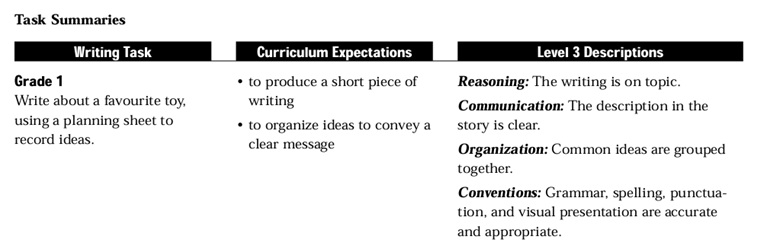
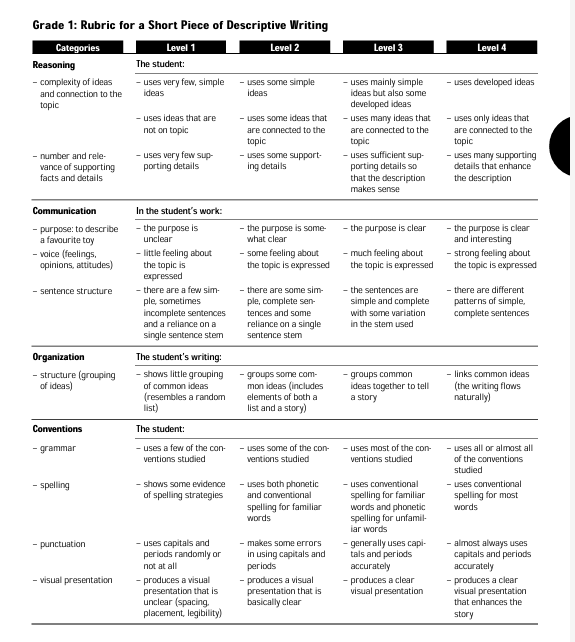
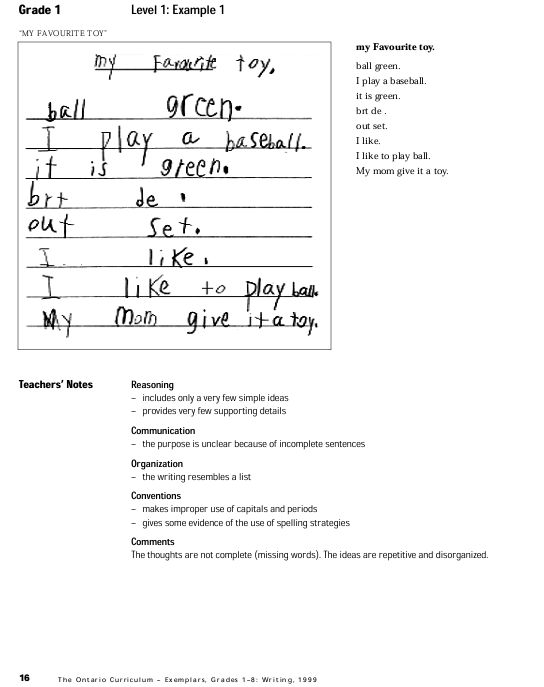
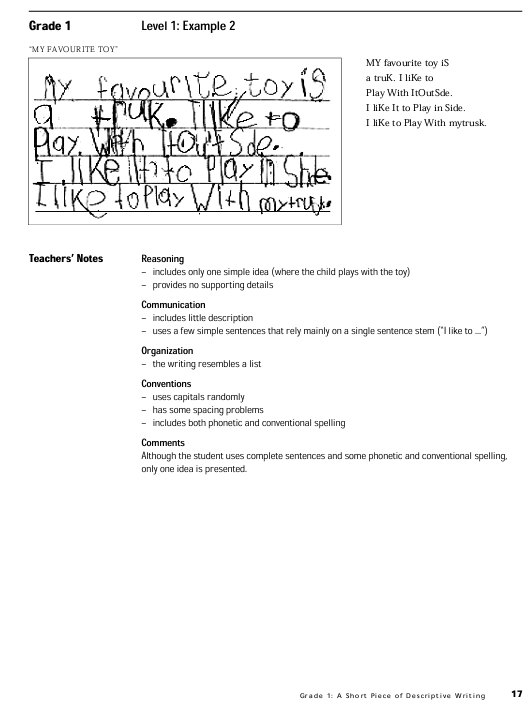
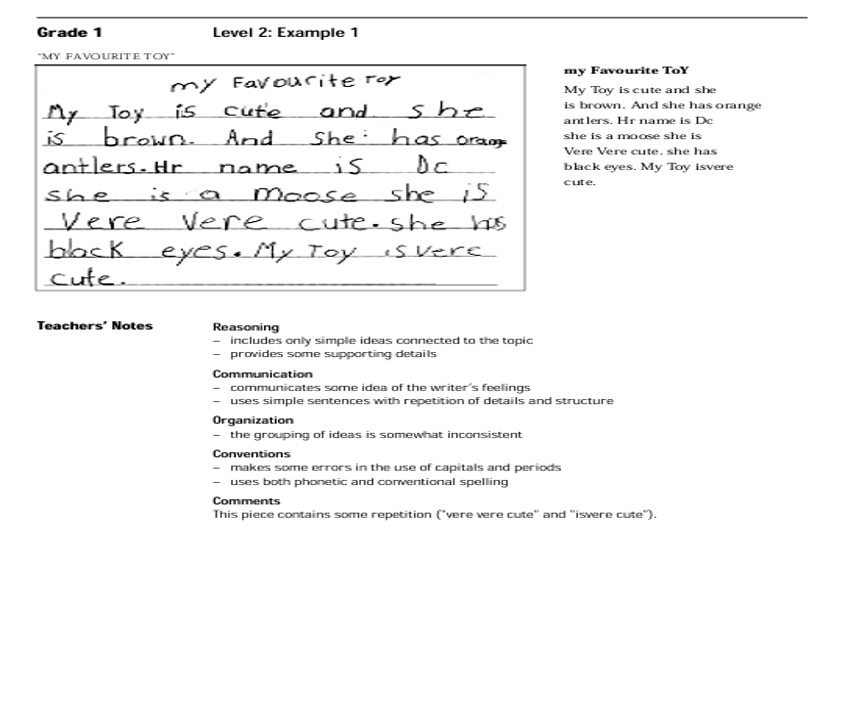
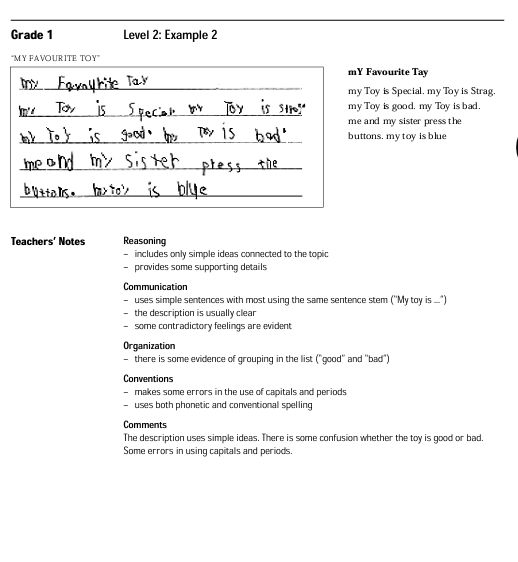
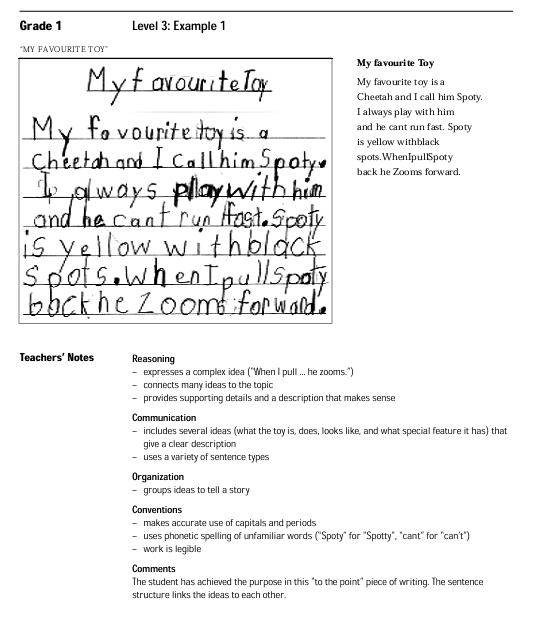
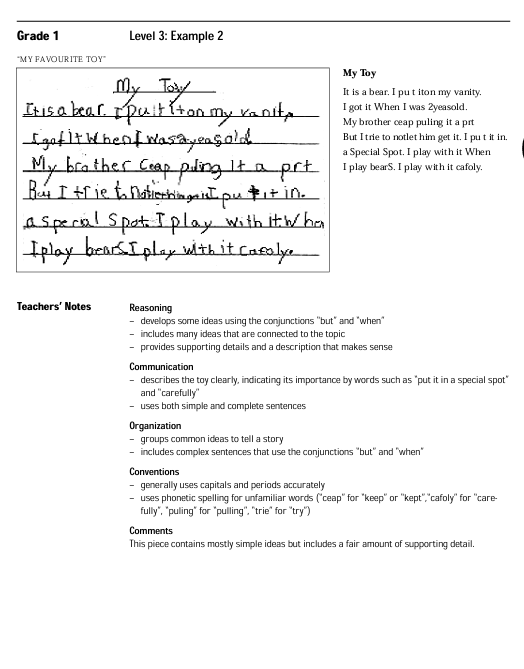
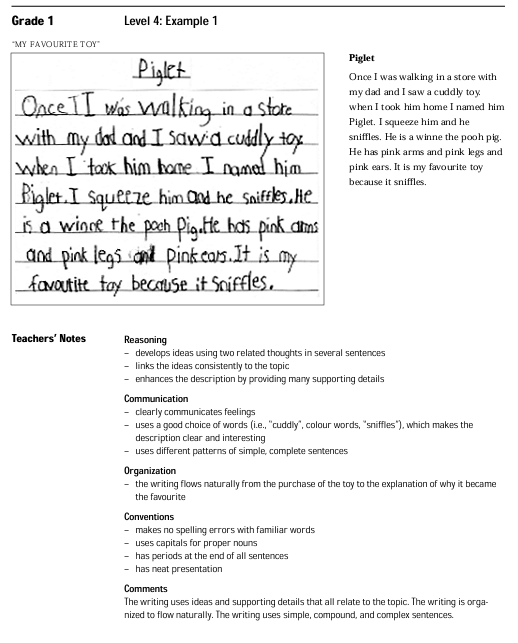
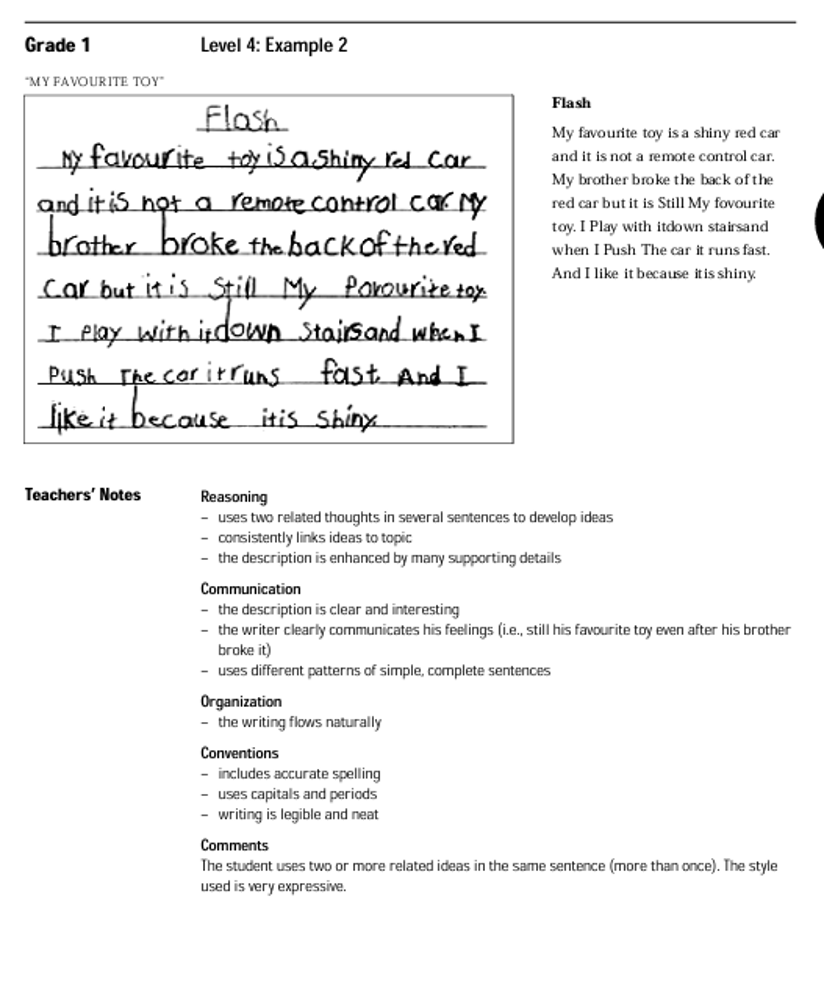
Ideally you want to develop your assessment/evaluation criteria with the students and student writing is highly task-specific, but the exemplars are one good strategy for familiarizing students with what the four levels look like and what they need to do to be successful.
And so, the fourfold relations are going to let the child’s assignment reveal itself as what it is. I gave the example last time of Heidegger’s image of the fourfoldedness of the jug.
Heidegger uses the example of the jug in his 1951 essay The Thing to demonstrate how a physical object is not just a collection of atoms, but a gathering point for the entire fourfold.
The Void as the Essence
- The Material Misconception: Science views a jug as a vessel made of shaped clay.
- The True Essence: Heidegger argues the essence of the jug is its emptiness—the void that holds.
- The Act of Pouring: The jug’s thingness is realized when it pours out what it holds, turning a physical object into an act of giving.
How the Jug Gathers the Fourfold
When water or wine is poured from the jug, all four elements of the fourfold are brought into a single, unified presence:
- Earth: The clay comes from the ground, and the poured water flows from earth’s springs.
- Sky: The rain that fed the springs or grew the grapes for wine came from the sky’s weather.
- Mortals: Human beings drink from the jug to sustain life and enjoy fellowship.
- Divines: The pour can be a libation—a ritual offering poured out to the gods, acknowledging the sacred.
The Contrast with Science
For Heidegger, science can measure the jug’s volume, but it flattens the jug into an object of consumption. By treating it as a “thing” instead, humans allow the jug to “world”—meaning it anchors a meaningful relationship between nature, humanity, and the sacred.
HAVE A GREAT SUMMER!

(AI Free Image)