



ps: Postmodern Religious Thought as Religion without Religion
Previously,
Why are there 2 Completely Different Bloodlines of Joseph in Matthew and Luke?
(2/2) Why are there 2 Completely Different Bloodlines of Joseph in Matthew and Luke?
(Conclusion) Why are there 2 Completely Different Bloodlines of Joseph in Matthew and Luke?
Reflections as the Summer Comes to an End: The Secular Roots of Esoterica
Now the Postscript
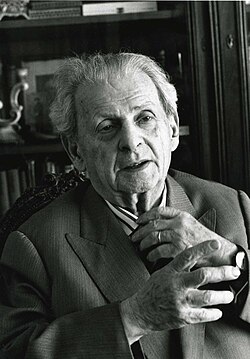
(Emmanuel Levinas wiki)
Postmodern thought rallies against the excesses of modern thought, although it is deeply rooted in the intellectual past. For example, reason wants to reach beyond itself, like in the antinomy of space. On the one hand, infinite space is deemed impossible due to the criterion of the inability to think it. Try to picture infinite space. You can’t. But, by the same criteria finite space is also impossible because you can’t think that either since to picture space as a finite container you think an inside but also an outside – hence always a further space. A popular example of this is finite space expanding: expanding into where? Of course, space either is finite or infinite, but reason becomes impotent here.
And so, with postmodern religious thought, in trying to characterize the divine within the human condition you run into the problem that the divine is not a part of the human condition apart from what numinous experiences your mind creates for you (just look at secular people) and so postmodern religious thought turns out to be religious in the everyday sense only as an unnecessary postscript. We see this with the postmodern religious philosophy of Jacques Derrida’s friend Emmanuel Levinas.
For Levinas in Totality and Infinity and related works, the face (visage) of the Other appears as vulnerability, nakedness, and a commanding height that interrupts the self’s egoism and totalizing grasp. It issues the primordial ethical imperative (“Thou shalt not kill,” care for me) and places the subject under infinite, asymmetrical responsibility for the Other (including the stranger, widow, orphan, enemy, or suffering person). This is not a symmetrical dialogue or reciprocal recognition but a heteronomous call that constitutes subjectivity itself. What does this mean?
Levinas explicitly connects this to the divine: “The dimension of the divine opens forth from the human face.” The face is the concrete locus where the idea of Infinity arises (drawing on Descartes), and metaphysics is enacted in relations with human beings. There can be no knowledge of or relation to God separated from the relation to the Other; the Other is indispensable for the relation with God. Precisely by the face, it manifests the height in which God is revealed. The face bears a trace of the Infinite or of “illeity” (the third-personal “He” of a God who has already passed and remains absolutely transcendent). So let’s try to get this straightforward and less “jargon-y.”
Levinas says the face of the suffering other is as close as you get to God. Emmanuel Levinas argues that the encounter with the face of the other person—especially in their vulnerability and suffering—is where we encounter the “trace” of the Infinite or God.
The Trace of God: Levinas famously stated that the face of the Other is “where God passes”. He did not mean God is an object you can see or prove. Instead, the radical, ungraspable otherness and vulnerability of another person point beyond themselves to the Infinite in the infinite responsibility it calls me to.
Ethics as First Philosophy: For Levinas, responsibility for the neighbor comes before abstract theology or ontology (the study of being). When you see a suffering person, their face issues a silent, absolute command: do not kill me, care for me.
The Human and the Divine: Meeting this radical ethical obligation is the only way humans truly relate to the divine. God is not found by looking up into the clouds or through dogmatic contemplation, but by looking down into the concrete, humbling need of the human other.
Analysis:
Of course, the alert reader will note God is superfluous here. When the suffering widow, orphan, stranger, and enemy catalyze the call of responsibility to and in me, this is neither unusual nor remarkable and certainly doesn’t imply God. It can be a powerful event, but it’s clear that there is no need to factor God into the equation. I remember my moral compass being awakened as a child in the school yard watching other children pull the legs off of Daddy Longlegs insects for fun.