



Reflections as the Summer Comes to an End: The Secular Roots of Esoterica
Previously,
Why are there 2 Completely Different Bloodlines of Joseph in Matthew and Luke?
(2/2) Why are there 2 Completely Different Bloodlines of Joseph in Matthew and Luke?
(Conclusion) Why are there 2 Completely Different Bloodlines of Joseph in Matthew and Luke?
And now, the Appendix
In the last post I said in the comments:
Hegel similarly engaged Böhme (whom he praised in lectures as anticipating modern philosophy’s scientific systems in describing the birth of God), Hermetic traditions, Kabbalah, and alchemy. His library included works by Agrippa, Böhme, Bruno, and Paracelsus. He associated with known occultists like Baader, showed interest in Mesmerism, psychic phenomena, dowsing, and sorcery, and structured aspects of his system (e.g., correspondences, initiation-like progress in the Phenomenology) in ways parallel to Hermetic theosophy. Contemporaries and early critics often linked Hegel and Schelling to mysticism and Gnosticism; later scholarship (Magee’s Hegel and the Hermetic Tradition and related work) treats these influences as deep rather than incidental. Both also investigated animal magnetism. But this is done in the sense that words become problematized so that terms having to do with the supernatural/superstition turn out to be philosophical, like how “God” becomes “Ground.” Heidegger says:
“In its formal meaning, pantheism means: pan-theos, ‘Everything – God’;
everything stands in relation to God; [this means] all beings are in relation to the
ground of beings. This ground as the One, hen is as ground what everything else,
pan, is in it, in the ground. Hen kaipan. The One is also the whole and the
whole is also the One … Hen kaipan, this followed Heraclitus’ fragment hen
panta einai, Fr. 50, and was according to the spirit of the time the chosen motto
of the three young Swabian friends, Schelling, Hegel, and Holderlin. (Schelling on Freedom, 68).”
To continue, for example, alchemy on a surface level involved turning initial metals into gold, but this had the deeper meaning of a transformation of the soul (since other metals don’t turn into gold), such as Adam’s eyes being opened to his nakedness or metanoia (repentant transformation of the mind).
Ancient Greek and Roman thinkers frequently stripped away the literal, supernatural weight of religious myths to expose underlying psychological, physical, or historical truths. This intellectual transition from mythos to logos allowed them to treat traditional religion as a vessel carrying a more rational or secular core.
Key Ancient Thinkers and Approaches
- Euhemerus (c. 300 BCE): Argued that the gods of popular religion were originally mortal kings, military conquerors, and civic benefactors whose deeds were exaggerated and mythologized over generations. His approach reduces divine myths to historical and sociological records.
- Theagenes of Rhegium (6th century BCE): Pioneered physical and moral allegory, suggesting that Homer’s tales of battling gods were actually coded secular descriptions of physical elements (like dry versus wet) or human psychological traits.
- The Stoics (e.g., Cleanthes, Zeno): Systematically allegorized traditional mythology into natural philosophy. To them, figures like Zeus or Hera were not corporeal beings in the sky, but physical forces, cosmic reason (Logos), or properties of the material world.
- Aristotle: Conducted empirical ethics and political science by systematically excluding divine retribution, mythic intervention, or the afterlife, grounding human order entirely in civic and natural terms.
In ancient Greece, traditional myths served as the primary vehicle for education, moral development, and civic identity. However, philosophers like Plato and Xenophanes argued that these stories did more harm than good. They critiqued traditional mythology for its moral corruption and sought to reshape it into a tool for civic excellence.
Plato’s Radical Critique and Censorship
In his seminal work, The Republic, Plato famously outlined a strict program of theological censorship for the ideal city (Kallipolis). He targeted the two main educational authorities of his day: Homer and Hesiod.
- The Problem of Divine Immorality: Plato argued that poetry frequently depicted the gods committing horrific acts, such as Zeus overthrowing his father, gods waging war against each other, or deities engaging in deception, adultery, and murder.
- The Psychological Impact: Plato believed that the human soul, especially in youth, is highly impressionable. If future citizens and rulers grow up hearing that the gods act selfishly or violently, they will believe that such behavior is natural, virtuous, and worthy of imitation.
- The Philosophical Counter-Principle: Plato established a strict rule for all civic stories: God is entirely good and can only be the cause of good. Because divinity is perfect, it cannot change shape, lie, or cause harm. Therefore, any myth suggesting otherwise must be legally banned from the city.
- The Use of “Noble Lies”: While Plato rejected traditional immoral myths, he did not abandon myth-making entirely. He recognized that the general public requires narrative-driven civic cohesion. He proposed creating new, carefully manufactured myths—like the Myth of Er or the Noble Lie (Myth of the Metals)—to encourage citizens to love their city and accept their civic duties. See my The Justified Lie by the Johannine Jesus in its Greco-Roman-Jewish Context
Similarly, regarding Numa Pompilius, Livy wrote:
And fearing lest relief from anxiety on the score of foreign perils might lead men who had hitherto been held back by fear of their enemies and by military discipline into extravagance and idleness, he (Numa) thought the very first thing to do, as being the most efficacious with a populace which was ignorant and, in those early days, uncivilized, was to imbue them with the fear of Heaven. As he could not instil this into their hearts without inventing some marvellous story, he pretended to have nocturnal meetings with the goddess Egeria, and that hers was the advice which guided him in the establishment of rites most approved by the gods, and in the appointment of special priests for the service of each. (Livy 1:19)
Also, Plutarch suggests that Numa played on superstition to give himself an aura of awe and divine allure, in order to cultivate more gentle behaviors among the warlike early Romans, such as honoring the gods, abiding by law, behaving humanely to enemies, and living proper, respectable lives. See Plutarch, “The Parallel Lives, Numa Pompilius” §VIII.
Xenophanes: The Pioneer of Anthropomorphic Critique
Before Plato, the pre-Socratic philosopher Xenophanes of Colophon (c. 570–478 BCE) laid the groundwork for this critique. He was the first to explicitly point out that human beings create gods in their own image.
- Moral Corruption: Xenophanes complained that Homer and Hesiod attributed to the gods “everything that is a shame and a reproach among men: theft, adultery, and deceiving each other.”
- Cultural Relativity: He famously observed that Ethiopians make their gods black and snub-nosed, while Thracians give theirs blue eyes and red hair. He joked that if horses and oxen could draw, they would depict gods as horses and oxen.
- Civic Consequence: By stripping the gods of their petty human vices, Xenophanes argued for a singular, non-anthropomorphic divinity that moves things purely by thought, setting a higher moral standard for civic behavior.
The Civic Goal: From Superstition to Virtue
For these philosophers, critiquing myth was not an attempt to destroy civic order, but to save it. By removing the irrational and immoral elements of religion, they aimed to:
- Shift civic loyalty from erratic gods to stable cosmic justice.
- Foster internal psychological harmony (temperance, courage, justice) in citizens.
- Base political authority on reason (logos) rather than fear of supernatural whims.
A Case Study Example from Rosicrucian Lore: The Chymical Wedding of Christian Rosenkreutz
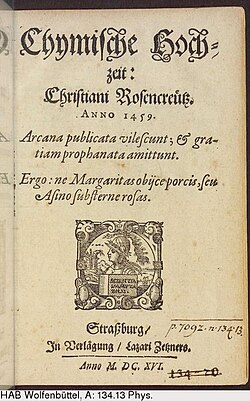
(The Chymical Wedding of Christian Rosenkreutz, wiki)
Last time I talked about the Freemasons (who may or may not be a little misogynistic though they have a female branch like Catholics have nuns but not female priests – “The Daughters of the Eastern Star” – but still generally a fun group of guys, lol), so this time I’ll talk about one of the core texts of another major secret society, the Rosicrucians.
Synopsis:
The Chemical Wedding of Christian Rosenkreutz (original German: Chymische Hochzeit Christiani Rosencreutz anno 1459), published anonymously in Strasbourg in 1616, is the third of the classic early Rosicrucian texts (after the Fama Fraternitatis of 1614 and the Confessio Fraternitatis of 1615). It is widely attributed to the Lutheran theologian and writer Johann Valentin Andreae (1586–1654), who later described an early version as a youthful ludibrium (prank, jest, or playful fiction), though the published form is richer and more layered.
It is an elaborate allegorical romance told in the first person by the elderly hermit Christian Rosenkreutz (CRC). Over seven days (structured like the days of Creation in Genesis and echoing alchemical stages), he receives a mystical invitation, journeys to a wondrous castle, undergoes tests and purifications (including a weighing of souls/guests), witnesses the “chymical wedding” of a king and queen, sees their beheading/death and alchemical dissolution, participates in their resurrection and rebirth (involving processes that produce homunculi who grow into the renewed royal couple), and is ultimately made a Knight of the Golden Stone. The narrative is filled with symbols, trials, mechanical wonders, dreams, biblical allusions (e.g., the wedding feast in Matthew 22), and alchemical imagery, including John Dee’s Monas Hieroglyphica.
Core Meanings and Interpretations
The work is primarily an alchemical allegory of the Magnum Opus (the Great Work). The “chymical” (chemical/alchemical) wedding represents the coniunctio or sacred marriage—the union of opposites (king/queen, sun/moon, sulfur/mercury, male/female principles). The seven days map onto stages such as calcination/nigredo, dissolution, separation, conjunction, fermentation, distillation, and coagulation. Death, putrefaction, and resurrection of the royal couple parallel the alchemical cycle of solve et coagula (dissolve and coagulate), culminating in the Philosopher’s Stone (symbolized by the Golden Stone). It critiques crude “gold-cooking” while elevating spiritual/transformative alchemy.
It is equally a spiritual and mystical allegory of the soul’s initiation, purification, death-to-self, and regeneration. Christian Rosenkreutz’s journey depicts inner transformation: trials of virtue and humility, ascent toward higher consciousness, and the mystical marriage of the soul (bride) with the divine (Bridegroom/Christ). Themes draw on Christian mysticism (e.g., the Song of Songs, resurrection), the imitation of Christ, and the path to unio sacra (sacred union). The castle functions as an interior/spiritual realm; the overall arc is one of enlightenment and rebirth rather than external reform (in contrast to the more societal focus of the earlier Rosicrucian manifestos).
Many interpreters (including historical Rosicrucians and modern esoteric readers) see a deliberate superposition of alchemical, Christian-theological, and Hermetic layers and read it as:
- An initiatic narrative of personal spiritual development.
- A symbolic critique or playful engagement with alchemy and contemporary occultism.
- A literary romance or even proto-science-fiction fantasy (as some modern commentators like John Crowley have suggested), blending wonder, satire, and serious symbolism.
Andreae’s later comments and the text’s enigmatic, multi-level style means like with deconstruction no single “correct” decoding exhausts it. It has inspired poets, alchemists, Rosicrucian groups, and esoteric traditions for centuries precisely because of its dense, initiatory symbolism of transformation through death and sacred union. Reading it invites immersion in its images rather than purely intellectual analysis.
Analysis:
To pick up on one thread, as I said the wedding focuses in on the union of opposites (light/dark, etc). This reflects the idea that concepts don’t just appear by themselves but in distinction to other concepts (an idea later popularized by structuralism). This is a key movement beyond Socratic definitional thinking about the individual thing. Aristotle noted, following part of Antisthenes’ doctrine, that definitions by themselves are unsatisfactory. If we consider definitions, we might think of the definition of justice, but this is also paired with exemplars such that a particularly noble act like the death of Jesus or Socrates or the impaled just man in Plato’s Republic are the very “definition” of justice.
With Plato, we may have the idea of Justice which is the really real (true being), while the particular just act is deficiently real (me on) offering a limited look or aspect of the idea justice: not nothing (ouk on), but deficient (me on) in relation to the primary image (paradeigma). This threefold cord (Ecclesiastes 4:12) of really real/deficient being/non being is what we call metaphysics from Plato to Hegel who perfected it with his thesis/antithesis/synthesis. Now, Heidegger notes it is Nietzsche who completed this line of metaphysics with his revaluation of values where the really real becomes the most deficient. The simple model I always use to explain this is the mansion “appears as” houseness incarnate, while houseness merely being present (parousia in Plato’s Phaedo) in the average house, and deficient in the dilapidated shack. To the next person though, the mansion may appear gaudy and the shack quaint/rustic. In this way we see beyond the hermetically sealed entity to the being of the entity (the houseness of the house in this case) that implies a relation to the person who is encountering it (what Heidegger called “Being in the World,” apophansis in Aristotle, the “as” structure, “taking something as something else” – compare Plato’s Sophist critiquing Antisthenes). So, if there is a dispute about whether the roof needs repair the one encountering the house “at-hand” is the arbiter. Another easy example of this is Niagara Falls appearing as a wonder of the world to a tourist, as background scenery to the commuter, and as noise pollution to the local resident. However, to the next tourist Niagara Falls may be a letdown given high expectations, and the next local resident may see the Falls as even more of a wonder than the first tourist because they are intimately connected to it.