



(Conclusion) Why are there 2 Completely Different Bloodlines of Joseph in Matthew and Luke?
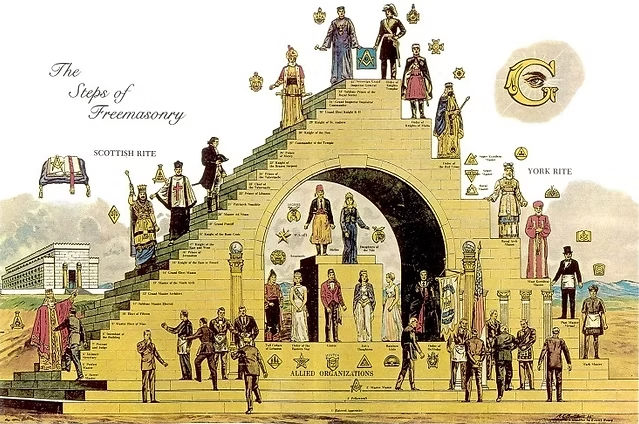
(The Steps of Freemasonry: Scottish / York rites, an image freely shared for distribution from any Masonic Lodge)
Previously,
Why are there 2 Completely Different Bloodlines of Joseph in Matthew and Luke?
(2/2) Why are there 2 Completely Different Bloodlines of Joseph in Matthew and Luke?
Now, the Conclusion:
For anyone interested in esoterica like freemasonry and Rosicrucianism, the image I outlined in the two previous posts of the path of substitutionary atonement sacrifice payment theology of Matthew vs the other path of repentance forgiveness theology of Luke, coming together as the vulgar combination of the 2 in Mark, will be familiar. Even in scholarship, Bart Ehrman with the Markan priority paradigm has to make the difficult argument that Mark was promoting sacrifice theology but unwittingly included forgiveness theology – which for Ehrman provides us with a window into the repentance position of the historical Jesus. Ehrman then has the difficult task of arguing there was no idea of Jesus’ death as a sacrifice prior to his death, but when followers had visions of him, they immediately concluded his death was meaningful and so must have been a substitutionary sacrifice.
Richard Carrier notes that ancient religions had an exoteric story that was sold to the masses and an esoteric core that was taught to the inner circle, as with the example of the story of Plutarch and the priestess of Isis. In the above freely shared Masonic image, we see the twofold path/progression of imagery with the Scottish Rite on one side of the Pyramid and the York Rite on the other. Freemasonry figuratively traces its lineage to the templar knights who supposedly had some great truth about Christ that threatened the church. Because of the secret they discovered they became ridiculously wealthy and powerful.
As a secular person, I am not involved in religious Rosicrucianism or freemasonry. To become a freemason, you have to swear allegiance on a religious book, so that’s not of relevance to me. Still, it’s interesting and we see the converging pyramid imagery everywhere, like on the all-seeing eye on the American 1-dollar bill:
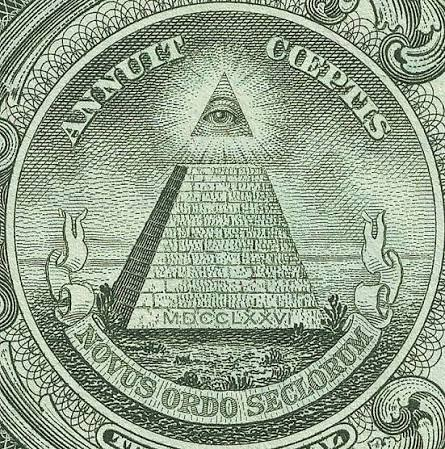
(wiki)
If you want to make an all-seeing eye, just make a circle with your hands and arms above your head and look at the shadow your body creates!
In philosophy, the converging of paths is best exemplified by Continental Productive Phenomenology, Hegel giving the example that was accidentally corrupted at press that a torn sock is better than a mended one: In the tearing, the hidden category of Unity is made conspicuous precisely “as” a lost unity. In my philosophy and religion posts on this blog, I’ve tried to capture the spirit of Hegel’s insight. I think Bradley Bowen is from the analytic tradition so his posts on this blog are different from mine.