



Thinkery Comics 2: Nietzsche
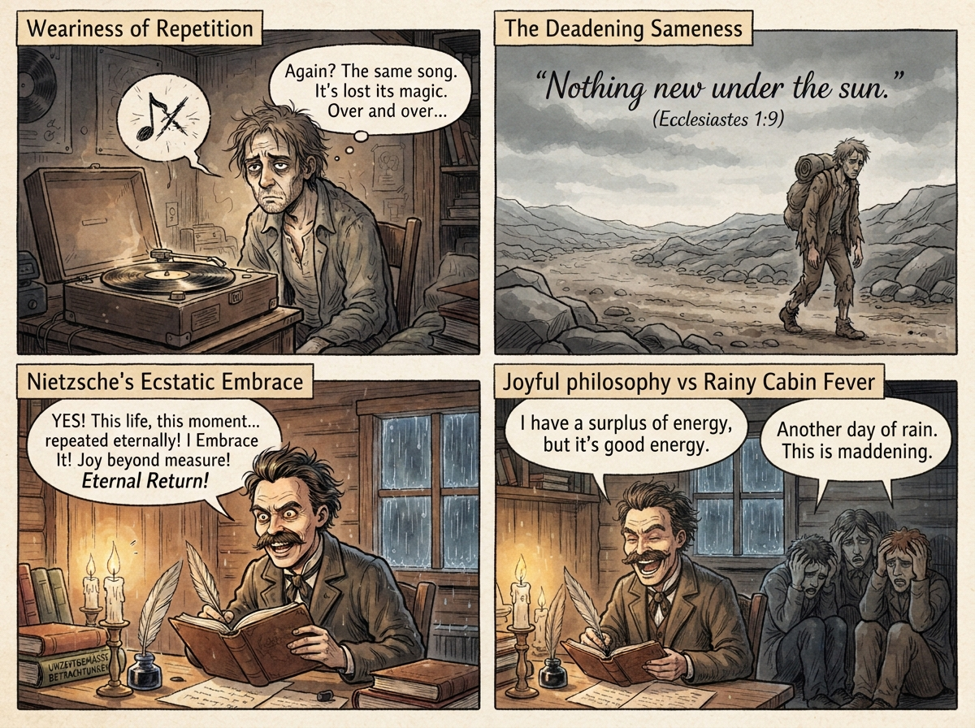
Background:
“The solitary speaks.”One receives as a reward for much ennui , ill-humour and boredom, such as a solitude without friends, books, duties or passions must entail, one harvests those quarters of an hour of the deepest immersion in oneself and nature. He who completely entrenches himself against boredom also entrenches himself against himself: he will never get to drink the most potent refreshing draught from the deepest well of his own being.”
― Friedrich Nietzsche, Human, All Too Human: A Book for Free Spirits
Eternal Return of the same is an idea made famous by Nietzsche but is also talked about by many thinkers such as in Ecclesiastes (“Nothing new under the sun”). If you have a tragic approach to life, beings lose their luster just by our spending time with them like a worn-out recording of a once favorite song. On the other hand, Nietzsche had a joyous approach to life so for example he delighted in writing his Untimely Meditation in a rainy cottage while his friends there suffered terrible cabin fever. In other words, Nietzsche once related in a letter to Overbeck his delight in working on his philosophy in a rainy cottage while his fellows, robbed of their distractions, had terrible cabin fever. Nietzsche was “in the zone.” The Greeks knew well that attaining the constancy of the movement of the stars was one of the great goals of philosophy.
Heidegger says
“To be absorbed by something … [means] ‘to be totally preoccupied by something , as for instance, when one says: He is entirely engrossed in his subject matter. Then he exists authentically as who he is, that is, in his task … Da-sein means being absorbed in that toward which I comport myself… To be absorbed in beholding the palm tree in front of our window is letting the palm tree come to presence, its swaying in the wind, is absorption of my being-in-the world and of my comportment in the palm tree. (Heidegger, Zollikon Seminar, 160-161)
Heidegger comments that
“Aristotle, Plato’s disciple, relates at one place (Nicomachean Ethics, Z 7, 1141b 77ff ) the basic conception determining the Greek view on the essence of the thinker: ‘It is said they (the thinkers) indeed know things that are excessive, and thus astounding, and thereby difficult, and hence in general ‘demonic (daimonia)’- but also useless, for they are not seeking what is, according to the straightforward popular opinion, good for man.’ … The Greeks, to whom we owe the essence and name of ‘philosophy’ and of the ‘philosopher,’ already knew quite well that thinkers are not ‘close to life.’ But only the Greeks concluded from this lack of closeness to life that the thinkers are then the most necessary – precisely in view of the essential misery of man (Heidegger, Parmenides, 100)”
Boss/Heidegger:
Our patients force us to see the human being in his essential ground because the modem ‘neuroses of boredom and meaninglessness’ can no longer be drowned out by glossing over or covering up particular symptoms of illness. If one treats those symptoms only, then another symptom will emerge again and again … They no longer see meaning in their life and … they have become intolerably bored (Heidegger, Zollikon, 160-161)
We see this with Seneca’s “nausea,” seasickness, which means profound boredom:
26. Some people suffer from a surfeit of doing and seeing the same things. Theirs is not contempt for life but boredom with it, a feeling we sink into when influenced by the sort of philosophy which makes us say, ‘How long the same old things? I shall wake up and go to sleep, I shall eat and be hungry, I shall be cold and hot. There’s no end to anything, but all things are in a fixed cycle, fleeing and pursuing each other. Night follows day and day night; summer passes into autumn, hard on autumn follows winter, and that in turn is checked by spring. All things pass on only to return. Nothing I do or see is new: sometimes one gets sick even of this.’ There are many who think that life is not harsh but superfluous. (Seneca ep. mor. 24. 26)
We see a similar thought about this eternal return of the same expressed in the Jewish tradition by Ecclesiastes: Ecclesiastes in the bible makes the point about the tedium and pointlessness of life because there is just a circular bad repetition ad nauseam of “the same” with the consequence that there is nothing new under the sun (Ecclesiastes 1:8-9), that life becomes inherently meaningless in the face of eternal recurrence:
All things are wearisome;
more than one can express;
the eye is not satisfied with seeing,
or the ear filled with hearing.
9 What has been is what will be,
and what has been done is what will be done;
there is nothing new under the sun.
Seneca says the rich are especially prone to boredom. In Epistle 24 Seneca says boredom can be such a problem that it leads to suicide. Life is seen not as bitter but superfluous, and one is prone to the libido moriendi or death drive. Seneca observed that some people seek death not out of great tragedy, but out of sheer exhaustion from the repetitive nature of life. He noted that both the highly educated and the ignorant could fall victim to this.
Like the historical analogy with Ecclesiastes and The Stoics, Nietzsche seems to very much have Schopenhauer in mind with eternal tragic temporal repetition. Schopenhauer said in On the Sufferings of the World:
“Boredom is a form of suffering unknown to brutes, at any rate in their natural state; it is only the very cleverest of them who show faint traces of it when they are domesticated; whereas in the case of man it has become a downright scourge. The crowd of miserable wretches whose one aim in life is to fill their purses but never to put anything into their heads, offers a singular instance of this torment of boredom. Their wealth becomes a punishment by delivering them up to misery of having nothing to do; for, to escape it, they will rush about in all directions, traveling here, there and everywhere. No sooner do they arrive in a place than they are anxious to know what amusements it affords; just as though they were beggars asking where they could receive a dole! Of a truth, need and boredom are the two poles of human life… [And in his essays on Pessimism Schopenhauer summarizes] “He who lives to see two or three generations is like a man who sits some time in the conjurer’s booth at a fair, and witnesses the performance twice or thrice in succession. The tricks were meant to be seen only once; and when they are no longer a novelty and cease to deceive, their effect is gone.”
To which Nietzsche responds to Schopenhauer regarding the performance from the point of view of the creative and artistic individual:
“56. Anyone like me, who has tried for a long time and with some enigmatic desire, to think pessimism through to its depths and to deliver it from the half-Christian, half-German narrowness and naivete with which it has finally presented itself to this century, namely in the form of the Schopenhauerian philosophy; anyone who has ever really looked with an Asiatic and supra-Asiatic eye into and down at the most world-negating of all possible ways of thinking – beyond good and evil, and no longer, like Schopenhauer and the Buddha, under the spell and delusion of morality –; anyone who has done these things (and perhaps precisely by doing these things) will have inadvertently opened his eyes to the inverse ideal: to the ideal of the most high-spirited, vital, world-affirming individual, who has learned not just to accept and go along with what was and what is, but who wants it again just as it was and is through all eternity, insatiably shouting da capo not just to himself but to the whole play and performance, and not just to a performance, but rather, fundamentally, to the one who needs precisely this performance – and makes it necessary: because again and again he needs himself – and makes himself necessary. – – What? and that wouldn’t be –circulus vitiosus deus? (Nietzsche, Beyond Good and Evil)
Eternal return wipes away meaningfulness from beings, and so this is tragic for the eros of glory seeking Achilles, but an opportunity for creation for the transfiguring godless agape of the artistic and healthy. Circular time devastates, like a favorite gospel song can go from presencing numinously to presencing irritatingly just by playing it on continual repeat. Heidegger quotes Nietzsche twice: “To stamp becoming with Being, that is the highest form of will to power.”