



The “Spirit” of Pride (It’s Pride Day here in Sydney, Nova Scotia Canada!)
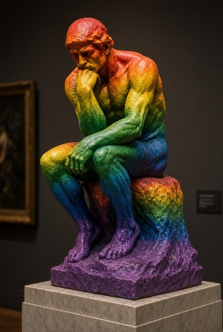
We speak in a vague way of mind, soul, and spirit, although when we eliminatethe intellect and the soulish passions, it’s unclear what would be left over as spirit. And yet we speak of spirit clearly when we say Zeitgeist, or acting in the spirit of justice, or the spirit of 76, etc. Sprit is the life force, like when we speak of spirits/ghosts. What is spirit and can etymology (word history) help us here?
Spirit fundamentally means “breath” or the animating vital principle, and its etymology clarifies why the word feels both concrete (as in life-force, ghosts, or “the spirit of ’76”) and elusive when contrasted with mind or soul.
The English word spirit entered in the mid-13th century from Anglo-French spirit / Old French espirit (modern French esprit), taken directly from Latin spīritus. Latin spīritus meant “a breathing, respiration, breath of the wind,” and by extension “breath of a god,” “inspiration,” “breath of life,” and thus “life itself.” It also covered disposition, character, vigor, courage, pride, or arrogance. The noun derives from the verb spīrāre (“to breathe, to blow”), possibly an onomatopoeic formation imitating the sound of breathing, or linked to a Proto-Indo-European root (s)peis- / (s)peys- (“to blow, breathe”). There are no strong direct cognates outside this Latin family. Related English words include inspire, expire, conspire, respire, and perspire.
In classical Latin, spīritus was primarily physical (air, breeze, breath). It later acquired philosophical and theological force as the invisible animating power. In Christian usage (especially the Vulgate translation of the Bible), it became the standard equivalent of Greek pneuma (“breath, wind, spirit”) and Hebrew ruach (also “breath, wind, spirit”). This is why early English uses often come from biblical contexts. The same breath-root appears across cultures: Greek pneuma and psychē (both ultimately tied to breathing), Hebrew ruach and neshama, and even Latin anima (source of “soul” and “animal,” from a different “breathe” root).
Distinctions from mind and soul
Mind, soul, and spirit are often used vaguely or interchangeably in ordinary speech, but their histories and traditional contrasts help:
Mind typically points to intellect, thought, cognition, or consciousness (Latin mens, related to memory and intention).
Soul (Old English sāwol, Germanic origin; Latin anima) more often denotes the individual living being, the seat of emotions, personality, moral life, or the animating principle tied to a particular body. It is what “has” life or individuality.
Spirit more readily suggests the pure life-force, the breath that comes from outside or above, the divine or impersonal animating energy, the immaterial residual (ghost), or the essential quality/disposition that can be shared or abstracted (courage, enthusiasm, “high spirits”).
Christian theology sometimes sharpened a distinction (soul as seat of emotions/personality; spirit as the higher, God-oriented, or purely vital aspect), though earlier periods treated the terms more fluidly, and biblical usage often overlaps them. When one tries to strip away intellect and “soulish” passions, what remains is often this residual sense of pure vitality, presence, or motivating force—precisely the “breath” idea. Many traditions treat spirit as the more universal or divine principle and soul as the individualized one.
Why “spirit of…” usages feel clear
Phrases like Zeitgeist (“spirit of the age/time,” from German Zeit + Geist), “the spirit of justice,” or “the spirit of ’76” (the animating qualities of the American Revolution) use spirit for the characteristic, intangible, driving quality or atmosphere of a thing, era, or ideal. This is a natural extension of the Latin sense of disposition, vigor, or essential principle. Geist itself is the Germanic cognate of English ghost (Old English gāst, originally “breath; spirit”), which is why “Holy Ghost” and “Holy Spirit” are synonyms. Spirits/ghosts as disembodied entities follow the same logic: the residual breath or vital force after the body is gone. Alcoholic “spirits” and the liquid in a spirit level continue the idea of a volatile, refined essence distilled from something.
Etymology therefore helps a great deal. It shows that spirit is not an arbitrary metaphysical label but a metaphor grounded in the most basic observable sign of life—breath. That metaphor expanded to cover the invisible force that makes something alive, energetic, characteristic, or transcendent. The vagueness arises because the same word was pressed into service for personal psychology, theology, folk belief in ghosts, and abstract collective qualities. When the intellectual and emotional layers are set aside, the core that remains is still this ancient sense of animating breath or vital principle. What is the spirit of life?
Last time I said in a note it needs to be kept in mind that whatever else philosophy was for the Greeks, the kind of thing we see Socrates doing was also a pastime. It’s puzzle overcoming, what Nietzsche called Will to Power, the spirit of life. We have jigsaw puzzles and sudoku and crossword puzzles and video games, but the Greeks had investigation and debate. Heraclitus saw this as a fundamental force of Life and gave the example of a child playing the skill game draughts. When we are absorbed in serious strategizing and problem solving, like when playing D&D or Risk, we are most alive. Nietzsche saw this will to overcome impasses as the basic force of life, like how an Elephant Ears plant’s leaves overcome their starting position and turn and strive toward the sunlight.
Our fundamental drive is to overcome our cabin fever, and so Nietzsche in a letter to Overbeck gives the example of delighting over creating his untimely meditation in a rainy cabin where his fellows were stripped of their distractions and were shack wacky. In the Politics Aristotle says only a beast or a god is at home in solitude. Plato had a good word for philosophy beginning in wonder in response to hitting an impasse or block in the path, literally an “aporia” that needed to be overcome.
This is the Spirit of Pride: Will to Power. This is not a question of domination but, to use a phrase of the pride icon Philosopher Michel Foucault, overcoming fascisms, both in society and in ourselves.
So, in Plato’s book on justice, the Republic, he talks in this way in the allegory of the cave going along according to our usual paradigm like the traditional definition of marriage when suddenly we see it does figurative violence to LGBTQ+ rights which can’t be appropriated by the traditional paradigm and definition, and so out of the spirit of justice we deconstruct the old paradigm and reconstruct it in a less violent, more inclusive way. This Epekeina tes ousias (ἐπέκεινα τῆς ουσίας) is a famous ancient Greek philosophical phrase from Plato’s Republic (509b). It means “beyond being” or “beyond essence.” Plato uses it to describe the ultimate Idea of the Good, which gives truth to all things that are known and power to the person who knows them, while surpassing them all in rank and worth. The first time Plato’s allegory was read in a way similar to this that I am aware of was Heidegger’s lecture course The Essence of Truth: On Plato’s Cave Allegory and Theaetetus (Based on a course of lectures delivered at the University of Freiburg in 1932). Will to Power isn’t power in the traditional sense of natural selection/survival of the fittest via Spencer and Darwin. As Nietzsche notes the weak often dominate the strong, such as a poor person suing a rich person in court or priests dominating a king.