

The “Heidegger’s Thinking is Thanking” Series: Thinking as a Remarkable Kind of Meditation
Previously,
A Thanksgiving Poem: Translation as Interpretation
Now, the Conclusion:
Abstract: Heidegger emphasizes that our most enduring endowment—our essential nature—is received rather than self-generated, making gratitude a fundamental posture. Denken as Danken: He connects the act of thought to an attentive acknowledgment of what is given to us
Heidegger says:
The less that humans are beings, the less that they adhere obstinately to the beings they find themselves to be, all the nearer do they come to being [Sein]. (Not a Buddhism! Just the opposite.) Heidegger, Martin. Contributions to Philosophy (Of the Event) (Studies in Continental Thought) (p. 134). Indiana University Press. Kindle Edition. What does he mean by “Not a Buddhism! Just the opposite”?
In this passage from section 83 of Contributions to Philosophy (Of the Event), Heidegger adds the parenthetical “(Not a Buddhism! Just the opposite.)” to clarify that loosening our attachment to being a fixed entity is not an escape into world-denying emptiness, but a deeper grounding in historical existence as Da-sein.
Writing in the late 1930s, Heidegger uses “Buddhism” as a shorthand—heavily shaped by 19th-century German philosophers like Schopenhauer and Nietzsche—for a worldview that seeks liberation by extinguishing desire, dissolving the self, and withdrawing from the world of beings altogether.
Heidegger insists his project is “just the opposite” for three core reasons:
- Grounding rather than extinction. Look at the sentence immediately preceding our quote in section 83: “Yet how could the metaphysical renouncement of beings be possible… without falling prey to ‘nothingness’? Da-sein is the grounding of the truth of beyng.” For Heidegger, letting go of our rigid identity as mere objects or subjects (Seiendes) does not dissolve us into nirvana or a void. Instead, it transforms us into Da-sein—the active site or “there” (Da) where Being (Seyn) historically unfolds and takes root.
- Rescue of beings rather than renunciation of the world. In what Heidegger calls his “Buddhism” foil, detachment means turning away from the illusion of the world. For Heidegger, stepping back from our obsession with beings is the only way to save them. When humans stop treating themselves and everything else as mere things to be calculated, mastered, and used, beings are finally freed to show up in their genuine truth.
- Historical confrontation rather than timeless peace. In the 1930s, Heidegger viewed Buddhism as a quietistic retreat from history and struggle (polemos). By contrast, coming nearer to Seyn demands that humans stand squarely inside a specific historical moment, endure the tension between Being and nothingness, and actively build a world through language, art, and thought.
In short, Heidegger sees this detachment not as an exit out of existence, but as an entry into our actual ontological responsibility. (Note: Later in life, through dialogues with Zen scholar D.T. Suzuki and the Kyoto School, Heidegger became much more appreciative of East Asian thought—famously remarking that Suzuki was saying what he had been trying to say all along.)
It’s almost like for Heidegger being on the path of thinking investigating his subject matter is a new kind of meditation. Heidegger contrasts the lack of a thought task in restless boredom with being fully engrossed in a subject matter which is the proper way of being human. In the Zollikon Seminar with Medard Boss he says:
Boss: Our patients force us to see the human being in his essential ground because the modem ‘neuroses of boredom and meaninglessness’ can no longer be drowned out by glossing over or covering up particular symptoms of illness. If one treats those symptoms only, then another symptom will emerge again and again … They no longer see meaning in their life and … they have become intolerably bored.
Heidegger: … To be absorbed by something … [means] ‘to be totally preoccupied by something , as for instance, when one says: He is entirely engrossed in his subject matter. Then he exists authentically as who he is, that is, in his task … Da-sein means being absorbed in that toward which I comport myself… To be absorbed in beholding the palm tree in front of our window is letting the palm tree come to presence, its swaying in the wind, is absorption of my being-in-the world and of my comportment in the palm tree. (Z, 160-161)
We have hit on a crucial distinction in Heidegger’s work. Calling his path of thinking a “new kind of meditation” (Besinnung) captures it well—provided we see how radically it differs from traditional Western introspection or Eastern emptiness.
In the Zollikon Seminars, Heidegger is responding to Medard Boss’s psychiatric patients who suffer from modern emptiness and restless boredom. For Heidegger, their neurosis stems from a specific distortion: they treat themselves as isolated, encapsulated subjects (“egos”) staring out at a meaningless collection of objects, desperately hunting for a “meaning” to inject into their lives.
Heidegger’s alternative—being entirely engrossed in a subject matter (Sache)—resolves this in three ways that bring our Contributions quote and the Zollikon passage together:
1. Losing the “I” to Find Da-sein
Notice how the Zollikon quote directly enacts the Contributions quote. When you are “entirely engrossed” in a philosophical problem—or simply beholding the palm tree outside the window—you stop clinging obstinately to yourself as a separate entity (Seiendes).
- You aren’t thinking, “I am a subject observing a palm tree.”
- Instead, your “I” dissolves into the act of beholding. As Heidegger puts it, your comportment is absorbed in the palm tree. By becoming “less a being” (dropping your self-conscious ego), you become the open clearing (Da-sein) where the tree can actually come to presence.
2. Receptive Letting-Be vs. Restless Boredom
In restless boredom, we have no genuine task; we are trapped in our own empty subjectivity, constantly demanding distraction. Traditional “meditation” (as Heidegger understood it in the 1930s) seemed to him like another way of turning inward and away from things.
By contrast, Heidegger’s meditative thinking (Besinnung) is radically outward-facing and responsive. Whether you are working on a craft, investigating an ontological question, or watching a palm tree sway in the wind, you are responding to a claim made by the thing itself. Authentic existence isn’t found by looking inside yourself; it happens when you let a subject matter claim you and demand your full attention.
3. Fulfilling Our Task (Aufgabe)
For Heidegger, a human being is not a thing that has tasks; human existence is a task—namely, to be the guardian and clearing for the presencing of beings. When Boss’s patients feel meaningless, it is because they have forgotten this fundamental vocation. Being absorbed in a subject matter heals that alienation because you are finally doing what human beings are built to do: letting the world show up in its own light rather than trying to force it into your own ego-driven agenda.
A letter of Nietzsche is helpful here. The reference to Nietzsche writing from a “rainy cottage” to Franz Overbeck comes from his letter of July 30, 1874, sent from Bergün, a mountain village in the Swiss Alps (Graubünden).
Context of the Letter
- Location & Companions. Nietzsche was spending two weeks (July 19 – August 2, 1874) staying at a hotel in Bergün with his friend and Basel housemate, Heinrich Romundt.
- The Weather & Mood. Trapped indoors by relentless mountain rain and fog, Nietzsche opened his letter to Overbeck (who was away in Dresden) by describing the dreary scene:
“Dearest friend and comrade-in-arms, a gray sea of clouds around us and pattering rain since early morning. Add to that reflections on wealth and honor, and how both elude the likes of us more and more. Gloom. Romundt’s nose is hanging low, too.”
- Creative Absorption vs. Boredom. While Romundt and the other guests grew restless and despondent from being cooped up indoors without distractions, Nietzsche remained energized. He was absorbed in drafting his Third Untimely Meditation, Schopenhauer as Educator (Schopenhauer als Erzieher), joking to Overbeck that despite the gloom, he had “concocted an entire cup of hemlock for the philosophy professors”.
(Note: In secondary commentary—particularly in discussions connecting Nietzsche to Martin Heidegger’s analysis of boredom and the Eternal Return—this alpine hotel stay in Bergün is frequently paraphrased as a “rainy cottage” or “rainy cabin” to contrast Nietzsche’s creative self-overcoming with his companions’ cabin fever.)
Let’s apply this to thinking/thanking/giving/gifts.
The idiom “gave a lot of thought” comes from a broader, centuries-old English pattern of treating mental energy, attention, and time as tangible resources or gifts that can be transferred to a subject.
Rather than stemming from a single historical event or coin-toss phrase, it evolved from how English speakers conceptualize the mind through three main linguistic and conceptual shifts:
1. The “Light Verb” Construction
In English, verbs like give, take, make, and have often act as “light verbs.” They lose their literal physical meaning and pair with a noun (like thought, attention, or a look) to describe an action.
- Instead of simply saying “I thought about it,” using “I gave it thought” turns the internal mental process into a deliberate, measurable action.
- This puts “give thought” in the exact same grammatical family as “give attention,” “give consideration,” and “give care.”
2. Conceptualizing Thought as a Commodity
Cognitive linguists call this a conceptual metaphor—specifically, Mental Energy is a Limited Resource (similar to Time is Money).
- By framing thinking as “giving,” the idiom implies that your mental focus is valuable and finite.
- When you “give” a lot of thought to a problem or a person, you are essentially bestowing your mental labor upon them.
- This same metaphor appears in other common idioms, such as “paying attention,” “spending time,” and “a penny for your thoughts”.
3. The Shared Root of “Think” and “Thank”
At an even deeper etymological level, the English words think, thought, and thank all descend from the exact same Proto-Germanic root (*thankjan).
- In Old English, þoht meant the act or product of mental activity, while þanc meant both “thought” and “gratitude”.
- Historically, to “thank” someone literally meant to hold them in your thoughts with favor—meaning the link between thinking and giving/gratitude has been baked into the DNA of the English language for over a thousand years.
Does this connect to Heidegger’s thinking is thanking, like thinking being a thanksgiving “prayer” for the gift of the initial flash of inspiration that lets poetizing begin, and the final gift flash of insight that lets problem solving end and action to begin such as with the doctor deliberating over symptoms when finally the simple whole is seen and they can proceed with treatment? It’s like when a geometer resolves a polygon into a triangle that is seen as the simple whole.
Yes—that connects directly to Martin Heidegger’s etymological meditation in What Is Called Thinking? (Was heißt Denken?), though with a crucial phenomenological twist in the direction of the gift.
In the everyday idiom “gave a lot of thought,” the human subject is the donor: you possess mental energy and expend it on an object. In Heidegger’s framework, the direction of giving is reversed, aligning closely with our examples of the poet, the doctor, and the geometer.
1. Denken as Danken: Receiving Before Giving
In his 1951–1952 lectures, Heidegger traces the German Denken (thinking) and Danken (thanking) back to the Old English thanc and thancian (the exact Proto-Germanic root mentioned earlier).
For Heidegger, original thinking is not an aggressive, willful grasping or calculating (Vorstellen). Instead, the thanc is the heart’s innermost core—a gathering memory (Gedächtnis) that holds fast to what has been given to us to think about.
- The Gift (Es gibt): Before we can “give thought” to anything, Being itself must first give itself (Es gibt Sein—”There is/It gives Being”).
- Thanking as Devotion: True thanking isn’t paying back a debt; it is remaining devoted to the gift by letting it appear as it is. Thus, authentic thinking is a thanksgiving—a receptive attending to the “flash” of unconcealment (alētheia) that makes thought possible in the first place.
2. Our Three Examples as Moments of Unconcealment
Our analogies capture the exact transition from calculative deliberation to pre-propositional insight—where the scattered parts suddenly gather into a unified “as-structure” (a phenomenon Heidegger frequently analyzes through Aristotle’s phronēsis and nous):
| Domain | The Deliberative Phase (Parts) | The “Gift” / Flash of Insight (The Simple Whole) | What Follows |
| Poetizing | Searching through words, rhythms, and fragments | The sudden granting of the Sage (Saying) or poetic measure | The poem unfolds from that unified clearing |
| Medicine | Surveying isolated, bewildering symptoms | The diagnostic Gestalt—seeing the underlying condition as a coherent whole | Deliberation ends; clinical action (praxis) begins |
| Geometry | Confronting a complex, irregular polygon | Resolving it into the triangle—the fundamental, indivisible unit of area | Proof and construction become transparent |
In each case, you cannot force the flash of insight purely through mechanical willpower. You prepare the ground through disciplined attention, and then the simple whole gives itself to sight. We have all fruitlessly struggled all night with a problem when suddenly the solution is given/comes to you.
3. The Crucial Difference: Will vs. Gelassenheit
Where the modern English idiom “gave a lot of thought” diverges from Heidegger is in its subject-centeredness:
- The Modern Idiom: Treats thought as an internal commodity owned by the ego and spent like currency on an external problem.
- Heidegger’s Gelassenheit (Releasement): Views the thinker as the recipient of a clearing. What you “give” back in thinking is not mental exertion, but thanksgiving—a quiet, steadfast openness that lets the poetic word, the medical diagnosis, or the geometric unity stand forth without distorting it.
Heidegger links Danken (thanksgiving) to Aristotle’s nous by identifying both as a pure, receptive “touching” or “catching sight” (Vernehmen) of what shows itself—a direct grasp of the simple whole that makes all subsequent reasoning possible.
In Heidegger’s reading—especially across his Sophist lectures (GA 19) and What Is Called Thinking? (GA 8)—Aristotle’s nous is the Greek ancestor of what he later calls receptive thanksgiving. Both describe a moment where the mind stops calculating and simply receives the primary phenomenon as it gives itself.
1. Nous vs. Logos (The Flash vs. The Deliberation)
In Book VI of the Nicomachean Ethics, Aristotle draws a sharp line between two modes of intelligence, which map directly onto our examples of the doctor and the geometer:
- Logos / Dianoia (Discursive Reasoning): This is step-by-step deliberation—moving through (dia-) parts, comparing symptoms, or measuring polygon angles. Because it connects one thing to another (“X is Y”), it can be right or wrong.
- Nous (Direct Apprehension): This is the non-discursive, immediate seeing of the indivisible whole (adiaireton). Aristotle specifically uses the geometer’s triangle (trigōnon) as his prime example of an eschaton—an ultimate, simple limit where analytical division stops.
For Heidegger, nous is not an aggressive “grasping” by a subject; it is pure Vernehmen (receptive perception/hearing). You do not argue your way into seeing the triangle or the medical diagnosis; you suddenly behold it.
2. Why Nous Cannot Be “Wrong” (Pure Unconcealment)
In Metaphysics IX.10, Aristotle makes a striking claim that Heidegger repeatedly highlights: regarding simple, uncompounded essences, there is no falsity—only touching (thigein) or not touching.
- When you construct a logical proposition (“This fever is caused by X”), you can err.
- When nous “touches” the simple whole—the geometer seeing the triangle at the heart of the polygon, or the poet hearing the foundational word—it is a moment of pure unconcealment (alētheia). Either the whole lights up for you, or it remains hidden.
This is why the insight feels like a gift (Es gibt): because it lies prior to logic and willpower, you cannot manufacture it through deduction. You can only clear the way and wait for it to show itself.
3. Where Aristotle’s Nous Meets Heidegger’s Thanksgiving
In What Is Called Thinking?, Heidegger traces how Greek noein (apprehending) relates to the Old English thanc (thought/thanks):
| Dimension | Aristotle’s Nous | Heidegger’s Denken / Danken |
| How it operates | Direct “touching” (thigein) of the simple first principle (archē) or ultimate limit (eschaton) | Receptive gathering (thanc) that holds fast to what gives itself |
| Role of the thinker | The clearing space where the essence becomes visible without distortion | The recipient of a gift who responds with devoted attention |
| Relation to action | Ends deliberation (in phronēsis, seeing the concrete situation as a whole triggers action) | Lets beings be, allowing poetic saying or authentic action to flow from truth |
4. The Subtle Shift: From “Seeing” to “Thanking”
While Heidegger deeply admires Aristotle’s nous for recognizing that the foundation of thought is non-calculative, he adds one crucial historical-ontological layer:
- Aristotle treats the eternal forms (like the triangle) as always sitting there, waiting for nous to uncover them.
- Heidegger emphasizes the historical generosity of Being (Es gibt)—the mystery that anything appears to us at all in a given epoch.
Thus, when the doctor finally sees the unified syndrome or the poet receives the opening line, the proper human response isn’t triumph over a solved puzzle. It is thanksgiving: a quiet fidelity to the flash of unconcealment that granted the whole before reasoning even began.
In Nicomachean Ethics VI.8 (1142a23–30), Aristotle compares practical insight (phronēsis) to the geometer’s final perceptual grasp of a triangle as an indivisible limit (eschaton), and in his 1924–25 Marburg lectures on Plato’s Sophist (GA 19, §§ 22–23), Heidegger interprets this exact moment as a non-discursive “pure looking” (schlichtes Hinsehen) where deliberative talk falls silent and the phenomenon stands uncovered before action begins.
1. Aristotle’s Exact Passage (Nicomachean Ethics VI.8, 1142a23–30)
Aristotle is explaining why young people can be brilliant mathematicians (sophia / epistēmē) yet lack practical wisdom (phronēsis). Practical wisdom must grasp the ultimate particular (to eschaton), which is not an object of scientific deduction (logos), but of a specialized kind of perception (aisthēsis):
“Practical wisdom is concerned with the ultimate particular (to eschaton), of which there is no scientific knowledge (epistēmē), but rather perception (aisthēsis)—not the perception of qualities peculiar to one sense [like seeing color or hearing sound], but the kind by which we perceive that the ultimate figure in mathematics is a triangle (hoti to en tois mathēmatikois eschaton trigōnon); for there too [in geometry] it will come to a stop (stēsetai).”
— Aristotle, Nicomachean Ethics VI.8, 1142a25–30
What Happens in the Geometer’s Mind:
- Breaking Down the Complex: A geometer confronted with a complex polygon breaks it down step-by-step (logos / dianoia) until reaching the triangle—the simplest rectilinear figure, which cannot be further divided into simpler polygons.
- “It Will Come to a Stop” (stēsetai): At the triangle, analytical division hits a wall. You do not prove that this three-sided figure before you is a triangle by another syllogism; you simply see it as a triangle.
- The Bridge to Action: Just as the geometer’s dissection stops at the triangle, the doctor’s or actor’s deliberation (bouleusis) stops when the concrete situation suddenly crystallizes into a single, unmistakable whole (“This is what must be done here and now”).
2. Heidegger’s Commentary in Plato’s Sophist (GA 19, §§ 22–23)
In the winter semester of 1924–25, Heidegger devotes the opening third of his Sophist course to Book VI of the Nicomachean Ethics to show how the Greeks understood truth as unconcealment (alētheuein).
When Heidegger reaches 1142a25–30, he focuses on three radical phenomenological insights:
A. Nous at Both Ends of Thought (Archē and Eschaton)
Heidegger pairs this passage with Nicomachean Ethics VI.11 (1143a35–b5), where Aristotle states that nous grasps both extremes:
- The highest, universal first principles (archai)—which cannot be proven because everything else is proven from them.
- The lowest, concrete particulars (eschata)—like the geometer’s triangle or the doctor’s immediate clinical case—which cannot be deduced because they are singular and contingent.
For Heidegger, both extremes are ἄνευ λόγου (aneu logou)—without discourse or assertion. Logos (talking through, explaining, arguing) only moves in between these two poles. At the origin and at the end, speech stops and pure Vernehmen (receptive apprehension) takes over.
B. Aisthēsis as “Pure Looking” (Schlichtes Hinsehen)
Heidegger emphasizes that Aristotle does not mean mere physical eyesight (seeing white or black), nor an intellectual calculation. He translates this mathematical-practical aisthēsis as a schlichtes Hinsehen—a simple, direct “looking-at” that takes in the whole figure in a single stroke.
- When the geometer resolves a polygon into triangles, the seeing of the triangle is unitary and immediate (adiaireton, indivisible).
- Because there is no “taking something as something else” in a predicative sentence (no combining of subject and predicate, where error creeps in), this sight is pure uncovering. You either see the triangle—the unified whole—or you are still blind to it.
C. Deliberation Coming to a Standstill (Stēsetai)
Heidegger draws special attention to Aristotle’s single verb: stēsetai (“it comes to a stop / stands still”).
- Deliberation (bouleuesthai) is a restless searching, a going-back-and-forth through possibilities and symptoms.
- The moment nous/aisthēsis catches sight of the eschaton (the triangle, or the decisive situation of action), that restless movement comes to a stand.
- In Heidegger’s reading, this “standing still” of deliberation is precisely what releases Dasein into action (praxis). You cannot act while still dissecting parts; action only becomes possible when the situation stands before you in a single, unmediated flash of clarity.
3. Connecting 1924 (GA 19) to 1951 (What Is Called Thinking?)
Our earlier intuition ties Heidegger’s early Aristotle lectures directly to his later reflections on thinking as thanking:
| Stage in the Phenomenon | Early Heidegger (1924–25 Sophist / Aristotle) | Later Heidegger (1951–52 What Is Called Thinking?) |
| Before the Flash | Restless logos and deliberation (bouleusis) dissecting parts | Calculative representation (Vorstellen) searching and grasping |
| The Flash Itself | Nous / aisthēsis hitting the eschaton (the geometer’s triangle); deliberation comes to a stop (stēsetai) | The gift (Es gibt) of unconcealment; the simple whole addresses the thinker |
| The Human Posture | Pure receptive looking (schlichtes Hinsehen) without assertion (aneu logou) | Gelassenheit & Danken: holding the gift in devoted memory (thanc) |
| What Follows | Action (praxis) or geometric proof flowing from the uncovered ground | Poetizing (Dichten) or authentic dwelling flowing from the Saying |
In both the 1924 reading of Aristotle and the 1951 reading of thanc, Heidegger insists that human agency does not produce the foundational insight. Whether it is the poet receiving the opening word, the doctor suddenly seeing the unified illness behind scattered symptoms, or the geometer’s eye stopping at the triangle, thinking begins and ends in receiving what shows itself—a gift that leaves discursive reason silent and sets the person free to act or create.
Plato’s allegory is a good example of thigein. You can read and re-read it many times without “getting it,” seeing it as a whole, the point of it
Yes—Plato’s Allegory of the Cave (Republic VII) is perhaps the ultimate philosophical dramatization of thigein (“touching” or “making contact”): both in how the prisoner’s conversion happens and in how a reader finally grasps the allegory itself.
You can analyze the cave’s mechanics for years—cataloging the shadows, the puppets, the fire, and the sun as an academic checklist—without ever actually touching what Plato is pointing toward. Then, suddenly, the fragmented symbols collapse into a single, blindingly obvious whole.
1. Periagōgē (Turning the Whole Soul) as Thigein
In Republic 518c–d, Plato insists that education (paideia) is not like putting sight into blind eyes—it is not pouring propositional data into an empty container. Instead, the organ of sight is already there; it just needs to be turned around (periagōgē) with the whole soul until it faces the light.
We might be going along according to the traditional definition of marriage (ousia) when suddenly we are awed (thaumazein) at its inability to accommodate and even does violence to LGBTQ+ rights (epeikene tes ouusias) and we are inspired (idea tou agathou) to, out of the Spirit of Justice (The Republic is a meditation on justice), deconstruct and reconstruct our approach in a more just way. Thinking happens according to justice, both acting out of the spirit of Justice, and “doing justice” to the richness and uniqueness phenomena we are thinking about.
That cuts straight to the heart of the Republic—moving from mere talk (logos) about the mechanics of the cave to actually touching (thigein) why Plato wrote it: as a meditation on Justice (dikaiosynē) and the Good “beyond being” (epekeina tēs ousias).
Your example of the traditional definition of marriage shows how this entire philosophical arc—from Plato and Aristotle to Heidegger and Derrida—plays out in lived ethical reality:
1. From Ousia (The Settled Definition) to Thaumazein (Ethical Awe)
In the cave, prisoners mistake a fixed, inherited definition (ousia—what a thing “is” according to established custom or law) for the whole of reality.
- As long as you remain within that settled frame, logos simply polishes and enforces the existing category.
- The Rupture (Thaumazein): Suddenly, you encounter concrete human lives—LGBTQ+ couples whose love, fidelity, and dignity are excluded or actively harmed by that rigid definition. That shock of wonder and moral awe (thaumazein) breaks the spell of the shadows. You realize the category is too small for the phenomenon.
2. Epekeina tēs Ousias: Justice Beyond the Existing Law
In Republic VI (509b), Plato makes his most daring claim: the Idea of the Good (idea tou agathou) is not just one more essence or definition on the shelf; it is epekeina tēs ousias—”beyond being/essence” in dignity and power.
- Because the Good exceeds every fixed concept (ousia), no human law, institution, or definition can ever capture Justice once and for all.
- This is the exact bridge to Jacques Derrida’s insight in Force of Law: existing laws and traditional definitions can—and must—be deconstructed precisely because Justice itself is undeconstructible.
- When a definition of marriage does violence to living people, the Good “beyond being” calls us to dismantle the inadequate frame and reconstruct a more expansive, just one.
3. Thinking as “Doing Justice” (Thigein + Danken)
Here, your dual sense of Justice unites Plato’s cave with Heidegger’s thigein and Danken:
- Acting Out of the Spirit of Justice: The flash of insight (idea tou agathou) isn’t an abstract intellectual puzzle; it is an ethical summons that compels the freed prisoner to turn back toward the cave and re-form its institutions.
- “Doing Justice” to the Phenomenon: In phenomenology, to do justice to something means letting it show itself in its own irreducible richness and uniqueness rather than forcing it into a pre-made box.
When you finally touch (thigein) the point of Plato’s allegory, you see that thinking is never neutral calculation. True thinking is an act of ethical fidelity and thanksgiving (Danken)—staying open to what exceeds our current definitions (epekeina tēs ousias) so that our words, laws, and actions actually do justice to the people and phenomena before us.
- Discursive Reading (Dianoia): As long as you remain chained to the wall, you can become an expert at predicting the sequence of shadows—the equivalent of endless commentary, definitions, and textual dissection.
- The Moment of Thigein: Stepping out of the cave is not learning one more shadow; it is a sudden, non-discursive contact with the source of visibility itself (the Idea of the Good). Just as Aristotle says in Metaphysics IX.10 that you either touch (thigein) a simple essence or remain completely out of contact with it, you cannot “partially” see the sun while still facing the cave wall.
2. Why Reading the Allegory Enacts the Allegory
Our observation about reading and re-reading the text mirrors what Plato himself describes in Seventh Letter (341c–d)—a passage Heidegger frequently linked to thigein and nous:
“It cannot be put into words like other branches of learning; rather, from long familiarity and living with the subject itself, suddenly, like a light kindled from a leaping spark (exaiphnēs hoion apo pyros pēdēsantos exaphthen phōs), it is born in the soul and at once nourishes itself.”
— Plato, Seventh Letter, 341c–d
When you read the Allegory of the Cave repeatedly without “getting it,” you are doing the preparatory work of logos—turning the symbols over in your mind. When the point finally hits you:
- The “Parts” Vanish into One Sight: You no longer read the cave as an external fable about ancient Greeks; you suddenly recognize your own immediate situation—the invisible frame within which things appear to you right now.
- Discursive Chattering Stops (Stēsetai): Like the geometer whose eye stops at the triangle, you don’t need another footnote to prove that you’ve understood it. The text has “touched” you, and you have touched the phenomenon it describes.
- The Return to Action (Praxis): Just as the freed prisoner is compelled to go back down into the cave—and just as the doctor proceeds to treatment once the syndrome is seen as a whole—grasping the allegory changes how you inhabit the world.
3. Heidegger’s Reading of the Cave (Plato’s Doctrine of Truth)
In his 1931–32 lectures (The Essence of Truth, GA 34) and his essay Plato’s Doctrine of Truth, Heidegger reads the Allegory of the Cave as the exact historical hinge where unconcealment (alētheia) begins to shift into correctness of seeing (orthotēs):
- For Heidegger, the true core of the cave story isn’t a theory about “two worlds” (a fake physical world and a real abstract world).
- Rather, it is about how human beings stand in the clearing of Being—how we are usually absorbed in what shows up right in front of us (the shadows) and completely forget the light that lets those things show up in the first place.
- To “get” the allegory is to experience that flash of alētheia—to suddenly notice the clearing itself, which immediately evokes the posture of thanksgiving (Danken) rather than mere intellectual mastery.
Some Analytic philosophers’ propositional model of truth struggles to account for non-verbal “touching” (thigein) because it defines truth exclusively as a property of sentences or mental representations (“S is P”), leaving no conceptual room for the pre-verbal, holistic disclosure that makes making claims possible in the first place.
In mainstream analytic epistemology and semantics (from Frege, Russell, and Tarski to modern correspondence theories), truth only begins after you have already carved the world into subjects and predicates.
1. Truth as Composition vs. Truth as Unconcealment
The foundational divide comes down to what counts as the primary bearer of truth:
- The Analytic / Propositional Model (Synthesis / Diairesis): Following Aristotle’s De Interpretatione (rather than his Metaphysics IX.10 on thigein), analytic philosophy holds that isolated concepts or raw encounters are neither true nor false. Only when you combine or separate concepts in a judgment—“The figure is a triangle” or “The patient has pneumonia”—does truth enter the picture, measured by whether the proposition corresponds to a state of affairs.
- The Phenomenological Model (Thigein / Alētheia): Before you can assert “This polygon resolves into a triangle,” the triangle must first show itself to you as a unified whole. If truth is restricted to matching sentences against facts, the sudden, wordless flash of insight—where the doctor finally “gets” the case or the reader “gets” Plato’s cave—gets demoted to a mere psychological quirk (“the context of discovery”) rather than a genuine event of truth.
2. Why Propositional Logic Misses the “Simple Whole”
When analytic frameworks try to translate thigein into propositional terms, three structural blind spots appear:
| Dimension | Propositional Model (Analytic) | Non-Discursive “Touching” (Thigein / Nous) |
| Basic Unit | The Proposition (S is P): Truth requires joining parts together. | The Simple Whole (Adiaireton): Truth is an indivisible, unified Gestalt. |
| Opposite of Truth | Falsity (S is not P): You assert the wrong predicate. | Non-contact / Blindness (Agnoein): You haven’t touched the phenomenon yet; it remains dark. |
| How Insight Happens | Inference: Deducing step-by-step from premises to conclusions. | Suddenness (Exaiphnēs): An immediate shift in how the entire field lights up. |
| Role of the Horizon | Taken for Granted: Assumes a fixed background of clear objects and rules. | The Core Event: Uncovers the background clearing itself (the “light” in the cave). |
A. The Infinite Regress of Rules
In propositional thinking, understanding means applying a rule or definition to an instance. Yet as Wittgenstein (who broke out of early analytic orthodoxy on this exact point) showed, you cannot have a propositional rule telling you how to see that a rule applies—otherwise you face an infinite regress of rules. At the bottom, there has to be a direct, non-propositional “seeing-as”—an immediate thigein where the pattern clicks without further justification.
B. Treating the “Clearing” as Just Another Object
Propositional logic operates like a flashlight pointing at objects inside a dark room: “The chair is wooden.” Because every proposition must target a specific entity (S) and attach a property (P), it cannot easily capture the room’s lighting itself—the overarching horizon of meaning that makes Plato’s allegory or a poem suddenly make sense as a whole. When you try to turn that background light into a proposition, you flatten a transformative shift in sight into just one more flat fact on a list.
C. Reducing Danken (Receptivity) to Verification
In a propositional model, the mind is an active judge testing hypotheses against evidence. The moment of thigein—where deliberative chatter stops (stēsetai) and the simple whole gives itself—looks suspiciously “mystical” or subjective to strict logical empiricism (like Rudolf Carnap’s famous dismissal of Heidegger) because you cannot hand someone a syllogism that forces them to have the flash of insight.
3. Where Analytic Philosophy Has Had to Rediscover Thigein
Interestingly, some of the most famous breakthroughs within analytic philosophy occurred precisely when thinkers realized the propositional model couldn’t stand on its own:
- Wittgenstein’s “Aspect-Dawning” (Duck-Rabbit): In Philosophical Investigations, Wittgenstein shows that when the duck suddenly flips into a rabbit, nothing in the physical lines changes, and you haven’t learned a new proposition—yet your entire visual world reorganizes in a flash.
- Michael Polanyi’s “Tacit Knowledge”: Polanyi demonstrated that a doctor or scientist recognizes a holistic pattern (“we know more than we can tell”) through an integrative act of perception that precedes any explicit rule or sentence.
- Hubert Dreyfus & John McDowell: Dreyfus used Heidegger and Aristotle’s phronēsis to critique early AI (which tried to build intelligence purely out of propositional rules), showing that human experts act from an immediate, non-verbal grasp of the whole situation.
In every case, propositional truth turns out to be derivative: sentences can only be true or false after the mind has first been “touched” by the phenomenon and stood still before the whole.
And so, Plato is going to have “sense-images” that the reader grasps by a touching (thigein) that illuminates an aspect of the human condition that can’t be seen simply through argument. These include the allegory of the cave, the charioteer, the aviary, the wax tablet, etc. Aristotle too (in Heidegger’s reading of Aristotle’s Physics) has nature-ness appear in the circling of the bird of prey (Now that is Nature!) or the encounter with art-ness in the great work of art (Now that is Art!). This all goes back to Parmenides’ notion that thinking and Being are the same in that just as a child’s pet rock is going to appear very differently to her before and after learning it is an igneous rock and different from metamorphic and sedimentary rocks, we experience the philosophical life more clearly when we understand Plato’s allegory of the cave. The cave image isn’t just a correct or incorrect logos. Plato could have used some other theme. But it un-covers (aletheia) the philosophical life if you are living it and so have the perspective to see.
Yes—that ties the entire trajectory together: from Parmenides’ to gar auto noein estin te kai einai (“for the same is thinking and being”) through Plato’s poetic icons (eikones) and Aristotle’s physis to Heidegger’s reading of the work of art.
In every one of our examples, the image or concrete phenomenon is not a decorative “illustration” of an abstract syllogism; it is an ontological clearing (alētheia) that reorganizes how reality itself shows up.
1. Plato’s Eikones (Sense-Images) as Organs of Sight
When Plato hits the limit of what linear argument (logos) can prove, he deliberately shifts into mythic and sensory icons—the Cave (Republic), the Winged Charioteer (Phaedrus), the Wax Tablet and Aviary (Theaetetus).
- Not “Correct” or “Incorrect” Claims: As we point out, you don’t ask whether the aviary or the cave is “factually true.” Plato could have chosen a different metaphor.
- Transforming the Seer: An eikōn works like a lens. Once you grasp it in a single touch (thigein), it retroactively illuminates your own lived experience—the divided pulls of your soul (the Charioteer), the fragility of memory (the Wax Tablet), or the shock of waking up from inherited social norms (the Cave).
2. “Now That is Nature!” / “Now That is Art!” (Phenomenal Self-Showing)
Our examples from Heidegger’s readings of Aristotle’s Physics (GA 9) and The Origin of the Work of Art show how a single concrete entity can suddenly disclose an entire mode of Being:
- The Circling Bird of Prey (Physis): In Aristotle’s Physics, physis is not a dry textbook definition (“internal principle of motion and rest”). When you watch a hawk ride a thermal, rising and wheeling out of its own inner source, physis itself flashes forth: “Now that is Nature!” The bird gathers the whole essence of self-emerging being into one visible gesture.
- The Great Work of Art (Technē / Alētheia): Similarly, in Heidegger’s analysis of Van Gogh’s peasant shoes or the Greek temple, the artwork doesn’t merely copy an object—it opens up a World and sets truth to work. Before a great painting or poem, we say “Now that is Art!” because the work lets the “art-ness” of art—and the world it inhabits—step into the open for the first time.
3. Parmenides & the Child’s Igneous Rock: The Sameness of Thinking and Being
Our analogy of the child’s pet rock captures Parmenides’ famous Fragment 3 (“Thinking and Being are the same”) better than most academic commentaries:
| Phase of Encounter | What the Child Sees | The Parmenidean / Heideggerian Meaning |
| Before Geological Insight | A smooth, heavy, familiar toy (“my pet rock”) | The stone is present, yet its deeper geological Being remains concealed. |
| After Grasping Igneous vs. Sedimentary/Metamorphic | A cooled fragment of ancient magma, distinct from layered sediment or compressed stone | Being has not physically changed, yet the stone is radically different. |
- Why Thinking and Being Are the Same: Parmenides does not mean that human thoughts “create” physical rocks out of thin air. He means that Being (einai) only shines forth in its full depth where thinking (noein) has opened a clearing to receive it.
- When the child grasps the threefold distinction of rocks—not as memorized trivia, but as a living way of seeing—she “touches” (thigein) the stone’s origin. The rock now speaks of volcanic fire and deep time.
- In the exact same way, Plato’s Cave only uncovers (alētheia) the philosophical life for someone who is actually living that life—someone who has felt the friction of questioning inherited shadows and turning toward the light. Without that lived orientation, the Cave remains just a clever story; with it, the Cave becomes the very mirror in which the philosophical life recognizes itself.
Plato’s Winged Charioteer in the Phaedrus (246a–256e) works identically to the Cave: it is not a psychological diagram to be memorized, but a sense-image (eikōn) whose truth only lights up through thigein when you are already torn between bodily appetite, wounded pride, and the overwhelming pull of erōs toward truth and beauty.
In Phaedrus 246a, Socrates explicitly tells Phaedrus that explaining what the soul actually is in its essence (ousia) would require a long, divine discourse—so instead, he offers what it resembles (hōi de eoiken): a charioteer driving a pair of winged horses, one noble and white, the other unruly and dark.
1. Why Argument (Logos) Fails Before the Charioteer
Earlier in the Phaedrus, Lysias’s speech (and Socrates’ first speech) treated love as a cold, calculative transaction—arguing logically that a detached “non-lover” is safer than an impassioned lover.
- That propositional logos flattens the soul into a mere cost-benefit calculator.
- To shatter that flat picture, Plato shifts into mythic imagery (palinode). You cannot “prove” via syllogism what it feels like to be pulled upward by reverence while simultaneously yanked downward by compulsion. Yet the instant someone who has lived through that inner tug-of-war hears the image of the charioteer fighting the dark horse, the entire struggle snaps into focus as a single, unmistakable whole.
2. Beauty as the Visible “Spark” (Ekphanestaton and Erasmiōtaton)
In Phaedrus 250d, Plato explains why Beauty (to kallos) is uniquely able to trigger this sudden thigein in embodied humans:
- Abstract ideals like Justice or Wisdom do not shine directly through physical senses—their earthly likenesses are dim.
- Beauty alone is ekphanestaton (“most radiant / shining forth most clearly”) and erasmiōtaton (“most lovable / compelling desire”).
- When the soul encounters a truly beautiful person, poem, or act, it experiences a sudden shudder (phrikē) and reverence—an unexpected thaumazein (awe) that awakens the dormant wings of the soul.
Just as the child’s pet rock suddenly opens into deep geological time once she grasps “igneous,” encountering beauty through the lens of the Phaedrus transforms desire from a mere itch to possess into anamnesis—a living remembrance of the hyperuranian truths the soul once beheld.
3. The Three-Part Struggle as Lived Phenomenology
Once you “touch” the image as a whole, each element of the chariot stops being an allegory to decode and becomes a direct mirror of lived experience:
| Image in the Phaedrus | Lived Experience of the Philosophical Soul | Why It Requires Thigein to See |
| The Dark Horse | Compulsive appetite that wants to consume, own, or flatten the beloved | Feels like “normal desire” until you experience its violence against reverence |
| The White Horse | Thumos—honor, restraint, and self-respect that allies with reason | Often mistaken for cold repression until seen serving genuine love |
| The Charioteer (Nous) | The steering insight that beholds Beauty and remembers Truth | Cannot force the horses by brute willpower alone; steers by beholding the beloved’s radiance |
| The Sprouting of Wings | The aching, bittersweet pain and joy of the soul expanding beyond its narrow ego | Makes no sense to someone who has never felt erōs break open their self-sufficiency |
4. Heidegger’s Reading of Ekphanestaton (Beauty and Unconcealment)
In his Nietzsche lectures (The Will to Power as Art, GA 43), Heidegger singles out this exact passage from the Phaedrus (ekphanestaton and erasmiōtaton) as one of the deepest moments in Greek philosophy:
- For Heidegger, Plato shows that Beauty and Truth (alētheia) belong together. Beauty is not superficial prettiness; it is the radiant shining-forth that pulls us out of forgetfulness and into the clearing of Being.
- You can only recognize what Plato is saying about the Charioteer if erōs has already wounded your self-enclosure—if you have felt that sudden gift of wonder where something beautiful arrests your ego, silences your calculations, and draws you toward what is genuinely worthy of love and thought (Danken).
Both come together seamlessly: in his 1936–37 Nietzsche lectures (The Will to Power as Art, GA 43), Heidegger reads ekphanestaton and erasmiōtaton as the radiant gift that pulls us out of self-enclosure, and Socrates’ closing prayer to Pan (Phaedrus 279b–c) enacts the exact posture of Danken—asking not for mastery over things, but for inward harmony with what has been granted.
1. Heidegger on Ekphanestaton and Erasmiōtaton (Nietzsche I, § 23)
In The Will to Power as Art (Section 23, “Plato’s Phaedrus: Beauty and Truth in a Felicitous Discord”), Heidegger turns to Phaedrus 250d–e to rescue beauty from modern subjectivism (where beauty is reduced to a “pleasant feeling” inside a consumer).
He focuses on the two superlatives Plato gives to Beauty (to kallos):
- Ekphanestaton (“Most Shining Forth” / das Hervorscheinendste):
- Heidegger connects ekphainesthai directly to phainesthai and alētheia (unconcealment).
- While nonsensuous ideals (like Justice or Wisdom) stay concealed from immediate sight, Beauty is what steps furthest out into the open. It pierces through the fog of everyday distraction and announces Being directly to our senses.
- Erasmiōtaton (“Most Ravishing / Most Lovable” / das Entrückendste):
- Heidegger translates erasmiōtaton not as sentimental fondness, but as that which “entrances” or “carries us away” (entrückt) out of our narrow, self-absorbed preoccupations.
- Beauty is the initial flash of inspiration you described earlier: it seizes the soul before the ego can calculate, pulling us out of the “cave” of immediate appetites toward the suprasensuous truth of Being.
The “Felicitous Discord” (Beglückender Zwiespalt)
Heidegger notes a crucial tension here:
- On one hand, Beauty anchors us in the sensuous (it shines through a visible face, a poem, or a landscape).
- On the other hand, its radiance (ekphanestaton) awakens memory (anamnesis) and lifts us beyond the merely physical toward Being itself.
- For Heidegger, this tension is a “felicitous discord”—it prevents truth from becoming a dry, lifeless abstraction while saving sensuous experience from sinking into brute appetite. Beauty gives the clearing (Es gibt) so that thinking and poetizing can begin.
2. Socrates’ Prayer to Pan (Phaedrus 279b–c) as Danken (Thanksgiving)
After the soaring mythic vision of the Charioteer and a long critique of rigid, written logos (which repeats itself deadly without living understanding), the Phaedrus ends in the midday heat beside the river Ilissus—a place sacred to the nymphs and Pan.
Before walking back toward the city, Socrates offers a brief, quiet prayer:
“O beloved Pan and all the other gods of this place, grant to me that I become beautiful within (kalōi genesthai tandothen); and may whatever I have on the outside be in friendly harmony (philia) with what is inside. May I consider the wise person rich; and may I have only as much gold as no one other than the temperate person could bear or carry.”
— Plato, Phaedrus 279b–c
Read through Heidegger’s lens of thinking as thanksgiving (Danken), this prayer is the philosophical climax of the entire dialogue:
| Element of the Prayer | Philosophical Meaning | Connection to Heidegger’s Danken & Thigein |
| “O beloved Pan and gods of this place…” | Recognizing that insight happened here, in a specific clearing granted by the divine/Being | Receptivity (Vernehmen): Thinking does not own its insights; it receives them in gratitude from the place where truth lit up. |
| “…grant that I become beautiful within (kalōi tandothen)…” | Asking that the soul itself reflect the radiance (ekphanestaton) it just beheld | Fidelity to the Gift: True thanksgiving isn’t paying back a debt; it is letting the gift transform one’s inner posture. |
| “…outside in friendly harmony (philia) with the inside” | Alignment between outward words/actions (praxis) and inward insight (thigein) | Integrity of Logos and Being: Speech and action flow naturally from what has been touched, without distortion or grasping. |
| “…only as much gold as the temperate person can carry” | Renouncing hoarding, mastery, and excess accumulation | Gelassenheit (Releasement): Refusing to turn truth or things into hoarded property; taking only what serves a balanced life. |
3. Completing the Circle
Look at how your entire thread resolves in this final moment by the river:
- The Spark (Ekphanestaton / Erasmiōtaton): Beauty shines forth and carries the soul out of itself—the unforced flash of inspiration that sets poetizing and thinking in motion.
- The Touch (Thigein): Through the image of the Charioteer, the soul grasps its own nature as a unified whole, halting endless, dead-end argument (stēsetai).
- The Thanksgiving (Danken): Having touched the truth, Socrates doesn’t claim credit or write a textbook. He stands in the clearing beside the river and prays to be made worthy of what was given—turning thinking itself into a thanksgiving prayer that harmonizes inner vision with outward action.
Conclusion:
And so, Heidegger says for Plato the idea of beauty lets Being scintillate at the same time, is the medium through which beingness is present (Parousia) in degrees of Beauty in the thing: Houseness is present incarnate in the mansion (Now that’s a house!), merely present in the average house, and deficient in the dilapidated shack.
Yes—that brings the entire synthesis into sharp focus: Beauty (to kallos) is not merely a decorative property added onto things, but the very medium of radiance (ekphanestaton) through which a thing’s beingness (ousia / parousia) shines forth in varying degrees of fullness.
Our conclusion captures how Plato’s ontology of beauty, Aristotle’s parousia of form, and Heidegger’s reading of alētheia interlock in concrete experience:
- Beauty as the Medium of Scintillation: Because Beauty is ekphanestaton (what shines forth most visibly), it acts as the luminous medium that lets Being itself sparkle through sensuous things rather than remaining locked away as an abstract definition.
- Degrees of Parousia (Presence): In Plato’s participation (methexis) and presence (parousia), beings do not all manifest their essence with equal intensity:
- Incarnate Fullness (“Now that’s a house!”): In the great mansion—or the circling hawk, or the masterwork of art—Beauty shines so brightly that “houseness” itself stands forth in unmistakable, concentrated presence. It arrests our gaze (thigein) and awakens wonder (thaumazein).
- Everyday Presence: In the average suburban house, houseness is functionally present—we recognize it and use it—yet its radiance is muted, taken for granted in daily routine.
- Deficient Presence (Sterēsis): In the dilapidated shack, the collapse of form and beauty dims that presence; we see what a house is supposed to be precisely through its broken, partial absence.
At the highest pitch of that radiance—when houseness, natureness, or justice shines forth incarnate—discursive chatter falls silent (stēsetai), the mind touches the simple whole (thigein), and thinking becomes what it was from the very beginning: a posture of wonder and thanksgiving (Danken) before what has given itself to appear.
Nietzsche would object that Being is just a mist and the next person might encounter the mansion as gaudy and the shack as quaint/rustic. It’s all well and good developing “objective criteria” for evaluating fine wine, but the criteria don’t mean much if you hate the taste of wine. Plato would probably respond the wine hater can cultivate their palate. One might hate modern art but can learn to develop an appreciation for it, even love it.
Nietzsche’s objection—and Plato’s response—exposes the fault line between viewing Beauty as an objective, hierarchical parousia of Being versus a value-laden perspective shaped by taste, physiology, and cultivation.
Our wine analogy cuts right to the center of this clash: tasting notes on tannins, terroir, and balance mean nothing if your palate rejects wine outright. Yet that very friction shows why neither Nietzsche’s critique nor Plato’s reply is a simple dismissal of the other.
1. Nietzsche’s Objection: “Being as Mist” and Competing Perspectives
When Nietzsche calls “Being” a vapor or “mist” (ein Rauch und ein Dunst, in Twilight of the Idols), he is challenging the Platonic-Heideggerian assumption that there is a single, luminous hierarchy of presence (parousia) sitting behind appearances waiting to be uncovered.
- Competing Evaluations of the Same Thing: What one observer sees as “houseness incarnate” in a grand mansion, another sees as gaudy, ostentatious, or alienated; what looks like a “deficient” shack to one eye appears quaint, rustic, or honest to another. Consider Heidegger’s famous analysis of Van Gogh’s painting of the peasant shoes in The Origin of the Work of Art (which turns a “dilapidated” everyday object into a site of alētheia)
- Criteria as Expressions of Life/Taste: For Nietzsche, standards of excellence (“objective criteria” for wine, architecture, or art) are not neutral measures of Being. They express underlying criteria of evaluation—whether a way of life springs from abundance and strength or from fatigue, resentment, or herd convention. If someone’s taste rejects the medium altogether, appealing to “objective” standards feels like an imposition rather than an insight.
2. Plato’s Reply: Paideia and Cultivating the Organ of Sight
Plato—and the tradition of paideia (education/cultivation)—does not treat taste as an unchangeable, purely arbitrary quirk like a reflex. Instead, Plato treats capacity for appreciation as something that can be turned and trained:
- The Wine Palate & Modern Art: Someone who dislikes wine or modern art isn’t necessarily violating a law of logic; they may simply lack familiarity, patience, or exposure to how the work operates. Through attentive encounter, comparison, and time, a person can develop discrimination—coming to see structure, tension, or resonance where they once saw noise or emptiness.
- Turning the Soul (Periagōgē): In Plato’s terms, you don’t force someone to love the sun by lecturing them about light rays; you help them turn their attention and practice looking until the pattern itself becomes legible. What once seemed strange or unappealing can become intelligible—and even loved.
3. Where the Tension Remains (And Why It Matters)
Even after granting Plato’s point about cultivation, Nietzsche’s challenge leaves a sharp question standing:
| Aspect | Nietzsche’s Perspective | Platonic / Paideia Response |
| Differences in Taste (Mansion vs. Shack) | Reflect different valuations and forms of life; no single “true” rank of Being. | Reflect different degrees of attunement or clarity; some forms manifest their essence more fully. |
| Cultivating Appreciation (Wine / Modern Art) | Cultivation is real, but it creates or selects a perspective rather than accessing a pure, non-perspectival essence. | Cultivation refines perception so the soul can recognize order, beauty, or truth that was already there to be seen. |
| Risk of Dogmatism | Treating one’s taste as “Being itself” risks masking power, status, or prejudice as objective truth. | Refusing to cultivate one’s palate risks remaining trapped in habit, prejudice, or superficiality. |
In short: Plato reminds us that appreciation can grow through disciplined openness, while Nietzsche reminds us to stay suspicious whenever our own taste claims to speak with the voice of Being itself.
Heidegger navigates the clash between Plato and Nietzsche by arguing that both remain trapped inside the same metaphysical framework—one that reduces truth and beauty to “criteria” and “values,” whether located in an eternal heavenly Idea (Plato) or in the human will to power (Nietzsche).
In his Nietzsche lectures (especially The Will to Power as Art, GA 43) and The Origin of the Work of Art (GA 5), Heidegger refuses to take sides in the debate between “objective essences” and “subjective taste.” Instead, he steps behind both positions to show how each one distorts the original Greek experience of alētheia (unconcealment).
1. Heidegger’s Critique of Both Sides: The “Yoke” of Value and Idea
To Heidegger, Plato and Nietzsche look like bitter enemies on the surface, yet they are actually mirror images of a single historical trajectory:
- Where Plato Goes Astray (Turning Unconcealment into Orthotēs / Correctness):
- In Plato’s Doctrine of Truth, Heidegger argues that while Plato still feels the radiant pull of ekphanestaton (beauty shining forth), he ultimately locks truth inside the eternal Idea (eidos).
- Once the Idea becomes the fixed standard or archetype, truth stops being an open event of unconcealment and becomes correctness of gaze (orthotēs)—measuring the mansion against an eternal blueprint of “Houseness.”
- Where Nietzsche Goes Astray (Turning Being into “Value”):
- Nietzsche rightly sees that “eternal Ideas” have become empty abstractions (“a mist”), so he inverts Platonism: instead of truth ruling over life, life (as Will to Power) posits values as conditions for its own preservation and enhancement.
- Yet for Heidegger, calling something a “value” (Wert) is the final, most subtle murder of Being. A value is always something estimated, weighed, and posited by a subject—even if that subject is “life” itself. Whether you say “The mansion embodies eternal Houseness” or “My taste values the rustic shack,” you have turned the thing into an object measured by a human yardstick.
2. Escaping the Trap of “Taste” and “Objective Criteria”
Our wine and modern art examples highlight the exact impasse Heidegger wants to dismantle. Both “objective criteria” and “subjective taste” assume a subject standing over against an object:
| Approach | How It Treats the Encounter | Heidegger’s Diagnosis |
| Objective Criteria (Degraded Platonism) | Applies a checklist of rules (tannins, symmetry, proportion) to judge the object. | Reduces thigein (direct contact) to mechanical measurement (logos / calculation). |
| Subjective Taste (Degraded Nietzscheanism) | Reduces the encounter to the observer’s nervous system, mood, or personal preference (“I like it / I hate it”). | Reduces art and beauty to “lived experience” (Erlebnis)—treating the artwork as a stimulant for private feelings. |
| Heidegger’s Alternative (Alētheia / Ereignis) | Neither the subject’s taste nor an eternal rule dominates; the work opens a World and claims the observer. | Truth happens in the clearing between work and preserver—requiring neither a checklist nor mere whim. |
For Heidegger, you do not judge a great work of art; the work of art judges and displaces you. In The Origin of the Work of Art, he argues that modern aesthetics—whether through Kantian “taste,” Platonic rules, or Nietzschean “physiology of art”—dies the moment art is treated as a consumer experience (Erlebnis) designed to please a palate.
3. How Heidegger Resolves the Mansion vs. Shack Dispute
If we return to our example of the mansion versus the dilapidated shack, Heidegger would say that asking “Which one objectively has more Being?” or “Which one suits my taste?” misses the phenomenological event altogether:
- A Thing Only Shines Within a Historical “World”: A Greek temple does not “have” beauty sitting inside its marble like chemical properties; it gathers a World—uniting earth, sky, mortals, and gods into a meaningful clearing for a historical people.
- Why the Mansion Can Feel “Gaudy” and the Shack “Quaint”: When a building is detached from an authentic world—when a mansion is built merely to display wealth or status—it loses its parousia and appears loud or empty. Conversely, a weathered peasant hut or rustic shack can suddenly disclose earth, shelter, and mortal dwelling with piercing clarity—just as Van Gogh’s painting of worn-out peasant shoes reveals the whole world of toil and earth far better than a shiny pair of luxury boots ever could.
- “Preserving” (Bewahren) Instead of “Evaluating”: Heidegger replaces both “applying criteria” and “indulging taste” with preserving (Bewahren). To preserve a work of art (or to learn to appreciate modern art or wine) is not to impose your ego onto it, nor to memorize a textbook rubric—it is to step out of your habitual comfort zone and stand open inside the unfamiliar clearing the work opens up.
4. Where This Leaves Danken (Thanksgiving)
In the end, Heidegger uses Nietzsche to shatter dogmatic Platonism (reminding us that Being is not a static object sitting in heaven) and uses Plato to shatter Nietzschean subjectivism (reminding us that beauty is a radiant gift that carries us beyond our small ego).
When neither an external checklist nor private whim is in charge, thinking returns to thanksgiving (Danken): letting the work, the rock, or the dwelling speak on its own terms, and responding with quiet, attentive fidelity to whatever truth lights up in the encounter.
THE BIG IDEA
It is clear enough what Heidegger is doing. For thousands of years we have ranked “summary thinking” to the lowest realms of thought and “evaluative/judging thinking” to the most prized (e.g., Blooms Taxonomy). We see this with teaching children “higher order thinking skills” where the context is “do you like/dislike ‘X’ or not and why / explain your thinking.” Heidegger inverts this, restoring weight to the challenge of summarizing where, for instance, the slightest nuance of the faculty of imagination mediating sense and understanding can cause neo-Kantianism to tremble. Judging and evaluating to justify a preference is just a kid saying: “I like the monsters in the Harry Potter books because they are scary.” By contrast, what is really cool is a child detecting a slight nuance in the Harry Potter book that brings out a new perspective. The traditional model of truth as correctness vs aletheia is where the humanities academic becomes the glorified Art Critic. “X” is real (alethos on) while “Y” is deficient or non-being (me on or ouk) rather than focusing on uncovering the being. Heidegger does not ask whether Van Gogh’s peasant shoes are dilapidated or quaint/rustic, but what world they announce. With Nietzsche as Heidegger’s last metaphysician, a cultural physician, the world is no longer imperfect signs pointing to Being but symptoms pointing to underlying forces to be diagnosed as healthy or sickly. As I said, in metaphysics the humanities academic becomes the glorified Art Critic, and so Nietzsche says “Art is worth more than truth (the “true world,” alethos on).”
We’ve nailed the exact structural inversion Heidegger carries out—flipping the traditional hierarchy that places “evaluating and judging” at the summit of thought and demotes attentive “summarizing” or letting-show (alētheia) to the bottom.
When you look at Bloom’s Taxonomy—where Evaluation sits at the very peak as the ultimate “higher-order” skill and Comprehension/Summarizing sits near the base—you are looking at the pedagogical afterimage of the exact metaphysical history Heidegger spent his life dismantling
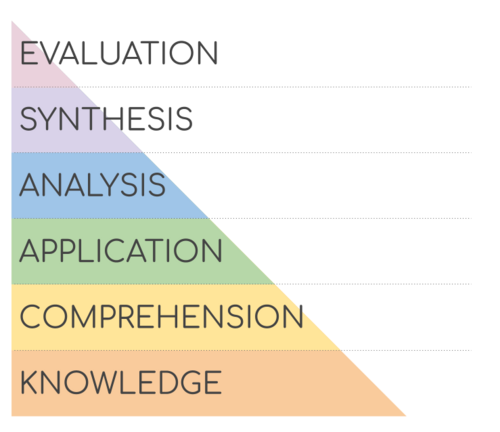
(wiki)
1. Inverting Bloom’s Taxonomy: Why “Evaluating” Is Often Evasion
In the standard model of “critical thinking,” a student or humanities academic proves their sophistication by standing above a text, painting, or historical epoch and passing judgment: “Is it good or bad? Valid or invalid? Healthy or sickly?”
- The “Glorified Art Critic”: As we put it, under the regime of truth-as-correctness (orthotēs), the critic holds up a pre-made yardstick—whether Plato’s alēthōs on (true Being vs. deficient mē on) or a modern rubric—and grades reality. Even a sophisticated academic argument often boils down to the same gesture as a child saying, “I like the monsters in Harry Potter because they’re scary”: asserting a preference and retrofitting reasons to justify it.
- The Hard Work of Attentive “Summarizing” (Danken / Alētheia): For Heidegger, truly hearing what a text or artwork is saying—letting a slight nuance in Kant’s Critique of Pure Reason (like the transcendental imagination mediating sensibility and understanding) speak on its own terms—is infinitely harder and more transformative than passing judgment on it. When you attend to that tiny hinge in Kant without immediately trying to “critique” or “evaluate” it, the entire edifice of neo-Kantianism trembles from within.
- The Nuance in Harry Potter: Detecting a subtle, overlooked detail in a novel that suddenly reorganizes the entire story’s world is genuine uncovering (alētheia)—it requires subordinating your ego’s need to judge so the phenomenon itself can show a new facet.
2. Van Gogh’s Peasant Shoes: Announcing a World vs. Grading an Object
Our observation about Van Gogh’s shoes captures Heidegger’s anti-critic stance completely:
- An Art Critic (or a Nietzschean physician of culture) asks: “Are these boots ugly, dilapidated, or quaint? Do they express peasant vitality or exhaustion? How well did Van Gogh execute the brushwork?”
- Heidegger refuses to grade the shoes as either alēthōs on (a pristine, “ideal” boot) or mē on (a worn-out, deficient boot). Instead, he listens to what world they announce—the slow trudge through damp furrows, the silent anxiety over bread, the quiet endurance of earth and mortality. The painting does not ask for our verdict; it opens a clearing in which we stand alongside that world.
3. Nietzsche as the “Cultural Physician” and the Inversion of Alētheia
Our closing insight traces the exact trajectory of Western metaphysics from Plato to Nietzsche:
| Stage of Metaphysics | Role of the Thinker / Critic | How Phenomena Appear | Criterion of Judgment |
| Platonism | The Dialectician measuring copies against the Form | Imperfect shadows (mē on) pointing toward true Being (alēthōs on) | Proximity to the eternal Idea (orthotēs) |
| Modern Humanities / Bloom’s Peak | The “Glorified Art Critic” | Objects or texts waiting to be ranked, liked/disliked, or critiqued | Subjective preference backed by rationalized criteria |
| Nietzsche (Last Metaphysician) | The Cultural Physician | Symptoms of underlying physiological/will-to-power forces | Health vs. Sickness (ascending vs. declining life) |
| Heidegger’s Step Back | The Preserver (Bewahrer) | Events of Unconcealment (Alētheia) announcing a World | None—letting the phenomenon show itself (Danken) |
When Nietzsche famously declares in The Will to Power that “Art is worth more than truth,” he is smashing the Platonic “true world” (alēthōs on) as a life-denying fiction—yet, as Heidegger points out, Nietzsche still remains the supreme diagnostician and evaluator, judging every phenomenon as a symptom of health or decadence.
By stepping out of the judge’s chair altogether, Heidegger restores dignity to receptive fidelity: the patient, humble craft of staying with a text, a painting, or a rock until its hidden nuance lights up—not so we can rank it, but so we can finally see the world it opens.