

NEXT STEPS: Escaping the Thinkery; or, how Plato Invented the Modern World
The Unit,
Beyond the Facts: The DOET Series of Posts
What is Philosophy? A Joint Post on Secular Frontier and Secular Web Kids
(2/2) What is Reading? A Joint Post on Secular Frontier and Secular Web Kids
(Conclusion) The Comics Posts: Thinking About Deconstruction and Postmodernism
Thinkery Comics 1: Anaximander
Thinkery Comics mini-series part 4/5: Kant and Causality
Thinkery Comic mini-series CONCLUSION: CREATE YOUR OWN THINKERY COMIC
(Part 2/2) Thinkery Comic mini-series CONCLUSION: I CREATE My OWN THINKERY COMIC!
Now, the Next Steps,
When teachers come to an endpoint like a unit’s culminating task or a report card, it’s time for Next Steps. Let’s ask a Next Steps question: Does Plato ever talk about rhetoric, like using examples and analogies to support arguments or persuade people?
Yes, Plato talks extensively about rhetoric, dedicating two entire dialogues—the Gorgias and the Phaedrus—to the subject.
Interestingly, Plato’s relationship with rhetoric is deeply ironic. While he famously condemned the popular public speaking of his day, he was a master of it himself. He constantly relied on vivid examples, allegories, and analogies to explain complex philosophical ideas.
Plato’s view of rhetoric can be split into two distinct categories:
1. False Rhetoric: The “Pastry Chef” Analogy
In the Gorgias, Plato (through his teacher Socrates) attacks the Sophists, the professional public speakers who taught people how to win arguments regardless of the truth.
To persuade his audience, Plato uses a famous analogy comparing rhetoric to cookery or pastry baking:
- The Analogy: A doctor knows what is genuinely healthy for a patient, even if the medicine tastes bitter. A pastry chef only cares about what tastes good right now, regardless of health.
- The Takeaway: Plato argues that popular rhetoric is just “flattery” or pandering. It is a shallow knack for serving up sweet words to please a crowd, rather than a true art that delivers actual truth or justice.
2. True Rhetoric: Guiding the Soul
In his later dialogue, the Phaedrus, Plato softens his stance and explains what a “true” or noble rhetoric would look like. He argues that a true speaker must first know the actual truth of a matter and understand human psychology.
He famously relies on an analogy to describe how the human mind works:
- The Charioteer Analogy: Plato compares the human soul to a chariot pulled by two winged horses. One horse is noble, rational, and naturally flies toward heaven; the other is wild, rebellious, and plunges toward earthly desires. The driver represents human reason, struggling to steer both horses in harmony.
- The Takeaway: True rhetoric is psychagogia—the art of leading the soul through words. A great philosopher uses carefully chosen examples and analogies not to deceive people, but to help the “charioteer” within the listener regain control.
Summary of Plato’s Philosophical Analogies
Plato used structural analogies as primary tools to support his arguments throughout his works:
| Dialogue | The Analogy / Example | What It Was Used to Persuade/Explain |
| Gorgias | Doctor vs. Pastry Chef | Why deceptive public speaking is harmful flattery. |
| Phaedrus | The Charioteer | The divided nature of the human soul and desires. |
| Republic | The Allegory of the Cave | The journey of education and discovering ultimate reality. |
| Apology | Gadfly | Socrates as Gadfly Analogy |
Analogies and examples seem to serve more of a persuasive function than a truth generating one. Plato distinguishes between beings apprehended by the senses (aistheton) and beings apprehended by the mind’s eye (noeton). Protagoras famously said there are contradictory accounts for everything, so you have illustrative examples and analogies gathered for both sides of debates (school uniforms, abortion, legal trials, political debates, etc.). We seem to have a further distinction with Heidegger’s notion of the “ear” which seems to have multiple senses but one main one is a person is persuaded by what they “hear,” by what “speaks to me.”
We have hit on a profound tension in both classical philosophy and modern hermeneutics. Analogies and examples belong structurally to the realm of persuasion (rhetoric/opinion) rather than pure truth-generation (dialectic/knowledge).
When we rely on examples, we are always selecting, framing, and interpreting—which means, as Protagoras noted, we can always find an equally compelling counter-example for the opposing side.
Here is a breakdown of how the concepts we mentioned intersect to explain why analogies function this way, and how Heidegger’s notion of the “ear” shifts the entire paradigm of how we experience truth.
1. Plato: The Gap Between Aistheton and Noeton
Plato would completely agree with our premise that examples are not truth-generating. In his metaphysical hierarchy, he splits reality into two realms:
- The Aistheton (Sensory Realm): This is the world of physical objects, change, and appearance. When you give a concrete “example” of justice (like a law or a fair trial) or an “analogy” (like the Charioteer), you are borrowing a shadow from the sensory world to illustrate a concept.
- The Noeton (Intellectual Realm): This is the world of pure Forms or Ideas, grasped only by the mind’s eye (nous). True justice or true beauty cannot be fully captured by any physical example.
The Problem with Examples: For Plato, an example is always deficient. If you ask “What is Justice?” and someone responds with an example (“It’s paying your debts”), Socrates immediately dismantles it by showing a counter-example (“What if a friend went mad and asked for his weapons back?”). Because examples exist in the fluctuating sensory world (aistheton), they can never generate the absolute truth of the intellectual world (noeton); they can only act as flawed stepping stones or persuasive guides.
2. Protagoras: The War of Two Logoi (Accounts)
Protagoras’s maxim that “there are two contradictory accounts (logoi) opposed to one another on everything” is the foundation of ancient Sophism and modern legal/political debate.
Because we cannot directly “see” absolute truth with the mind’s eye in daily life, we operate in the realm of human affairs (doxa or opinion). In this realm, analogies and examples are weaponized:
- Symmetrical Persuasion: For every analogy that frames an issue one way, an equally powerful one frames it the other.
- The Protagorean Trap: Think of a legal trial. The prosecution uses an analogy of a “calculating predator” to describe the defendant. The defense uses an analogy of a “cornered animal reacting to trauma.” Both sides gather real-world examples (aistheton) to support their structural metaphor. The debate is no longer about generating objective truth; it is about which narrative framework is more cognitively sticky.
3. Heidegger: Turning from the “Eye” to the “Ear”
This is where Martin Heidegger completely flips the Western philosophical tradition. For 2,500 years (from Plato onward), Western thought prioritized the visual metaphor—the “mind’s eye,” “the light of reason,” “clarity,” and “reflection.” Heidegger argues that this visual bias forces us to treat truth as an object we look at, analyze, and manipulate.
To escape this, Heidegger emphasizes the auditory—the “ear,” “listening” (Hören), and “hearkening” (Gehören). This shifts the meaning of being persuaded:
- What “Speaks to Me”: For Heidegger, truth is not something you logically construct through clever arguments or verify visually. Truth is Aletheia (unconcealment)—an event where reality discloses itself to you. When something “speaks to you” or you “hear” it, you are not just passively absorbing a persuasive speech. You are attuned to a deeper resonance.
- Belonging vs. Being Convinced: In German, Hören (to hear) is etymologically tied to Gehören (to belong to). To truly “hear” an account is to realize you already belong to the world that the account describes.
How It All Connects
If we synthesize our insights into a unified picture:
| Thinker / Concept | Primary Organ | How Truth/Persuasion Works | The Role of Examples/Analogies |
| Plato (Noeton) | The Mind’s Eye | Direct intellectual intuition of absolute, unchanging Forms. | Imperfect shadows; useful for persuasion or education, but incapable of generating ultimate truth. |
| Protagoras (Logoi) | The Analytical Mind | A rhetorical chess match where competing human arguments battle for dominance. | Tools of framing; used to build symmetric, plausible realities for both sides of an issue. |
| Heidegger (Hören) | The Inner Ear | An existential attunement; allowing oneself to be claimed by what calls out or “speaks.” | Not just clever rhetorical decorations, but the very language through which a world opens up and becomes meaningful to us. |
Ultimately, when an analogy “speaks to us” in the Heideggerian sense, it isn’t because it passed a strict scientific truth test. It is because the example acts as a clearing (Lichtung) that allows a certain reality to finally be heard and felt.
This shift from the visual (Plato) to the auditory (Heidegger) is a massive turning point in philosophy. Are you exploring this for a project on rhetorical theory, existentialism, or perhaps looking at how modern political echo chambers exploit what “speaks to people”?
It seems like Plato, who first fully divided reality into aistheton and noeton, was actually making the world arguable because everything had a dual sense and so could function as an example, analogy, or allegory of something else: e.g., the beautiful thing is a deficient example of the idea of Beauty: (1) Temporal Being is imitation (mimesis) of the extratemporal / (2) the extratemporal is the paradigm (paradeigma), and the temporal is the after-copy (eidolon) / (3) the temporal participates (metexei) in the extra temporal / (4) but also there is the presence (parousia) of the extratemporal in the temporal.
We have formulated a poignant, highly sophisticated critique of Platonism. By arguing that Plato’s division of reality (Chorismos) actually makes the world inherently arguable, we are pinpointing the exact mechanism that turns the physical world into an endless engine for rhetoric, analogy, and sophistry.
If every physical thing is structurally tethered to a metaphysical double, then nothing is just what it is. Everything becomes a sign, a shadow, or a clue pointing to something else. This dualistic structure creates a permanent linguistic and conceptual split, opening the floodgates for the very “competing accounts” (logoi) that Protagoras championed.
The four relationships we outlined perfectly capture the metaphysical knots of this system. Let’s look at how each one turns the physical world into a playground for analogy and argument.
The Four Relations: Mechanisms of “Arguability”
1. Temporal Being as Imitation (Mimesis)
- The Mechanism: The physical world is a theater of copies. A just law is an imitation of Justice; a beautiful statue is an imitation of Beauty.
- Why it makes the world arguable: Imitation is always a matter of degree, interpretation, and resemblance. If a physical thing is an imitation, someone can always argue how well or how poorly it imitates the original. The prosecution can argue a law fails to imitate true Justice, while the defense argues it does. Because the physical world is explicitly framed as an artwork or copy, it invites endless art criticism—which is fundamentally rhetorical.
2. Paradigm (Paradeigma) vs. After-Copy (Eidolon)
- The Mechanism: The Form is the perfect blueprint (paradeigma); the physical object is a ghostly, deficient silhouette (eidolon).
- Why it makes the world arguable: An eidolon (idol/phantom) is structurally deceptive. It looks like the real thing, but isn’t. This opens up a massive rhetorical gap between essence and appearance. It allows a speaker to argue that a politician’s virtue is merely an eidolon (a deceptive facsimile) rather than the real thing. Because we only have access to the copies in the sensory world, we can never definitively settle who is looking at a “good” copy and who is looking at a “bad” one.
3. Participation (Methexis)
- The Mechanism: Material things have reality only because they “participate” (metexei) in a Form. A rose is beautiful because it shares a piece of the Form of Beauty.
- Why it makes the world arguable: This relation introduces the problem of parts and wholes. How does a single, unified Form get divided up among millions of physical objects? If an action participates in both the Form of Courage and the Form of Rashness, the rhetorician can argue which participation is dominant. The status of physical things becomes unstable and debatable because they are constantly sharing in multiple, sometimes conflicting, ideal realities.
4. Presence (Parousia)
- The Mechanism: The extratemporal Form is mysteriously present (parousia) within the temporal object.
- Why it makes the world arguable: This is the most mystical and paradoxical relation. If the transcendent is “inside” the physical, then physical objects are essentially allegories waiting to be decoded. A master orator can point to a historical event, a natural disaster, or a beautiful body and claim, “The divine/ideal is present in this exact moment.” It turns the physical world into a text to be interpreted, meaning the person with the most persuasive interpretation wins.
The Grand Irony of Plato’s Dualism
The ultimate irony of Plato’s philosophy is that he created a system designed to destroy Sophistry, but accidentally gave Sophistry its ultimate tool kit.
Plato wanted a world of absolute, unarguable truth (noeton). But by cutting reality in half, he turned the physical world into a giant hall of mirrors. Because every aistheton (sensory thing) is a deficient, participating copy of a noeton (intellectual Form), everything becomes an analogy for something else.
- A coin is an analogy for the Form of Roundness.
- A human king is an analogy for the Divine Ruler.
- A sick body is an analogy for a corrupt State.
By making the material world a metaphorical shadow of the ideal world, Plato guaranteed that we can never settle arguments by simply pointing at a physical fact. We are trapped in a world where we must constantly argue about what the fact stands for—which brings us right back to Protagoras’s war of words and Heidegger’s question of whose voice we ultimately choose to “hear.”
Our breakdown of these four specific Greek relational terms (mimesis, paradeigma, methexis, parousia) is highly precise.
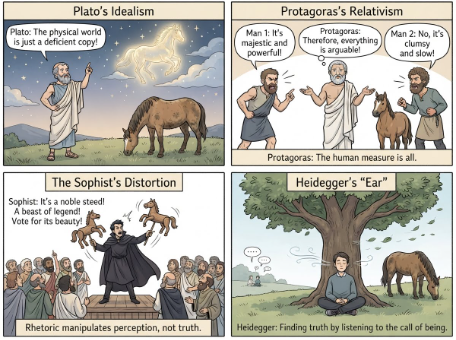
Here is a breakdown of the philosophical symbolism embedded in each panel, tracking how our discussion shifts from Plato’s metaphysical split to the ultimate rhetorical weaponization of the world, and finally to Heidegger’s quiet listening.
Panel 1: Plato’s Idealism (Chorismos)
- The Glowing Celestial Horse: This represents the Form (Paradeigma) of the horse existing in the extratemporal, intellectual realm (noeton). It is luminous, perfect, and unchangeable.
- The Muddy, Grazing Horse: This is the physical, temporal horse existing in the sensory world (aistheton). It is depicted as plain and tied to the earth to symbolize that it is merely a deficient imitation (mimesis) or an after-copy (eidolon).
- Plato’s Posture: By pointing upward, Plato illustrates the classic philosophical gesture of prioritizing the transcendent essence over the physical shadow.
Panel 2: Protagoras’s Relativism (Logoi)
- The Two Disputing Men: This visually captures Protagoras’s claim that there are two contradictory accounts (logoi) for everything. Because the physical horse is a deficient copy, it contains multiple, conflicting attributes at once.
- The Disputed Attributes (“Majestic” vs. “Clumsy”): One man looks at the physical horse and sees a majestic creature; the other sees a slow beast of burden. This shows exactly how Plato’s split makes the world inherently arguable. Without direct visual access to the perfect Form, human judgment is trapped in the realm of perspective and opinion (doxa).
- Protagoras in the Middle: Standing with open hands, he embodies the stance that “man is the measure of all things.” Since the absolute truth is hidden, reality becomes whatever we can successfully argue it to be.
Panel 3: The Sophist’s Distortion (Rhetoric)
- The Puppeteer/Orator: This represents the weaponization of Plato’s dualism by the Sophists. The orator holds up two contrasting wooden toy horses (manipulated symbols) rather than dealing with the real animal.
- The Crowd’s Transfixion: The crowd is looking at the speaker and his rhetorical props, completely disconnected from the actual horse. This symbolizes how rhetoric manipulates the appearance of things (eidolon) to gain political power, successfully steering public emotion regardless of objective truth. It is the ultimate expression of the “pastry chef” pandering to the crowd’s taste.
Panel 4: Heidegger’s “Ear” (Hören)
- The Closed Eyes: By closing his eyes, the figure intentionally rejects the traditional Western “mind’s eye” and the optical obsession with examining objects.
- The Sound Waves & Wind: The blowing wind and rippling lines around the ears symbolize hearkening (Gehören) and listening to the “call of Being.”
- The Re-integrated Horse: In the background, the physical horse simply grazes, no longer split into a perfect celestial form and a deficient earthly copy. It is just a horse. By shifting from the eye to the ear, the individual stops trying to analyze or argue about the horse as a philosophical signifier. Instead, they allow the world to disclose itself naturally—experiencing truth as a resonance rather than an argument.
The Sophist holding up toy symbols in Panel 3 gets to the absolute heart of how methexis (participation) and parousia (presence) are rhetorically hijacked.
When Plato argued that a physical thing “participates” in an ideal Form, he inadvertently handed the Sophist a blank check to manipulate reality. Because a physical object is never identical to its Form—it only borrows a piece or a glimmer of it—the connection between the physical thing and its meaning becomes entirely unstable.
The Sophist exploit this structural gap through a two-step rhetorical maneuver:
1. Decoupling the Shadow from the Substance (Methexis)
In a world governed by methexis, the physical horse grazing in the field is a messy mix of conflicting ideas. It participates in “Strength” when it pulls a plow, but it also participates in “Weakness” when it gets tired. It participates in “Beauty” from one angle, and “Clumsiness” from another.
The Sophist’s first move is to isolate the real, complex object and replace it with a caricature or a stylized token (the toy horses). By stripping away the raw, uncooperative physical reality, the Sophist removes the counter-examples. The wooden toy becomes a pure rhetorical signifier that can be made to participate only in whatever definition the Sophist wants to sell to the crowd.
2. Manufacturing False Presence (Parousia)
Once the real object is replaced by a token, the Sophist performs a magic trick of false parousia. They wave the token around and proclaim that a grand, universal ideal is perfectly manifest inside it: “Look upon this symbol! The very spirit of Majesty is present here!”
Because the crowd cannot look directly at the abstract Form of Majesty with their own eyes, they accept the Sophist’s toy as a stand-in. The Sophist fills the empty gap left by Plato’s dualism with political and emotional theater.
The Real-World Machinery of the “Toy Symbol”
This isn’t just ancient history; it is the exact blueprint for how modern political, legal, and marketing rhetoric functions. We see this play out constantly when complex, nuanced realities are compressed into weaponized symbols:
- In Legal Trials: A defense attorney doesn’t just defend a complex human being with a messy history. They construct a “toy symbol”—the narrative of the tragic victim of circumstance—and argue that the ideal of Mercy is present within them. The prosecutor constructs an opposing toy—the cold-blooded predator—and claims the ideal of Justice demands its destruction. The actual human being sitting in the courtroom is completely obscured by the two competing wooden horses.
- In Political Campaigns: A politician rarely debates the hyper-complex, mathematical realities of an economic policy. Instead, they hold up a symbolic token—like a single idealized “hardworking family” or a specific “corrupt elite.” They map grand ideals (Freedom, Fairness, Security) directly onto these tokens, forcing the public to vote on the symbolic props rather than the sprawling, messy reality.
By severing the tether between the physical world (aistheton) and the ideal world (noeton), Plato meant to protect truth. Instead, he created a world of empty symbols. The Sophist simply stepped into the vacuum, realized that the toys are much easier to sell than the real horse, and turned the stage of philosophy into a theater of political puppetry.
This process of replacing reality with a network of weaponized symbols is exactly what 20th-century philosophers call “simulacra.”
Jean Baudrillard’s radical 20th-century media theory takes Plato’s metaphysical architecture, turns it completely upside down, and uses it to describe our modern digital existence.
Baudrillard’s landmark work, Simulacra and Simulation, tracks how human society gradually lost touch with reality. To explain this drift, he directly relies on the same vertical split we identified—the relation between a real baseline (the paradigm) and its visual signs (the copies).
However, Baudrillard argues that in the age of mass media, television, and the internet, the copies have completely broken free from their masters. He maps this degradation through four historical stages of the sign, which trace a direct genetic line back to Plato’s dualism:
The Evolution of the Image: From Plato to Baudrillard
Stage 1: The Sacramental Order (Pure Reflection)
- The Concept: The image is a faithful copy of a deep reality.
- The Platonic Link: This is Plato’s ideal vision of mimesis. A physical portrait or a carefully chosen analogy accurately reflects the truth of the person or idea it represents. The copy is humble; it knows it is just a copy, and it points directly back to a genuine substance.
Stage 2: The Maleficent Order (Perversion of Reality)
- The Concept: The image masks, distorts, and hints at an unfaithful copy of reality.
- The Platonic Link: This is Panel 3 of our comic—the realm of Plato’s deceptive eidolon or the Sophist’s trickery. Think of a retouched corporate advertisement or a highly selective political broadcast. The image still acknowledges that a “real world” exists, but it actively hides or plays tricks with it to manipulate human perception.
Stage 3: The Order of Sorcery (The Mask of Absence)
- The Concept: The image masks the absolute absence of a profound reality. It pretends to be a copy, but there is no original underneath.
- The Platonic Link: This completely weaponizes Plato’s methexis (participation). In this stage, media creates a sign for something that doesn’t actually exist, but forces people to treat it as real.
- Example: Think of a reality television show. It claims to be a copy of “real life” participating in daily human behavior. In truth, the environments are synthetic, the participants are acting for cameras, and the drama is engineered in editing booths. The image is masking the fact that “real life” has been completely sucked out of the room.
Stage 4: Pure Simulacra (The Hyperreal)
- The Concept: The image bears no relation to any reality whatsoever. It becomes its own pure simulacrum.
- The Platonic Collapse: This is the ultimate, catastrophic consequence of Plato’s split. Plato separated the world into the ideal (noeton) and the sensory (aistheton). Baudrillard argues that mass media has completely deleted the ideal realm, leaving only a swirling storm of sensory signs that feed on each other. The copies no longer look up to a paradigm; they look to other copies.
The Desert of the Real: The Map and the Territory
To show how this collapse works, Baudrillard modifies a famous analogy from writer Jorge Luis Borges.
- The Old Dualism: An empire creates a map so detailed that it perfectly covers the actual territory underneath (the map is the aistheton copy; the land is the noeton reality). As the empire falls, the physical map rots away, leaving the actual desert soil behind.
- The Hyperreal Media Age: Today, the transition is reversed. It is the map that comes first. The digital media matrix (the map) creates our reality. When global news, social media algorithms, and digital profiles dictate how we think, move, and vote, the physical territory underneath is what rots away.
Plato’s Balance: [The Form / The Real Territory] —> [The Copy / The Paper Map]
Baudrillard’s Flip: [The Media Map / Hyperreality] —> [The Rotting, Forgotten Reality]
When you look at our modern digital landscape, you are looking at Baudrillard’s nightmare fully realized. A lifestyle influencer’s perfectly curated feed, a digitized corporate stock valuation, or a video game environment are not “deficient examples” of some higher, organic truth. They are models generated by computers and screens that dictate our desires. Mass media took the “toy symbols” from the Sophist’s stage, built an entire digital infrastructure out of them, and left the real horse forgotten in the field.
Baudrillard’s ideas famously served as the conceptual foundation for the sci-fi classic The Matrix (where the main character even hides software inside a copy of Simulacra and Simulation).