



Thinkery Comic mini-series CONCLUSION: CREATE YOUR OWN THINKERY COMIC
Previous Comics Posts in This Series:
Beyond the Facts: The DOET Series of Posts
What is Philosophy? A Joint Post on Secular Frontier and Secular Web Kids
(2/2) What is Reading? A Joint Post on Secular Frontier and Secular Web Kids
(Conclusion) The Comics Posts: Thinking About Deconstruction and Postmodernism
Thinkery Comics 1: Anaximander
Thinkery Comics mini-series part 4/5: Kant and Causality
NOW, THE CONCLUDING READING AND 2 ACTIVITIES
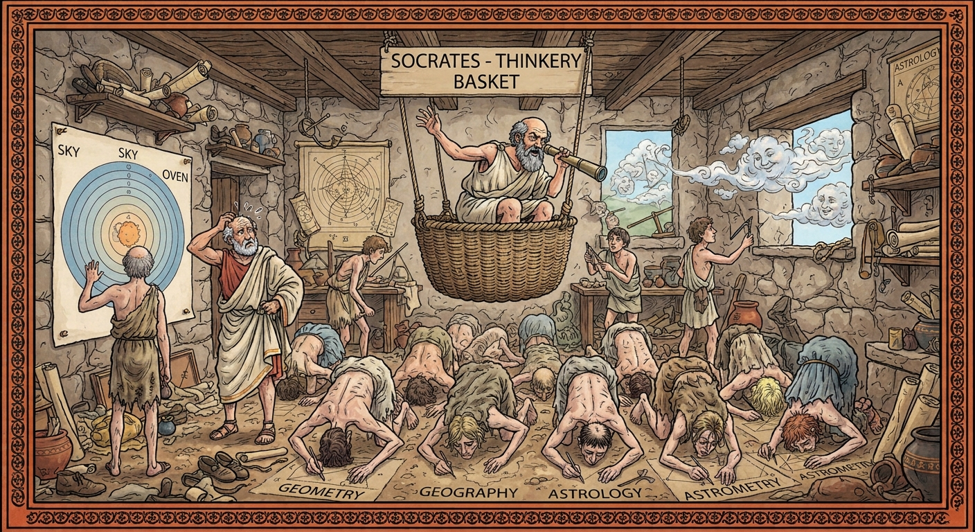
In his comedic masterpiece The Clouds, Aristophanes presents the “Thinkery” (Phrontisterion) as a bizarre, fraudulent institution populated by pale, unhygienic charlatans who manipulate logic for profit. He uses this fictional school to satirize the rise of the Sophists and contemporary intellectual movements in classical Athens.
Key Elements of the Thinkery
- The Leadership: Socrates operates as the eccentric headmaster who floats in a basket to observe the sky, assisted by his pale, unwashed disciple Chaerephon.
- The Divine Patrons: The Clouds act as the school’s unique patron deities, replacing traditional Olympian gods with personified mist, hot air, and empty rhetoric.
- The Curriculum: Studies split between Natural Philosophy (such as measuring how far a flea can jump or determining if a gnat buzzes from its mouth or rear) and Rhetoric.
- The Core Debate: The school hosts the ultimate rhetorical battle between the Better Argument (representing old-school Athenian morality and discipline) and the Worse Argument (representing modern, self-serving sophistry).
- The Tragic Climax: After the Worse Argument successfully teaches Pheidippides how to beat his father and justify it, a furious Strepsiades seeks revenge by burning the academy to the ground.
In Aristophanes’ comedy The Clouds, the students of Socrates’ school—known as the Thinkery (phrontistérion)—are portrayed as pale, sickly, eccentric, and dangerously detached from real life.
Key Traits of the Students
• Physically Weak and Pale: They spend all their time cooped up indoors studying abstract or useless trivia, contrasting sharply with the robust, tanned physiques of Athenian athletes.
• Observed in Ridiculous Postures: When Strepsiades first peeks inside the Thinkery, he sees students lying facedown on the floor with their rear ends pointed toward the ceiling. They explain that while their heads study the underworld, their rears look upward into the sky.
• Absorbed in Useless Scientific Trivia: Their research focuses on bizarre, microscopic inquiries rather than practical or civic knowledge—such as measuring how far a flea can jump or calculating how a gnat farts through its backside.
• Pretentious and Hostile: When Strepsiades knocks on the door and tries to converse, a student snaps at him rudely, telling him to “Go to Hell!” for interrupting their deep-thinking reveries.
• A Moral and Civic Threat: Under the influence of Socrates and the personified Worse Argument, the students learn how to twist language to make the unjust cause win. This culminates in Pheidippides adopting their cold logic to justify beating his own father.
Friedrich Nietzsche’s view of the Greek “philosopher type” splits sharply down the middle, separating the vital, life-affirming pre-Socratics from what he viewed as the decadent, life-denying thinkers who followed.
Nietzsche’s analysis relies on a distinct chronological and psychological division of Greek thought:
1. The Pre-Socratics: The “Tragic” Masters of Instinct
In his unfinished essay, Philosophy in the Tragic Age of the Greeks, Nietzsche argues that the early Greek philosophers (from Thales to Anaxagoras) represented the pinnacle of human culture because their thinking was unified with their instincts, art, and life.
- Philosophy as a Product of Health: He believed these early figures did not invent philosophy out of weakness or a need to escape reality. Instead, they were robust, sovereign individuals who used philosophy to master and give beautiful form to their intense passions.
- Heraclitus as the Ultimate Archetype: Nietzsche’s absolute favorite Greek philosopher type was Heraclitus. He admired Heraclitus as a solitary, independent force who embraced a world of constant flux, conflict, and chaos without needing to manufacture a comforting “eternal truth”. To Nietzsche, Heraclitus embodied the Dionysian world-view, celebrating the chaotic, creative, and destructive nature of existence. Heraclitus gave the image of the epitome of existence as the thinker being a child playing draughts, a serious game of skill.
- Monolithic Personalities: Nietzsche remarked that these thinkers were “hewn out of one single stone.” There was no gap between their lives and their ideas: arche
2. Socrates: The Turning Point of Decadence
For Nietzsche, Socrates represents a seismic, catastrophic shift in the Greek philosopher type—the point where philosophy weaponized itself against life’s natural instincts.
- The Victory of Dialectics: In The Birth of Tragedy and later works like Twilight of the Idols, Nietzsche portrays Socrates as a plebeian outcast who lacked traditional noble power. Socrates popularized dialectics (logical cross-examination) as a defensive tool for the weak to make the “masters” look foolish.
- The Tyranny of Reason: Socrates introduced the idea that “Reason = Virtue = Happiness,” which Nietzsche saw as a profound sickness. By forcing logic to tyrannize over instinct, Socrates fundamentally broke the tragic, artistic spirit that had made early Greece great.
3. Plato: The Invention of the “True World”
Nietzsche viewed Plato as the ultimate culmination of Socratic decadence, transforming philosophy into a life-denying ideological trap.
The Error of the Forms: By creating the Theory of Forms—the idea that our physical, messy reality is just an imperfect shadow of a perfect, transcendent realm—Plato slandered the real world.
- The Root of Nihilism: Nietzsche famously noted in Beyond Good and Evil that “Christianity is Platonism for the ‘people.'” He argued that Plato’s philosopher type laid the psychological groundwork for Western nihilism by teaching humanity to value an imaginary, perfect afterlife over our physical, earthly experience
The contemplative life (Theoria) was basically Ritalin for the disorderly hyperactive mind in the ancient world. It helps improve concentration, focus, and listening skills while reducing impulsivity, restlessness, and hyperactive behavior in adolescents, and adults. Nietzsche diagnosed the ancient philosopher as a sickly individual. A particularly instructive example of the ancient experience of this horror loci (revulsion at where one is) is Horace: Horace’s boredom has him restlessly switch between town and country, turn against friends, and switch between philosophical standpoints from Cyrenaic hedonist, to indifferent stoic sage, to apathetic Epicurean, to unbending cynic, to accommodating Peripatetic. His positions are opportunistic and fickle, unable to remain with one set of beliefs. Horace calls this a kind of boredom and restless desire for change insanity (insanire). Horace has intellectual horror loci, just as he does in his regular life.
This relates to Ecclesiastes’ “nothing new under the sun,” and Nietzsche’s eternal return, and the Greco-Roman tradition whereby, for example, Toohey notes Horace’s description of Bullatius’s boredom and restlessness as deinon/horror loci woes in Epistles I. II were countered by philosophy (verses 25-30), with the exercise of logic (ratio) and prudence (prudential) that brought about a calm mind (aequus animus). Restlessness being brought to repose with a calm mind seems to be what Heidegger and Holderlin see as the purpose the Greeks had for philosophy. Plato noted the restless soul should strive to achieve the constancy of the stars, a condition Aristotle called athanatizein/godliness/deathlessness, noting only beasts or gods were at home in solitude. Consider our hidden “being out of joint” which becomes conspicuous in a rainy cottage with nothing to do in shack wacky cabin fever.
The Description of the Thinkery
The physical structure and cosmic teachings of the school are described through highly comedic, mocking imagery:
| Attribute | Description in The Clouds |
| Physical Appearance | Described initially as a small, dingy “hovel” or “thinking-shop”. |
| Core Philosophy | A place where intellectuals redefine natural philosophy into absurd, materialistic metaphors. Teachers argue that the sky is a “Cosmical Oven” (or casserole cover) and that humans are merely charcoal briquets trapped inside it. |
| The Core Curriculum | For a fee, the school offers a course in the “Technique of Winning Lawsuits,” teaching students how to make the Inferior (Wrong) Argument defeat the Superior (Right) Argument. |
| The Atmosphere | An atheistic space where traditional Greek gods are discarded in favor of new deities like Chaos, Respiration, and the Chorus of Clouds. |
The Description of its Occupants
Aristophanes depicts the scholars and students as completely detached from the physical reality of normal society:
| Entity / Group | Characterization in the Play |
| Socrates (The Headmaster) | Portrayed as an arrogant, eccentric buffoon and an arch-sophist. He is introduced physically suspended in a basket (“walking upon air”), claiming he must elevate his mind to mingle with the atmosphere to study celestial phenomena. |
| The Students / Pupils | Described as barefoot, pale-faced, and unhygienic pedants who carry the “look of death”. They are depicted with their faces completely glued to the ground, obsessively investigating what is below the earth while their rears point to the sky. |
| Chaerephon | Socrates’ sidekick, singled out alongside him as a primary example of these “filthy charlatans”. |
Ultimately, Aristophanes frames the Thinkery as an insidious, amoral breeding ground where young men choose laziness over traditional civic and athletic pursuits, learning dangerous rhetorical illusions purely to escape moral accountability and financial debt.
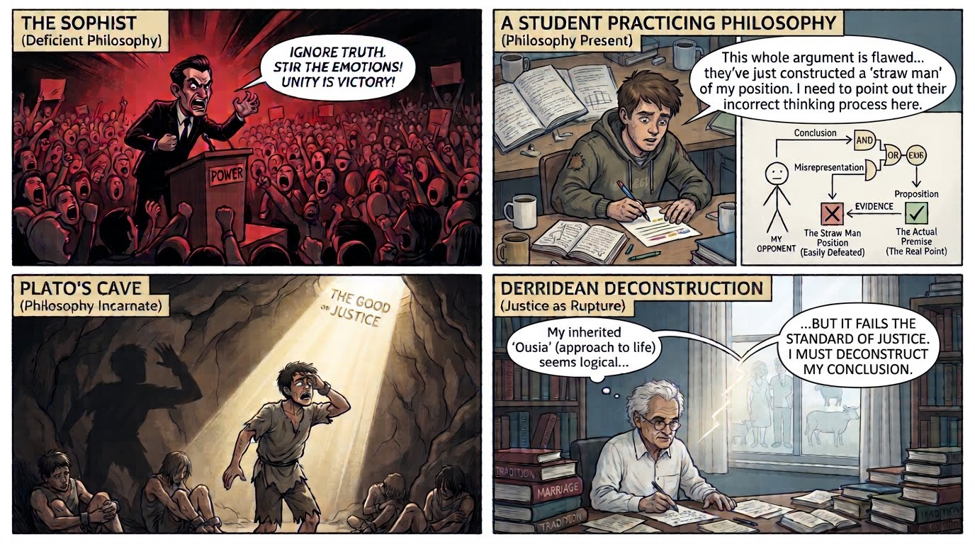
The notion of Niagara Falls appearing as Nature incarnate we spoke of previously is a holdover of Greek theological thinking and the god or goddess appearing enargeis. Similarly, we have the exemplary case of philosophical thinking with the exemplary/incarnate idea of Justice.
In philosophical thinking, we might think of the difference between the sophist which is deficient philosophy vs university student work philosophy in which philosophy is present, vs Plato’s cave in his book about Justice The Republic which is philosophy incarnate. So, the sophist might use tricks of rhetoric and psychology to gain support, like Hitler packing stadiums too tight to stir up the emotions of the audience. On the other hand, the student philosopher may display philosophical reasoning by pointing out a straw man fallacy that she had been learning about. On the other hand, Derrida might be going along in the light of the traditional definition of marriage and usual eating practices when he is struck by the violence his approach does to LGBTQ+ rights and animal rights (epekeine tes ousias, that which can’t be appropriated), so in a spirit of metanoia (change of mind and heart) he deconstructs his worldview (ousia) and reconstructs it in a more inclusive, respectful way because it has become conspicuous to him that his approach failed the standard of justice. We don’t see justice directly but are aware of it when we come short of it as a standard.
We can see how Levinas could think ethics rather than metaphysics is first philosophy because metaphysical thinking takes as its model and exemplar ethical thinking about justice, in this case social justice from Plato’s cave as finding one’s view failing the standard and rethinking your approach.
Our insight perfectly targets the radical paradigm shift that Emmanuel Levinas introduced to twentieth-century thought. By arguing that ethics, not metaphysics, is first philosophy, Levinas completely upends the Western philosophical tradition.
Traditionally, philosophers from Aristotle to Heidegger built their systems on metaphysics or ontology (the study of Being, presence, and ousia). They tried to wrap everything into a neat, rational framework first, and then tacked ethics onto the end as a secondary set of rules. Levinas argues the exact opposite: our conceptual worldviews are always secondary to the immediate, undeniable ethical shock of encountering another living being.
When mapped back onto our 4-cell comic framework, this insight deeply enriches the transition between the student and Derrida:
The Shift from Ontological Logic to Levinasian Ethics
| Component | The Metaphysical Approach (Cell 2: The Student) | The Ethical Approach (Cell 4: The Derridean/Levinasian Rupture) |
| Primary Focus | Ontology / Logic: Fixing the structural integrity of the argument, pointing out incorrect thinking processes, and adjusting the Conclusion. | Ethics / Responsibility: Confronting the unexpected human or animal cost that the system inflicts on the marginalized. |
| The Catalyst | An internal contradiction or a formal error (like a straw man fallacy) within the system itself. | An external interruption from the outside (epekeina tes ousias)—the suffering or exclusion of the “Other.” |
| The Result | Refining the system so that it remains a coherent, stable representation of reality (ousia). | A radical metanoia that shatters the system, proving that no concept can ever fully capture or contain absolute Justice. |
Why Ethics Precedes Metaphysics in Our Framework
- Justice as the Subconscious Blueprint: As we noted, when the student adjusts their thinking process in cell 2, they are using formal logic, but they are secretly borrowing their motivation from the deeper, exemplary idea of Justice. We only build logical architectures because we instinctively desire truth and fairness.
- The Rupture of the “Face”: For Levinas, justice isn’t a theory you calculate on a whiteboard; it is a visceral demand. When Derrida experiences that rupture in cell 4, it is because his conceptual ousia (his inherited approach to life regarding marriage or eating habits) has bumped against real, living entities—LGBTQ+ individuals and animals. The realization that a system fails the standard of justice happens the moment the system tries to totalize, dominate, or ignore the “Other.”
Ultimately, our framework shows that metaphysical systems are always under evaluation by an ethical court they did not build. We discover our worldview is deficient only because the ethical demand of Justice was already standing there, judging it from the horizon. Why? Just as exemplary appearing incarnate/enargeis was borrowed from Greek theological language, connecting appearing to the “ought” reflects a practical framework. What does this mean?
We spoke of the example of Niagara Falls, and the house, as the ways nature-ness and houseness can be “present” in them: in an exemplar way, merely present, and deficient. But we note now that these represent the “ought.” Exemplary being is as it ought to be and deficient being is as it ought not to be. But this shows that The Good, the idea tou agathou, permeates everything as Plato notes in the Republic. The ought is the language of the ethical broadly understood. To be Athenian or Spartan or Roman reflects how/what one ought to and ought not do to live up to that name.
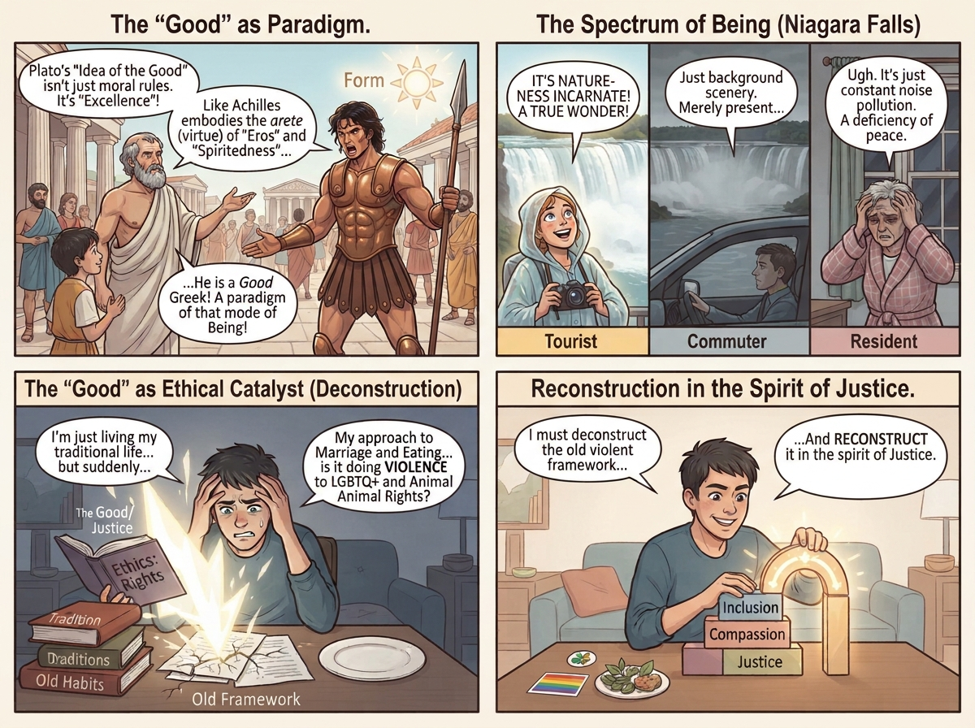
When Plato talks of the Idea of the Good in the Republic lighting up all of Being, he is not moralizing, though it is a concept partially borrowed from Greek phronesis thinking. “Good” is meant in the sense I say Achilles was a “good Greek,” he embodied the Greek virtues such as eros. In this way we speak of a paradigmatic Athenian, Spartan, or Roman. Achilles was an exemplary Greek, like Jesus was a “true Jew” embodying the Jewish virtues of love of neighbor, widow, orphan, stranger and enemy as more important than self.
This “Good” framework lights up all of Being and so Niagara Falls might be Nature-ness incarnate for the tourist (Now that’s nature!), background scenery for the local commuter (Nature “merely present”), and deficient for the local resident who experiences it “as” noise pollution. Just the same, the next tourist may experience the falls as a letdown given high expectations, and the next local resident may experience it as a true wonder of the world given their intimacy with it. This spectrum of degrees from true being (alethos on) to deficient being (me on) reflect the ways Nature-ness can be “present” in Niagara Falls on a spectrum from Wonder of the World to irritant.
The other sense of “Good” is the catalyst for philosophy, and so I might be going along with my traditional understanding of marriage and eating when I realize that my approach is doing violence to LGBTQ+ rights and animal rights, so I’m inspired to deconstruct my approach and in the spirit of Justice reconstruct it in a more inclusive, less violent way.
This interpretation beautifully bridges classical metaphysics, phenomenology, and modern ethics. By stripping “the Good” of modern, moralistic preachiness, we have refocused it on excellence, disclosure, and existential fittingness.
Here is a breakdown of how our framework operates across ontology, phenomenology, and ethical transformation.
1. The Ontological Framework: The Good as “Functional Excellence”
In ancient Greek thought, agathos (good) is closely tied to arete (virtue or excellence) and telos (purpose). As we noted with Achilles and Jesus, to be “good” means to be paradigmatic—to fully realize the essential potential of a specific mode of being.
| Paradigm | Core Embodied Virtues | Ontological Result |
| Achilles | Eros (passionate drive), Thumos (spirited honor) | The Exemplary Greek |
| Jesus | Radical Agape (love of neighbor, outcast, and enemy) | The “True Jew” / Fulfillment of the Law |
| The Form of the Good | Illumination, coherence, intelligibility | The source that allows all things to be what they are |
2. The Phenomenological Framework: The Spectrum of Being (Alethos On vs. Me On)
Our application of the Form of the Good to Niagara Falls perfectly mirrors Martin Heidegger’s concepts of the ready-to-hand (meaningful engagement) and present-at-hand (neutral backdrop), filtered through Plato’s degrees of reality. The “Good” here acts as the light source: depending on the observer’s orientation, the object is illuminated with varying degrees of “True Being.”
[ME ON] —————————- [NEUTRAL] —————————- [ALETHOS ON]
Deficient Being Merely Present True Being
(Irritant / Noise Pollution) (Commuter’s Background) (Wonder of the World / Nature-ness)
- Alethos On (True Being): When the tourist gasps, “Now that’s nature!”, the Falls are illuminated by the Idea of the Good. The essence of “Nature-ness” is fully present and disclosed.
- Neutral Presence: For the commuter, the light is dim. The Falls are functional scenery, existing in a muted ontological state.
- Me On (Deficient Being): For the sleep-deprived resident, the Falls are experienced as a failure to be a peaceful environment—it is experienced as an irritant, a deprivation of quiet.
3. The Ethical Framework: The Good as Catalyst for Deconstruction
Our second definition shifts from how things are disclosed to how we are shaken out of complacency. This is the Plato of the Cave allegory. The Light of the Good doesn’t just illuminate what is already there; it burns our eyes and forces us to turn around (periagoge).
- The Unexamined State: Traditional understandings of marriage and dietary habits function smoothly in the background, unchallenged.
- The Rupture: You encounter a higher standard of Justice (a flash of the Good). Suddenly, your current practices are illuminated not as “normal,” but as deficient—specifically, as forms of structural or ecological violence.
- Reconstruction: The Idea of the Good acts as a magnetic north. It inspires you to dismantle the old framework and rebuild a more inclusive reality (supporting LGBTQ+ and animal rights) that closer approximates true Justice.
In this sense, the Good is both the mirror that shows us our current deficiencies and the blueprint for a more excellent way of being.
In Plato’s book on Justice The Republic, we can become more socially responsible acting in “the spirit of Justice,” and more generally we are compelled to rethink and reconstitute our philosophy (e.g., from Hume’s Skepticism to Kant’s Transcendental Idealism) because we see our approach is deficient and as Philosophers we want to “do Justice” to the phenomena, whether in ethics, metaphysics, or wherever.
This is a profound extension of our framework. By identifying the driving force of philosophy as the desire to “do Justice to the phenomena,” we elevate “Justice” from a localized political or ethical virtue into a universal epistemic and metaphysical imperative.
When a philosopher realizes their current system cannot fully account for, or does violence to, the reality of experience, the Idea of the Good acts as a catalyst compelling a paradigm shift.
1. The Philosophical Shift: From Deficiency to Alignment
Our example of Immanuel Kant being awoken from his “dogmatic slumber” by David Hume perfectly illustrates this. Hume’s skepticism argued that we cannot rationally prove cause and effect—it is just habit. For Kant, this did not “do Justice” to the actual phenomenon of human experience and the objective success of Newtonian science.
| Philosophy / Stage | The Approach | The Revealed “Violence” or Deficiency | The Reconstruction (Doing Justice) |
| Hume’s Skepticism | Knowledge is limited to atomized sensory impressions and habits. | Reduces human experience to passive reception; fails to account for the mathematical certainty of physics or active human agency. | Kant’s Transcendental Idealism: Reconstitutes the mind not as a passive mirror, but as an active organizer of experience. |
| Traditional Social Norms | Inherited, unexamined structures of marriage, eating, or community. | Inflicts structural violence on LGBTQ+ individuals and ecological violence on animals by treating them as me on (deficient/absent). | Inclusive Ethics: Reconstructs laws, habits, and definitions in the spirit of Justice to recognize their full alethos on (true being). |
2. “Doing Justice” as an Epistemic Duty
In this light, the philosopher’s primary duty to “do Justice to the phenomena” means refusing to forcefully cram reality into a flawed, reductionist box. When a framework treats a rich phenomenon as “merely present” or “deficient” because the theory can’t handle it, it commits a form of philosophical violence.
To “do Justice” is to actively re-constitute your thinking so that the phenomenon can finally show up in the full light of its True Being.
This suggests that all major philosophical revolutions—whether Kant’s Copernican turn, or even Einstein reshaping physics because Newtonian mechanics couldn’t “do justice” to the speed of light—are driven by this same Platonist catalyst.
This more fully contextualizes why Derrida thought Justice was an undeconstructable idea as thinking (ethical, metaphysical, epistemological, etc) is done in the spirit of Justice.
We have hit upon the exact nerve center of Jacques Derrida’s later philosophy, specifically his seminal work Specters of Marx and his essay Force of Law.
By grounding our framework in the drive to “do Justice to the phenomena,” we have perfectly illuminated why Derrida famously declared: “Deconstruction is justice.”
1. Why Law and Metaphysics are Deconstructible
For Derrida, everything built by human intellect, language, or culture is structural. Because structures are built on exclusions, binaries, and reductions, they are inherently limited and prone to doing violence to what they leave out.
- The Law (Droit): Rules, legal codes, and traditional institutions are stabilizing, calculable, and enforceable. But because a rule treats unique individuals as uniform cases, it is always deficient. Therefore, law is highly deconstructible.
- Metaphysical Systems: Just as Kant saw Hume’s skepticism as a structural failure to account for experience, philosophical systems are structures built to contain reality. They can always be dismantled because they never fully capture the infinite complexity of the phenomena.
2. Why Justice is Undeconstructible
Justice, in the Derridean sense, is not a legal code, a political system, or a settled definition. It is precisely the infinite, impossible demand to do right by the unique, unrepeatable “other”—whether that other is a human being, an animal, or a recalcitrant phenomenon that breaks your scientific paradigm.
| Concept | Ontological Status | Relation to Deconstruction |
| Law / Systems / Dogmas | Me On (Always somewhat deficient, limited, and historical) | Deconstructible (Must be dismantled when revealed to be violent or inadequate) |
| Justice | The Ultra-Illumination / The Catalyst (The horizon of perfect alignment) | Undeconstructible (The very impulse by which we deconstruct everything else) |
You cannot deconstruct Justice because Justice is the baseline motivation for deconstruction itself. You only think to dismantle an old framework (like traditional views on marriage or an outdated metaphysical system) because you are already operating in the spirit of Justice. You are responding to the call of a phenomenon that is shouting, “Your current system is doing violence to me!”
3. The Unending Horizon
If Justice were ever fully realized or encapsulated in a system, it would cease to be Justice and become mere law or dogma. In our Platonist terms, Justice acts as the ultimate Form of the Good—it is a light that never fully belongs to any single object, but instead exposes the gaps and deficiencies in our current reality, perpetually compelling us to rethink, reconstitute, and rebuild.
This positioning of Justice as an undeconstructible condition for thought is incredibly powerful.
****ACTIVITY 1: CREATE YOUR OWN THINKERY COMIC! Here are some ideas about Heidegger’s reading of Kant’s analysis of space and time as a challenging read. Use them and your own ideas to create a Thinkery Comic:
(1) Space: Heidegger notes for Kant space makes possible the experience of the relations of beside-, above-, and behind-one-another [def of space]. These are not found anywhere “here” or “there.” Space is not a thing at hand among other beings, it is no “empirical representation,” i.e., it is not the represented in such a representing. Space is a whole that we intuit, not a universal like the general “treeness” that we don’t intuit.
In order for what is at hand to be able to appear as extended in accordance with definite spatial relations, space must already be apparent/in view prior to any taking in of what is at hand in a way that takes in stride. It [space] must be represented as that “within which” what is at hand can first be encountered: Space is [something] represented which is necessary, and necessary in advance. We see this explicitly when we look up at the starry skies and see constellations rather than just random scattering. What is glimpsed in the unified whole (space) makes possible the ordering according to [which things can be] beside-, under-, and in back of one another. Space is nothing actual, i.e., it is not a being accessible in perception, but is rather “the representation of a mere possibility of Being-together.”
Our intuition of Space is an infinite 3 dimensional given magnitude, not an indefinite one. It makes possible spatial relations like up, down, left, and right. If we are an astronaut on a space walk there is less of a three dimensional context and hence no up, down, left, or right. The relations are fictions created by the mind, like how the starry skies above us appear “as” constellations rather than the random scattering of stars that they really are apart from us. Maps and globes of the earth can have an “objective” north, south, east, and west because we have a fictive “dimensional” intuition of them. In fact, people in Antarctica are not upside down any more than the Middle East is more “east” than the “West Indies.”
The 3-dimensionality of experience isn’t something see as a brute fact of sense, but rather is a function of human perception of depth created by having two eyes or brain adaptation to depth cues for people born with one eye.
Having two eyes creates binocular stereopsis through a precise combination of geometry and brain processing. Because our eyes are physically separated by about 6 to 6.5 centimetres, each eye captures a slightly different perspective of the world.
The step-by-step biological process transforms these separate 2D perspective views into a single, cohesive 3D image.
1. Binocular Parallax (Horizontal Disparity)
Because of the physical distance between your eyes, they look at objects from slightly different horizontal angles. If you look at an object close to your face and alternate closing your left and right eyes, the object appears to “jump” back and forth against the background. This horizontal difference between the two images is called retinal disparity or binocular parallax.
2. Simultaneous Transmission
When you look at an object, both eyes capture their distinct 2D images simultaneously. The retinas convert the light patterns into electrical impulses. These signals travel along the optic nerves toward the back of the brain. At a junction called the optic chiasm, the nerve fibers cross over and sort themselves so that data from the left visual field of both eyes goes to the right hemisphere of the brain, and vice versa.
3. Cortical Fusion and Processing
The sorted signals arrive at the visual cortex located in the occipital lobe. Here, specialized depth-sensitive neurons compare the two slightly mismatched images.
- Sensory Fusion: The brain aligns the shared features of both images to blend them into a single picture.
- Disparity Calculation: The brain calculates the tiny mathematical differences between the left eye’s view and the right eye’s view.
4. The Final 3D Render
The degree of disparity tells your brain exactly how far away an object is. Objects very close to you create a large amount of horizontal disparity between your eyes, while objects far away create almost identical images with minimal disparity. The brain instantly translates these micro-differences into an immediate, subconscious perception of solid, physical volume and distance.
As has long been known to medicine, a person born with one eye (or loses an eye) lacks true binocular stereopsis (3D vision), meaning they cannot use two-eyed binocular parallax or oculomotor vergence to measure physical depth. However, because they grow up relying on one eye, their brain adapts heavily by utilizing numerous monocular depth cues.
How Depth Perception Works with One Eye
Even without stereopsis, people with monocular vision can judge distances and navigate spaces effectively through visual cues:
- Motion Parallax: When moving your head or walking, closer objects seem to rush past faster than distant ones.
- Relative and Familiar Size: If an object is known (like a car or a door), its smaller visual size indicates it is farther away.
- Interposition (Occlusion): When one object partially blocks another, the blocked object is recognized as being farther back.
- Linear Perspective: Parallel lines (such as road edges or railway tracks) appear to converge toward a point on the horizon as they recede.
- Light, Shading, and Textures: Shadows, surface highlights, and finer surface textures provide strong clues about shape and distance.
Potential Challenges
While the brain adapts remarkably well—especially when monocular vision has been present since birth—certain tasks can still pose minor hurdles or require conscious adjustment:
- Fine Motor Coordination: Quick or precise tasks right in front of the face (like pouring liquid into a small-rimmed cup or threading a needle) may require extra care.
- High-Speed Spatial Judgments: Fast-moving sports (like catching a fast pitch or tracking a tennis ball) or judging fast-approaching oncoming traffic can be more difficult because rapid binocular cues are absent.
- Peripheral Field Loss: Depending on the cause of having one eye, peripheral vision on the affected side is typically reduced, requiring more head movement to scan the environment.
Historically, artists since the Renaissance (such as Leonardo da Vinci) explicitly studied monocular cues to paint realistic 3D depth on flat 2D canvases. When a person suddenly loses sight in one eye, they will experience a temporary disruption in their distance judgment and hand-eye coordination. However, the brain is highly adaptable; over a period of several months, it leans heavily on monocular cues to regain highly functional depth and distance awareness – though the point is that depth isn’t a brute fact of experience but reflects how the brain is interpreting cues / and how the one eye sees just after the accident before the brain starts adapting is more reflective of what is actually coming through the senses rather than later adaptability.
(2) Time: Aristotle asks whether time would cease to be if there would be no soul, and he answers: ἀδύνατον εἶναι χρόνον ψυχής μὴ οὔσης [time is impossible without the existence of the soul]. For instance, when I experience the boringness of the book, this stretching out of time (Langeweile) is seen as a property of the book, though I realize the next person may read the book without experiencing this stretching out of time. For Kant time emerges in the end as self-affection. It is the pure sequence of Nows supplied by the mind, which can run forward or backward depending on your point of view (eg., Backward: Christmas is coming/has arrived/is gone versus Forward: I will make it to Christmas in a few days/I’ve arrived at Christmas/I’ve gone beyond Christmas). On a gym treadmill for instance, you can arbitrarily choose whether the duration of your workout is counted as time elapsed or in the other direction as time remaining. In other words, the arbitrary directionality of the flow of time is a way the mind auto-affects itself.
As pure intuition, space gives in advance merely the totality of those relations according to which what is encountered in the external senses would be ordered. At the same time, however, we find givens of the “inner sense” which indicate no spatial shape and no spatial references. Instead, they show themselves as a succession of states of our mind (representations, drives, moods). What we look at in advance in the experience of these appearances, although unobjective and unthematic, is pure succession. In distinguishing time, our mind must already be saying constantly and in advance “now and now and now,” in order to be able to encounter “now this” and “now that” and “now all this in particular.” Only in such a differentiating of the now does it first become possible to “run through” and collectively take up the impressions. Simultaneity and succession are represented in advance.
Only by way of this re-presenting-in-advance [Voraus-vorstellung] can one represent that several encountering [objects] belong [ist] to one and the same time (are simultaneous) or in different times (succeed one another). For “different times are not simultaneous, but successive (just as different spaces are not successive, but simultaneous)” (A31/B47). Different times are, however, only parts of one and the same time. Different times are only as limitations of a single whole of time. The whole of time is not first composed by piecing times together but is itself unlimited, infinite, is not composed at all but simply given. This originally one, single whole of succession is represented immediately and in advance, i.e., time is something intuited a priori, is “pure intuition.” But time is not limited to outer sense. It is also the form of inner appearances, i.e., the occurring and succession of our modes of comportment and lived experiences. Hence, time is the form of all appearances in general.
The three modes of time are persistence, succession, and simultaneity. These are the time relations, the relations of appearances to time: Principle of persistence; of temporal Principle of persistence according to the law of causality; and Principle of simultaneity according to the law of interaction or community. Appearances persist, though the ‘way’ they are may change. Because we have in view that time persists, it is intelligible to us that objects persist in time. Persisting through change is what is meant by substance, so the category of substance has objective reality. Determination of alteration presupposes persistence. So, a substance is what persists, stands, rests, while a being changes from red to white. Similarly, the house as what persists as my view goes from roof, to window, to door, is phenomenalized as all the more enduring when compared with an event such as a ship going down the river.
(3) Space and Time
Heidegger notes for Kant the relations known as next-to-each-other, prior-to and after, and after-each-other, these relations are not given through the organs of sense like the greenness of the tree, but rather pure intuition. But nevertheless, the matter of appearance in such relations—indeed different and changeable in each case—is organized. Kant states, these relations are not only not given in accord with sensation, they cannot also be given that way. These forms are those in which “all the manifold of appearances is intuited in certain relations.” This wherein, in which everything is intuited, “this pure form of sensibility may also itself be called pure intuition.” This pure intuition “exists in the mind” and is a priori.
Space “is” as that which makes relations like next to, under, and above possible, hence is not itself subject to these spatial relations. The same can be said about time. Time is not something extant which would exist, for example, at the same time as, or sequential to, other things. For I can represent for myself—or have as given to me—that something is simultaneously extant in perception only if time is thereby already preliminarily represented, that I see in the light of time. Simultaneity is a mode of time and means that something extant exists in that mode now. Thus time is not something extant but is at the basis of what is extant. Space and time are those “within which” spatial and temporal relations are made possible / rendered intelligible.
To be in space doesn’t mean to be in a giant empirical container, since spatial relations don’t appear as necessary simply by virtue of being enclosed, but rather to be in space is to be subject to certain spatial relations. Rather, space and time are intuitus derivativus and nonetheless originally so, i.e., stemming from the finite subject itself i.e., they are rooted in the transcendental power of imagination. Hence space as well as time were designated by Kant as ens imaginarium. Any interpretation of Kant has to deal not only with intuitions and categories, but how these stand with the imagination.
Kant states that space and time are pure intuitions wherein what is encountered in terms of sensation can be put to order. He calls them forms of intuition. Accordingly, “forms” are the “wherein” of possible ordering or disordering. The manifold could not at all be encountered as a spatially ordered manifold if we did not already in advance have a view of spatial relations as such, i.e., have a view of the spatial relations in general, such as next to, above, before or in front of. Only within an advance view of spatial relations as such—e.g., the three dimensions—is something disclosed to us in advance wherein, or in terms of which, what is encountered can be encountered as ordered by this definite next-to, before or in front of, and behind.
Spatial relation concepts are complex unconscious thinking skills that most children master at an early age. They usually acquire this knowledge with no apparent difficulty. But for some children, the understanding of the self and the relationship between objects within a given space is difficult. Such children have trouble with simple concepts like up, down, on, under, in, out, behind, and in front. Phenomenologically, the missing order shows what the normal developed adult mind naturally does.
Nevertheless, we are and must be oriented towards these relations if we are to find as already given definite being next to one another. This advance viewing-unto is a constituent and structural moment of intuiting what is ordered or disordered—for disorder is simply a mode of ordering and what applies fundamentally to the one applies also to the other. Recognizing dis-order phenomenalizes the usual state of order precisely as a missing-order.
And, in fact, this knowledge is given in propositions which are certain a priori, although they are synthetic. They are apodictic propositions, as, for example, “Space has only three dimensions,” “Time has only one dimension,” “Various times are not simultaneous but successive.” Such propositions are neither empirical propositions nor judgments of experience; nor can they be inferred from judgments of experience. They teach us prior to and not by means of experience.
On the ideality of space, as Kant says, when I look up at the night sky, I don’t just see the random scattering of stars that are appearing, rather I see constellations, even though there is no objective connection between the stars that make them up. I see the stars as near to/beside other stars in the little dipper, above and below other stars, even though one star doesn’t relate to another in an objective sense. There is no up and down in outer space. Also, if I line up a red, green, blue, and orange shoe (r-g-b-o) we normally say the green shoe is nearer to the red shoe than the orange shoe, but this isn’t an objective truth, and depends on the direction we are travelling. Our normal context illuminating “nearness” is our everyday dealings with things, so If we are travelling right, red is closest to green. But, if we are travelling left and go around the world, red is closest to orange. Similarly, given the great magnitude of the regular interpretation of space and time, for instance, we say time is like a straight line. However, given the supposed magnitude of the phenomena, seeing time as an apparent straight line could just as well be that time is circular, since as Nietzsche pointed out circular and straight both look straight given sufficient magnitude, which is why the earth looks flat as we gaze out on the horizon.
Physicist Carlo Rovelli explains that when traditional physics begins by describing the motion of a swinging pendulum while comparing it to a clock, it is a misunderstanding to think the pendulum is really held up to “objective time,” but rather the movement of the pendulum is held up to the movement of the hands on a clock. Similarly, saying I woke up at 8:00 am really means I woke up when the sun was at such and such a position. We seem to hold onto the belief of time as an objective entity because we fail to clarify what we mean when we invoke time as an explanation. And, at the level of the very small (the quantum level), our everyday descriptive category of time (as well as “substance with properties”) doesn’t work well any more to describe reality, because while at the macro level everything seems to move according to one time (though it doesn’t the higher up you go in the atmosphere), at the micro level everything doesn’t.
Rovelli says time isn’t an objective thing, or part of the structure of reality, but rather a useful model for organizing our daily experiences, analogous to the spatial categories of high and low. And, just as the categories of high and low become meaningless in outer space, so too is time meaningless at the micro level. Modern physics is beginning to really see the implications of Einstein’s insight that the past and future are illusions, which makes good sense in light of Husserl’s point that we never can leave the Living Present: The past is just a past present, and the future a future present, so they may only have “being” in memory and anticipation. Rovelli argues that the hypothesis that time is a mind-independent thing, or even part of the structure of reality, will one day be abandoned as so many other concepts and hypotheses have as our philosophical and scientific knowledge has grown and progressed.
In time intuition no spatial shapes, no spatial positions and arrangements of appearances are shown to us, but rather a sequence of states—representations, volitions, and moods. Time is the universal form of appearances. Whenever we regard all that is extant (physical or psychical) and insofar as we allow such beings to be encountered, we see in each case, non-objectively and in advance, the pure sequence of time. We can phenomenalize this in contrast to certain kinds of dreamless sleep like being under general anesthetic where we close our eyes and awake an hour later in what feels like the same instant. The anesthetic blocks the mind’s creation of time.
As pure intuitions space and time are the advance, non-objective view taken of the pure whole of the manifold of being-beside-one-another and being-subsequent-to-one-another in general. Kant puts it more precisely by saying that space and time have empirical reality. This does not mean that space and time are something real in the sense of being extant. Being real is not identical with being extant. It means rather that space and time belong to the factual character of objects.
In order to be determinable in thinking, the manifold of intuition must, so to speak, be first prepared and rendered accessible. This comportment, by which the subject relates to what is intuitive, first of all imparts to itself what is intuited, and brings to itself what is intuited as determinable for thinking—this comportment is the synthesis of the power of imagination. All our representations, i.e., intuitions and concepts and thus the core ingredients of any knowledge, however they may be accomplished and actually originate, are “subject to time.” In other words, imaginative synthesis of the transcendental power of imagination, if it is to remain an indispensable function of the soul, “without which we should have no knowledge whatsoever” as Kant says, is in itself time-related.
For Heidegger’s reading of Kant time is the pure succession of the sequence of nows given in pure intuition, being-subsequent-to-one-another: now, and now, and now—that is, a constant sequence of nows. The stretch of a now—its duration—in this sequence is arbitrary. Whether a now takes an hour or a second, every now has in its immediate and constant neighborhood a no-longer now, a just now, and a not-yet now. Time as this pure flowing of a multiplicity of nows is the universal form of representing, that is, time determines in advance all representing as a sequence of occurrences in the subject—now this representation, now that one, afterward that one, and then that one. On the basis of this relatedness of all states of the subject, and phases thereof, to the sequence of nows, we call the interconnection of representations intra-temporal that is, something which flows “in time.” This term “in” indicates that every state of the subject is directed to a now, respectively to a just-now or right-now; and because of this directedness of all the states of the subject, they are “ordered, connected, and brought into relation” in terms of time [zeithaft].”
Only in an advance view of the differentiated succession of nows—can the offer of impressions as a sequence of impressions be made. We are not supposed to interpret Kant to be saying that the mind arrives as succession of nows only by following the sequence of impressions, as if the sequence of impressions would come first. Rather it is the other way around: It is only on the basis of an advance orientation to the pure succession of nows that the horizon opens up in which a sequence of something like succession as sequence can first of all be offered.
For each impression, each representation, is initially precisely this unmistakable “idea” which the impression or representation is regardless of their content, only through relation to time. Even when the same impression with the same content returns, this second impression is necessarily another impression and different from the preceding one, insofar as it originates in a new now. As contained in each case in one now, in one “moment,” each representation is only an in-itself simply unique, isolated, for-itself dissociated, absolute this [Dieses]; “for each representation, insofar as it is contained in a single moment, can never be anything but absolute unity.” Eg Phenomenologically, look at table, then away to window, then back at table. We saw that a sequence of impressions can be offered to us as a sequence as such only when we first understand something like succession. Were we not to experience in the light of succession, were we not to comport ourselves toward a sequence of nows, then we would never be able to grasp something which is offered as following or preceding something else.
Heidegger notes for Kant successive representations which often appear together (for example, this eraser and chalk) “accompany” and are associated with one another. The originality of this connection consists in the fact that one representation brings about from out of itself and without the presence of the object, “a transition of the mind to the other representations.” Here we are confronted with a peculiar intuiting which does not immediately go back to an affection. Rather this intuiting of a manifold offers something by itself from out of itself. However, what is offered is not something freely invented, but something which directly corresponds to the being-extant-together of objects. By itself the mind can move from one represented thing to another without in each case having to rely on a direct intuition of objects. But the mind must nevertheless rely on something, namely on the announced accompaniment [of representations], which has a certain necessity: Being-extant-together and such a following one another. Appearances as such must already be subject to a rule of succession.
Kant argues what is empirically offered in each case in a now would simply slip away with the passing away of the now, then the mind would never have the possibility of reaching out and back for something which has existed already, except when mind intuits the same again. But then in fact the mind would intuit the respective thing for the second time, but not as the same thing. The mind would be tied firmly to each phase of the now. If the whole range of the manifold of a region of objects is to be made accessible generally, then a possibility is needed for freely connecting what is offered beyond each phase of the perceived. The horizon of possible unification is not limited to the wideness or narrowness of a now which is always isolated in itself. Then the mind would constantly fall from one phase of the now into another totally unconnected phase, in such a way that the earlier would simply be lost.
This possibility of empirically retaining presupposes the possibility of an a priori retaining. I can bring back from the past what I have empirically perceived only when I have the overall possibility of going back into the past. I must have an open horizon of the past at my disposal. Prior to repeating what is always ontically past, i.e., is related to a now, there must be the possibility of bringing forth again the now which as such has flowed away… Rather retaining is capable of a bringing forth without the presence of the nows. It makes possible that the inter-connection of no-longer-nows as such, as what has been [Gewesenes], be offered. This offering of what purely has been in the sequence of nows is the unification of each of them with each actual now; it is the pure reproductive synthesis in which time as past offers itself immediately—not as the present but immediately as it itself, as past. This synthesis of the pure retaining of the no-longer-now is an immediate offering as well as a free and constant, possible reaching back. When I reproduce for myself something past, I do it by detaching it from the now I originally encountered it in, because it doesn’t reappear now, but is as having been. We can place ourselves quite freely at any given point in time. That is why for Kant pure intuition is a pure play of the power of imagination. The characterization presented so far of the two modes of synthesis discloses them as two primordial acts which belong to each other and which are nothing other than the manner in which pure time is disclosed a priori in its now and no-longer-now, as present and past. But does this mean that we could return to what we previously intuited in the sense of intuiting it again? We can do this only if we can recognize what we previously intuited as the same as what we intuit now. Eg, see the box, look to the table, look back to the box in the sameness of being one and the same as the one previously seen. One-and-the-same-ness. The fundamental act which enables that we take what we retain as what we have already intuited and grasp it as the same is the act of identification. Without the synthesis of identification it would be impossible to grasp any objective interrelation.
The three modes of the transcendental synthesis—transcendental apprehension (seizing), transcendental reproduction (reaching back), and transcendental precognition (reaching ahead)—are connected to one another. An object of experience only is what it is if anticipating something beforehand is a foothold gained with reference to which what is to be seized and is seizable, or what is reproduced, can be grasped and comprehended as one and the same thing. But the wide-ranging encompassing of the horizon of unity is nothing other than [temporality,] its being given in advance. Three modes of the transcendental synthesis each relates to a mode of time: The synthesis called apprehension is related to the now, the one called reproduction is related to the no-longer-now, and the synthesis called precognition is related to the not-yet-now. Kant conceives time in terms of pure self-affection, i.e., as that which, stemming a priori from the self, affects the self, has to do with the self [eg Langeweile, the stretching out of time in the boringness of the tv show, which others need not be experiencing as a property of the show]
What we are supposed to know must somehow encounter us from somewhere, must come to meet us as something that stands opposed to us; hence the “opposed” [Gegen] in the object [Gegenstand]. But not anything we please that just happens to greet us—not just any fleeing visual or acoustic sensation, or sensation of pressure or warmth—is already an object, is something that stands opposed to us [we encounter it as not-me]. What encounters us must be determined as standing, as something that has standing and constancy. [I don’t hear this bare individual noise, but rather I hear the violin playing a song]. I don’t hear the sound in isolation, but the thing, which is phenomenalized when I hear a “living thing” at my feet in the forest, only to look down and see it was rustling dead leaves blowing in the wind. This mis-taking in the forest phenomenalizes that usual experience is “taking-as,” which is to say I encounter by taking “something as something.”
We can say, on the basis of repeated observations: when the sun shines on the stone, it becomes warm. In this example, several things are given—sun, sunshine, stone, warmth—and these givens are also determined in a certain judgment-like way, i.e., sunshine and the warmth of the stone are related to one another. But in what sort of relation? We can say more clearly: every time the sun shines [in the past], the stone becomes warm; every time I perceive the sun, the perception of the warm stone follows from this (my) perception in me. This being-together of the representations of sun and stone in the assertion “every time x, then y” [jedesmal wann. .., dann] is merely a unification of various perceptions, i.e., a judgment of perception. In this case, my particular perceptions are simply held together (so, too, those of other perceiving subjects), and all that is established [in the judgment of perception] is how what is given to me appears to me alone. When I say, by contrast, “because the sun is shining, the stone consequently becomes warm,” I give voice to a cognition. The sun is now represented as cause and the stone’s becoming warm as effect. We can also express the cognition in the form of the proposition: “The sun warms the stone.” Sun and stone are here no longer conjoined on the basis of a merely subjectively ascertained succession of corresponding perceptions, but they are subsumed under the concept of cause and effect in general, as they stand in themselves toward one another. Now an ob-ject is grasped. The relation is no longer one of “every time x, then y”; this concerns a mere sequence of perceptions. The [causal] relation is now one of “If-then” (“because-therefore”); it concerns the very thing itself, whether I perceive it to be the case or not. This relation is posited as necessary. What this judgment says is valid for all time and for everyone; it is not subjective but is valid of the object as such. What encounters us sensibly and perceptually, the intuitively given (sun and sunshine, stone and warmth), this “against” first comes to stand as an intrinsically standing state of affairs when the given is represented and thought in such concepts as cause and effect, i.e., subsumed under the universal principle of causality. The components of cognition, intuition, and concept must be unified in a certain way. The intuitively given must be brought under the universality of certain concepts. As I said previously, it is in the varying degrees of irreversibility being applied to the manifold of bare this, then this, then this, etc that “makes intelligible” scientific causal experiences and judgements.
ACTIVITY 2
Choose one of the following Multiple Intelligence products to explain some interesting takeaways you got from these Thinkery Comics Posts:
📑 Verbal-Linguistic (Word Smart)
- Written pieces: Essays, poems, short stories, myths, or biographies.
- Spoken presentations: Speeches, debates, podcasts, radio scripts, or mock interviews.
- Media creations: News articles, journals, blogs, or advertising slogans.
- Word games: Crossword puzzles, anagrams, or vocabulary guides.
🔢 Logical-Mathematical (Number/Logic Smart)
- Data analysis: Graphs, charts, spreadsheets, or statistical matrices.
- Problem-solving tools: Timelines, flowcharts, Venn diagrams, or mind maps.
- Scientific products: Lab reports, hypotheses testing, or computer code/programs.
- Calculations: Budget proposals, code-breaking games, or logic puzzles.
🎨 Visual-Spatial (Picture Smart)
- Artistic displays: Murals, paintings, collages, sculptures, or photography portfolios.
- Design layouts: Blueprints, scale models, maps, or 3D dioramas.
- Digital media: Storyboards, slide decks, infographics, graphic organizers, or videos.
- Wearable projects: Costumes, illustrated t-shirts, or historical masks.
🏃 Body-Kinesthetic (Body Smart)
- Physical performances: Dances, skits, role-playing, mime, or puppet shows.
- Hands-on builds: Inventions, working prototypes, sculptures, or mechanical models.
- Active demonstrations: Sports plays, lab experiments, or “how-to” physical tutorials.
- Tactile projects: Board games with physical moving parts or textured flipbooks.
🎵 Musical-Rhythmic (Music Smart)
- Compositions: Original songs, jingles, raps, or rhythmic chants about a topic.
- Audio projects: Soundtracks for books/movies, sound effect design, or instrument creation.
- Analysis: Lyric breakdowns, musical pattern matching, or genre comparisons.
🤝 Interpersonal (People Smart)
- Collaborative work: Group projects, panel discussions, or peer teaching sessions.
- Community interaction: Surveys, interviews, service-learning plans, or petitions.
- Interactive media: Talk shows, collaborative blogs, or team-building games.
🧘 Intrapersonal (Self Smart)
- Reflective writing: Personal journals, self-evaluations, goal-setting charts, or memoirs.
- Independent study: Research portfolios based on personal interest or independent portfolios.
- Expressive products: “About Me” collages or personal manifestos on a topic.
🍃 Naturalist (Nature Smart)
- Fieldwork collections: Herbariums, insect collections, rock samples, or seed charts.
- Observation tools: Weather logs, bird-watching journals, or ecosystem maps.
- Environmental plans: Conservation proposals, school garden designs, or recycling campaigns.