



Thinkery Comics 3: Plato
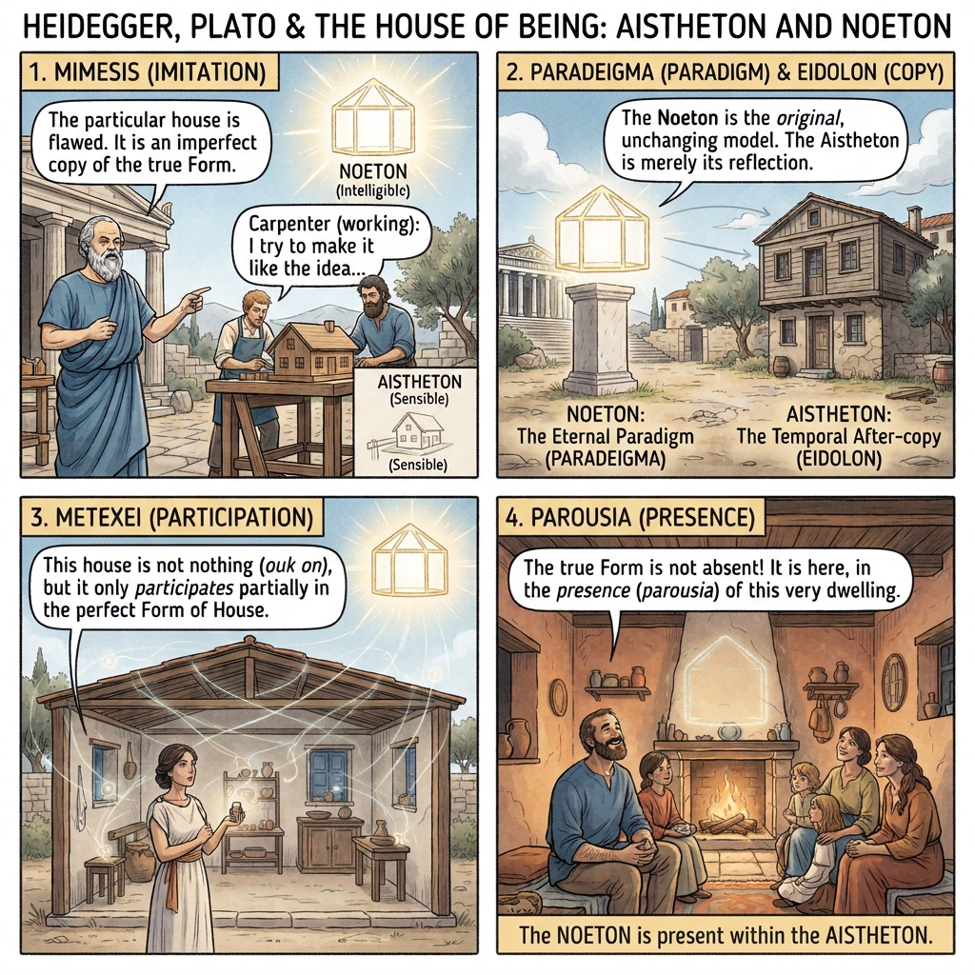
Heidegger points out that since Plato, anything that ‘is’ can be differentiated into two realms, the aistheton and the noeton, that which is apprehended by the senses and that which can be apprehended by nous, the mind’s eye. The noeton is that which truly is because it is not subject to the changeability of the things of the senses, and hence is constant. The particular house shows the essence, house as such, but only in a limited way, and hence is me on, not simply nothing, ouk on, but deficient with respect to what truly is, the primary image, the paradeigma (see Heidegger, Holderlin’s Hymn The Ister, 24).
Plato envisions a fourfold way in which the aistheton relates to the noeton.
(1) Temporal Being is imitation (mimesis) of the extratemporal / (2) the extratemporal is the paradigm (paradeigma), and the temporal is the after-copy (eidolon) / (3) the temporal participates (metexei) in the extra temporal / (4) but also there is the presence (parousia) of the extratemporal in the temporal.
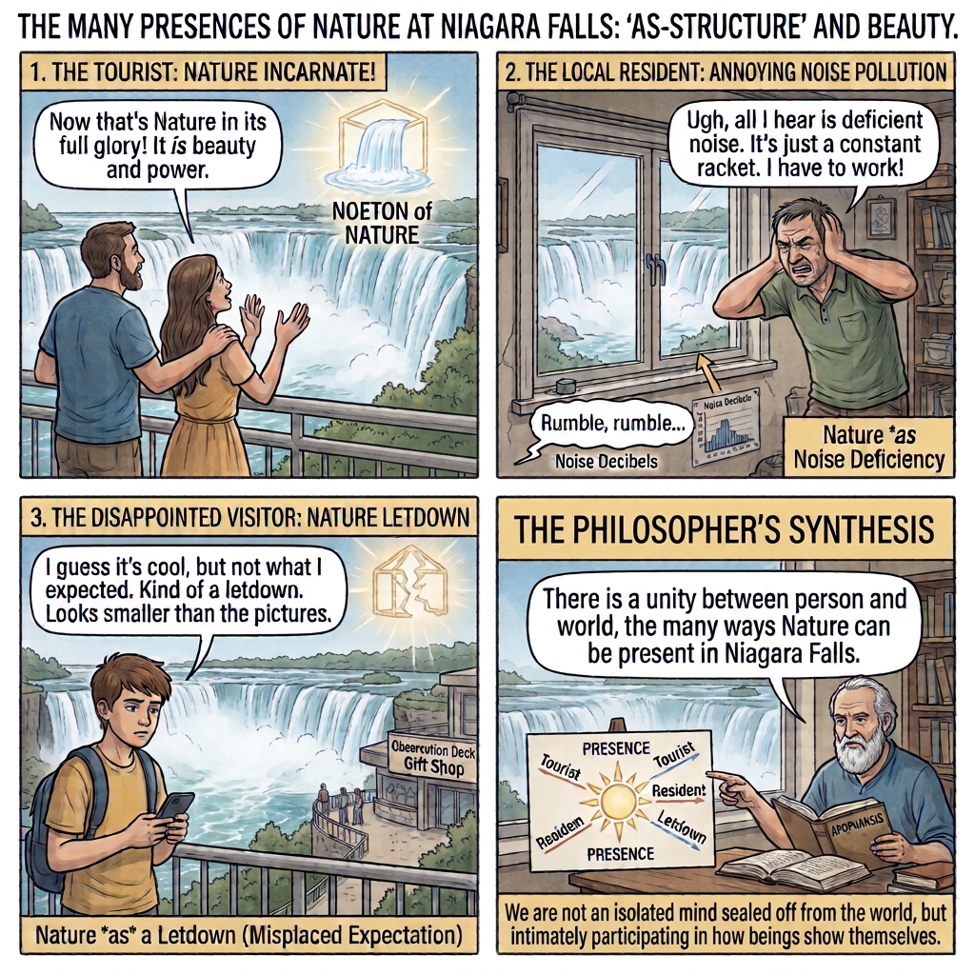
If we narrow in on “presence,” in the Phaedo and Gorgias Plato gives the example that in the beautiful thing the idea of Beauty is “present.” For Plato, the idea of Beauty is the medium that connects the aistheton and noeton. For example, Niagara Falls is going to appear “as” Nature in various degrees of Beauty depending on the viewer: To the tourist, it may appear as Nature incarnate: “Now that’s Nature!” To the local commuter, Niagara Falls may appear as background scenery, “mere” nature. To the local resident, Niagara Falls may appear deficiently, as annoying noise pollution. In addition to those basic 3, the next tourist may experience Niagara Falls as a letdown in relation to their high expectations, and the next local resident may experience the Falls as glorious because of how intimately connected they feel to the “wonder of the world.” These are the ways Nature can be “present” in Niagara Falls.
Similarly, houseness may be present incarnate in the mansion, merely present in the average house, and deficient in the dilapidated shack – though the next person may encounter the mansion “as” gaudy and the shack “as” quaint/rustic. This is not psychologizing nature/houseness but seeing the original unity between man and world: taking something “as” something else, as Aristotle made explicit with apophantic judgments. For instance, if I hear a living thing at my feet in the forest only to look down and see I mis-took rustling dead leaves in the wind “as” a living thing, this error shows my basic disposition toward the world is taking something “as” something else.
The next post is on Kant and for the final post in this comics series I’ll return to Plato.