


The New Testament and Josephus
Josephus’s legacy is inherently complicated. To many of his contemporaries and later Jewish generations, he was branded a traitor and an opportunist who abandoned his people for Roman luxury. Paradoxically, his works were entirely ignored by ancient Jewish communities but painstakingly preserved by the Christian Church. This was because his writings offer crucial contextual background on the New Testament world, the timeline of early Roman emperors, and contain some of the oldest non-biblical references to Jesus Christ and John the Baptist.
This post looks at the intertextuality (literary dependance) of New Testament writing on the writings of Josephus. For example, Price argues
On the whole Matthew seems to have borrowed the birth story of Jesus from Josephus’ retelling of the nativity of Moses. Whereas Exodus had Pharaoh institute the systematic murder of Hebrew infants simply to prevent a strong Hebrew fifth column in case of future invasion, Josephus makes the planned pogrom a weapon aimed right at Moses, who in Josephus becomes a promised messiah in his own right. Amram and Jochabed, expecting baby Moses, are alarmed. What should they do? Abort the pregnancy? God speaks in a dream to reassure them. “One of those sacred scribes, who are very sagacious in foretelling future events truly, told the king that about this time there would a child be borne to the Israelites, who, if he were reared, would bring the Egyptian dominion low, and would raise the Israelites; that he would excel all men in virtue, and obtain a glory that would be remembered through the ages. Which was so feared by the king that, according to this man’s opinion, he commanded that they should cast every male child into the river, and destroy it… A man, whose name was Amram, … was very uneasy at it, his wife being then with child, and he knew not what to do… Accordingly God had mercy on him, and was moved by his supplication. He stood by him in his sleep, and exhorted him not to despair of his future favours… ‘For that child, out of dread for whose nativity the Egyptians have doomed the Israelites’ children to destruction, shall be this child of thine… he shall deliver the Hebrew nation from the distress they are under from the Egyptians. His memory shall be famous whole the world lasts.’” (Antiquities, II, IX, 2-3) … It is evident that Matthew has had merely to change a few names. Herod the Great takes the role of the baby-killing Pharaoh, and he is warned by his own scribes (along with the Magi) of the impending birth of a savior, whereupon he resolves to kill every child he has to in order to eliminate the child of promise. Joseph takes the place of Amram, though the precise cause of his unease is different. Mary takes the place of Jochabed. A dream from God steels Joseph, like Amram, in his resolve to go through with things.
The hypothesis that the author of Luke-Acts utilized the works of Flavius Josephus (specifically Jewish Antiquities, published around 93–94 CE) is a prominent subject in New Testament scholarship. Proponents of this theory, such as scholars Steve Mason and Richard Pervo, argue that several specific characters, events, and peculiar chronological errors in Luke-Acts are best explained as loose borrowings or “mangled” readings of Josephus’s texts.
If we assume a timeline where the New Testament writers had access to Josephus, the strongest textual points of contact include:
1. The Theudas and Judas the Galilean Chronology (Acts 5:36–37)
This is widely considered the strongest argument for dependency. In Acts, the Pharisee Gamaliel delivers a speech defending the apostles by reminding the Sanhedrin of past failed rebellions. He states that Theudas rose up first, followed later by Judas the Galilean “in the days of the census.”
- The Josephus Connection: In Antiquities (Book 20), Josephus records the rebellion of Theudas, which occurred around 45 CE under the procurator Cuspius Fadus. Immediately after describing Theudas’s death, Josephus transitions to mentioning the execution of the sons of Judas the Galilean, taking the opportunity to remind his readers who Judas was (his rebellion occurred in 6 CE).
- The Argument: Judas actually rebelled before Theudas by nearly 40 years. Proponents of the dependency theory argue that the author of Acts skimmed Josephus’s text, saw the name of Judas right after the story of Theudas, and mistakenly reversed the historical timeline in his own narrative.
2. The Egyptian Rebel (Acts 21:38)
When Paul is arrested in Jerusalem, a Roman tribune mistakes him for a specific revolutionary, asking: “Are you not the Egyptian, then, who recently stirred up a revolt and led the four thousand men of the Assassins out into the wilderness?”
- The Josephus Connection: Josephus gives extensive attention to this same “Egyptian false prophet” in both The Jewish War and Antiquities. Josephus notes that this figure led his followers into the wilderness and to the Mount of Olives.
- The Argument: Acts and Josephus use remarkably similar terminology here, notably the specific Greek term for “Assassins” (Sicarii). While Josephus wildly inflates the total number of followers to 30,000 in one account, he notes in another that 400 were killed and 200 captured. The specific detail of the Egyptian, the wilderness, and the Sicarii strongly mirrors Josephus’s thematic packaging of Jewish revolutionary movements.
3. The Graphic Death of Herod Agrippa I (Acts 12:21–23)
Both Acts and Josephus (Antiquities 19.8.2) provide highly dramatic, theatrical accounts of the sudden death of King Herod Agrippa I in Caesarea.
- The Parallels: In both accounts, Herod addresses a public assembly while wearing a magnificent garment (Josephus specifies it was made entirely of silver, reflecting the morning sun). In both texts, the crowd flatters him, hailing him as a god rather than a mortal. Herod accepts the blasphemous praise and does not rebuke them. He is immediately struck with a violent internal affliction and dies days later (Acts notes he was “eaten by worms”; Josephus describes excruciating stomach pains).
- The Argument: While the core event was a major public matter, the matching narrative arc—the dazzling robe, the shout of apotheosis, the immediate divine judgment via internal illness—suggests Luke-Acts may have adapted Josephus’s highly stylized literary account.
4. The Quirinius Census Contradiction (Luke 2:1–2)
Luke famously frames the birth of Jesus around a worldwide registration ordered while Quirinius was governor of Syria, during the reign of King Herod the Great.
- The Josephus Connection: Josephus explicitly details the census of Quirinius in Antiquities Book 18, firmly anchoring it to the year 6 CE—specifically as a consequence of Rome deposing Herod’s son, Archelaus, and converting Judea into a Roman province. This took place roughly ten years after the death of Herod the Great (4 BCE).
- The Argument: Historians who favor dependency suggest that Luke wanted to weave his narrative into a grand Roman historical tapestry. To do so, he borrowed the famous “Census of Quirinius” from Josephus but erroneously backdated it to fit into the lifetime of Herod the Great.
5. Lysanias, Tetrarch of Abilene (Luke 3:1)
When establishing the date for the start of John the Baptist’s ministry, Luke lists several regional rulers, including Lysanias, tetrarch of Abilene.
- The Josephus Connection: Secular history knows of a ruler named Lysanias of Chalcis/Abilene, but he was executed by Mark Antony in 36 BCE—decades before the events of the Gospels. However, Josephus later mentions that the emperors Caligula and Claudius bestowed the “tetrarchy of Lysanias” upon Herod Agrippa I and II as an administrative title.
- The Argument: Critics argue that Luke read Josephus’s references to the “tetrarchy of Lysanias” being handed out in the mid-1st century and mistakenly assumed a man named Lysanias was actively ruling Abilene during the reign of Tiberius Caesar.
Summary Comparison of Key Parallels
| Event / Character in Luke-Acts | Josephus’s Account (Antiquities) | The Dependency Argument |
| Gamaliel’s Speech (Acts 5) | Theudas is detailed; Judas’s sons are mentioned immediately after. | Luke reversed the historical timeline based on Josephus’s text layout. |
| The Egyptian Prophet (Acts 21) | Details the Egyptian leading Sicarii (Assassins) into the wilderness. | Luke mirrors Josephus’s specific vocabulary and context. |
| Death of Agrippa I (Acts 12) | Agrippa wears silver, is called a god, and dies of stomach illness. | Luke adapts a highly dramatized, stylized historical event. |
| Quirinius Census (Luke 2) | Clearly places the census in 6 CE, long after Herod’s death. | Luke misplaced a famous landmark event to create a narrative framework. |
The relationship between these texts remains heavily debated, with alternative viewpoints suggesting both authors simply drew on a pool of shared oral history or common Roman records.
While the argument for dependency is usually centered almost entirely on Luke-Acts, scholars have occasionally looked for connections between Mark, Matthew, and John and the works of Josephus, like Price’s example of Matthew I gave above. Because Mark, Matthew, and John do not share Luke’s specific ambition to write a formal, Greco-Roman style history, explicit parallels are much harder to find. Previously I tried to show the gospel writers deliberately repurposed Josephus’ account of John the Baptist to create the Christian story. For example, just as the defeat of Herod’s army was seen as God’s punishment for the wicked killing of John the Baptist, the destruction of the temple by Rome was God’s punishment for the wicked killing of Jesus. Other such parallels exist fleshing out the Jesus story, like the Jewish elite enlisting Rome to torture the doomsayer Jesus ben Ananias and Jesus Christ being killed for fear of sedition like Josephus’ John the Baptist.
- The Parable of the Wedding Banquet (Matthew 22:7): In this parable, the king (representing God) sends servants who are mistreated and killed by the guests (representing the religious elite). The parable notes: “The king was enraged. He sent his army and destroyed those murderers and burned their city.” Most scholars interpret this direct addition by Matthew as a retrospective explanation for Rome’s burning of Jerusalem.
- Luke 19:41–44: Luke depicts Jesus weeping over Jerusalem. He predicts that enemies will dash the city to the ground “because you did not recognize the time of God’s coming to you.”
2. Early Church Fathers and Apologists
As Christianity increasingly separated from Judaism and grew into a predominantly Gentile movement, prominent church leaders formalized this “divine retribution” argument:
- Justin Martyr (c. 100–165 CE): In his writings following the Bar Kokhba revolt, Justin directly stated that the desolation of Judea and the destruction of the Temple were just punishments from God inflicted because the Jewish people rejected and crucified Christ.
- Origen of Alexandria (c. 184–253 CE): Responding to pagan critics, Origen explicitly argued that the Jewish nation was destroyed by God because of their sins against Christ. He famously wrote in Contra Celsum that the calamities befell the Jewish people because they committed “the most impious crime” in conspiring against the Savior.
- Eusebius of Caesarea (c. 260–339 CE): In his definitive work Church History, Eusebius wrote that “the divine justice… finally overtook them for their crimes against Christ and his Apostles, totally destroying the whole generation of these evildoers from the earth.” Eusebius pointed to the roughly 40-year gap between the crucifixion and the fall of Jerusalem as evidence of God’s “long-suffering” patience, giving them time to repent before executing judgment.
The Flight to Pella Tradition
To further reinforce this narrative, early church historians like Eusebius popularized the tradition that the Christian community living in Jerusalem received a divine oracle warning them to flee across the Jordan River to the town of Pella before the Roman siege began. By framing the event this way, early Christians argued that God intentionally rescued the followers of Jesus while delivering swift, apocalyptic judgment upon the religious elite and inhabitants who had rejected him
Historically and theologically, most biblical scholars interpret the wedding banquet parable as a direct commentary on the destruction of Jerusalem and its Temple in AD 70 as divine judgment. Jesus specifically aimed this parable at the Jewish religious elite—the chief priests and Pharisees—who were actively plotting His death.
The connection between the parable and the destruction of the Temple relies on several historical and textual layers:
1. The Immediate Context and Audience
In Matthew 21, right before this parable, Jesus enters Jerusalem and directly confronts the religious leaders. He tells the Parable of the Tenants, where vineyard workers kill the landowner’s son. Matthew explicitly notes the reaction: “When the chief priests and the Pharisees heard Jesus’ parables, they knew he was talking about them“ (Matthew 21:45). The Parable of the Wedding Banquet immediately follows, extending this specific critique.
2. The Prophetic Timeline
The timeline in Matthew 22:7 perfectly mirrors the historical events of the first century:
- The Action: “The king was enraged. He sent his army and destroyed those murderers and burned their city.”
- The Historical Fulfillment: In AD 70, roughly 40 years after Jesus’ crucifixion, Roman legions under Titus besieged Jerusalem. They brutally slaughtered the population, plundered the city, and completely burned down the Second Temple.
For the early Christian community reading Matthew’s Gospel, this verse was an undeniable reference to the catastrophe of AD 70.
3. The Theological Shift
In the ancient Near East, the Temple was viewed as the literal footstool of God on Earth. Interpreting its destruction as divine punishment was not a new or uniquely Christian concept; it followed a deeply rooted Old Testament prophetic pattern.
- Whenever Israel’s leaders rejected God’s prophets and fell into corruption, God used foreign empires (like the Babylonians in 586 BC) as an instrument of judgment to destroy the Temple.
- Jesus applies this same prophetic framework to His own generation. By rejecting and killing the ultimate messenger—the King’s Son—the elite sealed the fate of the city and its religious epicenter.
A Nuance: The People vs. The Elite
While the parable firmly attributes the city’s ruin to the rejection of the Son, modern scholars emphasize that Jesus’ anger was primarily directed at the corrupt religious establishment (the elite who controlled the Temple system) rather than the Jewish people as a whole. The tragedy of AD 70 was that the catastrophic failure of these leaders ultimately brought ruin upon the entire city.
Berman comments about the “Christ Killers wrath” passage I looked at previously from 1 Thessalonians:
This text seems quite specific that God’s wrath has finally descended upon the Jews in some definitive manner. The Greek word to focus on here is τέλος (telos) which means “utmost,” denoting “finality.” How could the Paul of the letters and his co-authors Timothy and Silas of 1 Thess have known about this before 70 CE? Most scholars tend to view this wrath of God as referring to Emperor Claudius’s expulsion of the Jews in 49 CE, but by comparison to the destruction of the temple in 70 CE, the former hardly constitutes “the wrath of God.” How could that possibly be viewed as the ultimate doom of the Jewish nation? …If we go by the logic of the interpolation theory, then we might as well conclude that Mark 13 is an interpolation in order to rescue the rest of the Gospel and make what remains pre-70 CE. This is illogical, and to my knowledge no one has ever made such an argument. So why make this kind of claim for I Thessalonians? Is not the more parsimonious answer that the entire letter post-dates 70 CE exactly as Baur suggested? Thematically, I Thess 2:16 dovetails with 1:10 And to wait for his Son from heaven, whom he raised from the dead, even Jesus, which delivered us from the wrath to come. And also 5:1: For God hath not appointed us to wrath, but to obtain salvation by our Lord Jesus Christ. Who died for us, that, whether we wake or sleep, we should live together with him. Notice that I Thess 5:1 connects the wrath to Jesus’s death just like 2:16 does, and 1:10 talks about people who were delivered from the wrath which obviously distinguishes them from those who have experienced the wrath.
We also find later individuals showing up in the Pauline letters. Both Clement and 1 Corinthians were written to the Corinthians and both mentioned a person named Fortunatus. This is not a coincidence; they’re talking about the same person. Berman also makes the case for Epaphroditus and Clement being the same as Josephus’s Epaphroditus and Titus Flavius Clemens.
Because Josephus provides our most detailed account of the First Jewish-Roman War (66–73 CE) and the destruction of Jerusalem, scholars often analyze the Gospels’ prophecies of the city’s downfall to see if they reflect post-war knowledge derived from Josephus’s The Jewish War (published around 75–81 CE).
The primary points of discussion regarding Mark, Matthew, and John include:
1. Mark and Matthew: The “Abomination of Desolation” and the Siege
In the Olivet Discourse (Mark 13 and Matthew 24), Jesus predicts the destruction of the Temple and warns his followers to flee to the mountains when they see the “abomination of desolation” standing where it should not.
- The Josephus Connection: In The Jewish War, Josephus describes how Roman soldiers brought their imperial standards (idols bearing the image of Caesar) into the Temple precincts, sacrificed to them, and declared Titus imperior. He also describes the horrific famine during the siege, where mothers resorted to cannibalism.
- The Argument for Dependency: A small minority of critical scholars argue that the vividness of the warnings in Mark and Matthew—specifically Matthew’s addition of “then there will be great tribulation, such as has not been from the beginning of the world”—mirrors Josephus’s dramatic literary style and framing of the tragedy. Most mainstream scholars, however, conclude that Matthew and Mark are simply using standard Old Testament apocalyptic imagery (from the Book of Daniel) rather than borrowing from Josephus.
2. Matthew: The Death of Zacharias, Son of Barachias (Matthew 23:35)
In a scathing critique of the religious leaders, Matthew’s Jesus laments all the righteous blood shed on earth, “from the blood of righteous Abel to the blood of Zacharias son of Barachias, whom you murdered between the sanctuary and the altar.”
- The Josephus Connection: In The Jewish War (Book 4.5.4), Josephus records a striking event that occurred during the siege of Jerusalem in 68 CE. A wealthy, righteous man named Zacharias, son of Baruch, was falsely accused of treason by the Zealots. After a mock court acquitted him, two Zealots flew into a rage and murdered him right in the middle of the Temple court.
- The Argument: In the Hebrew Bible, the prophet Zechariah is indeed the son of Berechiah, but he was not murdered in the Temple. Conversely, a priest named Zechariah son of Jehoiada was stoned in the Temple court (2 Chronicles 24), but his father’s name is wrong. Proponents of dependency suggest that Matthew accidentally conflated the Old Testament figures with the highly dramatic, infamous murder of Zacharias son of Baruch recorded by Josephus, revealing that Matthew was writing post-70 CE with knowledge of the war’s specific atrocities.
3. John: The Threat of the Romans (John 11:48)
Unique to the Fourth Gospel, the Sanhedrin meets to discuss Jesus’s growing popularity after the raising of Lazarus. They worry: “If we let him go on like this, everyone will believe in him, and the Romans will come and destroy both our holy place and our nation.”
- The Josephus Connection: Josephus’s entire historical thesis in The Jewish War is that the Jewish nation was destroyed not because of Roman cruelty, but because radical Jewish revolutionaries and false prophets forced Rome’s hand, destroying the Temple from the inside out.
- The Argument: Scholars who view John as a late document (late 1st or early 2nd century) argue that this verse is deeply ironic, reflecting a post-war reality. The author of John frames the Sanhedrin’s fears in a way that aligns closely with Josephus’s political worldview: that failing to contain popular messianic figures directly invited the Roman devastation of Judea.
Ultimately, while you can find thematic overlap in Matthew, Mark, and John, none of them have the glaring verbal and chronological smoking guns found in Luke-Acts (like the Theudas/Judas reversal).
Berman notes while the mention of King Aretas in 2nd Corinthians 11:32 may appear to be strong evidence for Paul’s activities in the 30s CE, Josephus Flavius never suggests that King Aretas IV ever had control of Damascus, not even temporarily. In Antiquities 13:15.1-2, Josephus reportsthat Aretas III, who lived a century earlier, did control Damascus for a time. This is a major problem for the standard Pauline chronologists because the mistake of making Damascus under the authority of Aretas IV is indicative that 2nd Corinthians is a forgery and not composed by the pre-war historical Paul. An author writing in the 30s would not make such an error, but a confused 90s Saul/reader of Josephus (or another similar source) easily could.
Berman argues the actual evidence suggests that (A) King Aretas III controlled Damascus, not King Aretas IV; (B) Acts corrects 2nd Corinthians by making Paul flee from Jews instead of King Aretas’s men; and, (C) both 2nd Corinthians and Acts are recycling stories from Josephus. While King Aretas IV came into conflict with Jews in the year 30 CE, the event, as described in 2 Corinthians and Acts, never happened. Thus, the King Aretas IV temporal anchor in 2nd Corinthians is not evidence of a pre-war Paul as it first appeared. Indeed, this strongly suggests a much later date for the writing of 2 Corinthians.
First Thessalonians talks about the wrath of God on Judea, but why would it do this prior to the Jewish war? Paula Fredriksen thinks this is an interpolation, but maybe the whole letter is written later.
Maybe the idea of Paul’s conversion meant what could have happened if the Paul in the 30s who attacked James would have converted, though he never did. It seems to have a literary coloring. Price says:
4. Paul’s Conversion (9:1-21)
As the great Tübingen critics already saw, the story of Paul’s visionary encounter with the risen Jesus not only has no real basis in the Pauline epistles but has been derived by Luke more or less directly from 2 Maccabees 3’s story of Heliodorus. In it one Benjaminite named Simon (3:4) tells Apollonius of Tarsus, governor of Coele-Syria and Phoenicia (3:5), that the Jerusalem Temple houses unimaginable wealth that the Seleucid king might want to appropriate for himself. Once the king learns of this, he sends his agent Heliodorus to confiscate the loot. The prospect of such a violation of the Temple causes universal wailing and praying among the Jews. But Heliodorus is miraculously turned back when a shining warrior angel appears on horseback. The stallion’s hooves knock Heliodorus to the ground, where two more angels lash him with whips (25-26). He is blinded and is unable to help himself, carried to safety on a stretcher. Pious Jews pray for his recovery, lest the people be held responsible for his condition. The angels reappear to Heliodorus, in answer to these prayers, and they announce God’s grace to him: Heliodorus will live and must henceforth proclaim the majesty of the true God. Heliodorus offers sacrifice to his Saviour (3:35) and departs again for Syria, where he reports all this to the king. In Acts the plunder of the Temple has become the persecution of the church by Saul (also called Paulus, an abbreviated form of Apollonius), a Benjaminite from Tarsus. Heliodorus’ appointed journey to Jerusalem from Syria has become Saul’s journey from Jerusalem to Syria. Saul is stopped in his tracks by a heavenly visitant, goes blind and must be taken into the city, where the prayers of his former enemies avail to raise him up. Just as Heliodorus offers sacrifice, Saul undergoes baptism. Then he is told henceforth to proclaim the risen Christ, which he does.
Luke has again added details from Euripides. In The Bacchae, in a sequence Luke has elsewhere rewritten into the story of Paul in Philippi (Portefaix, pp. 170), Dionysus has appeared in Thebes as an apparently mortal missionary for his own sect. He runs afoul of his cousin, King Pentheus who wants the licentious cult (as he views it) to be driven out of the country. He arrests and threatens Dionysus, only to find him freed from prison by an earthquake. Dionysus determines revenge against the proud and foolish king by magically compelling Pentheus to undergo conversion to faith in him (“Though hostile formerly, he now declares a truce and goes with us. You see what you could not when you were blind,” 922-924) and sending Pentheus, in woman’s guise, to spy upon the Maenads, his female revelers. He does so, is discovered, and is torn limb from limb by the women, led by his own mother. As the hapless Pentheus leaves, unwittingly, to meet his doom, Dionysus comments, “Punish this man. But first distract his wits; bewilder him with madness… After those threats with which he was so fierce, I want him made the laughingstock of Thebes” (850-851, 854-855). “He shall come to know Dionysus, son of Zeus, consummate god, most terrible, and yet most gentle, to mankind” (859-861). Pentheus must be made an example, as must poor Saul, despite himself. His conversion is a punishment, meting out to the persecutor his own medicine. Do we not detect a hint of ironic malice in Christ’s words to Ananias about Saul? “I will show him how much he must suffer for the sake of my name” (Acts 9:16).
Cadmus in Euripides’ Bacchae famously said “If this man (Dionysus) is no god as you say, still, say that he is. Be guilty of a splendid fraud, declaring him the son of Semele, for this would make it seem she gave birth to a god and would confer honor on all our race.”
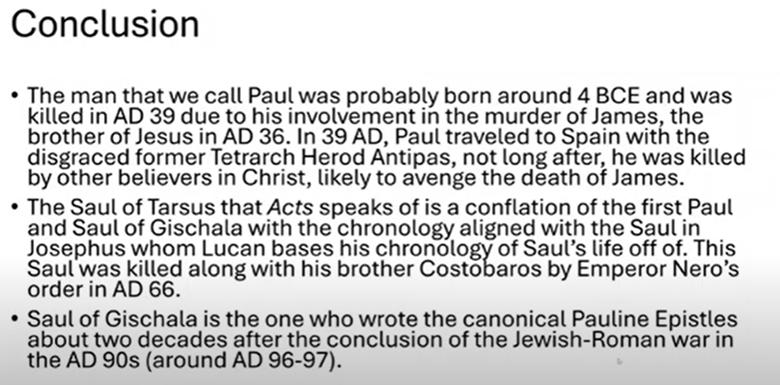
Jerome notes Saul of Gischala changed his name to Paul post 70 CE and might be the figure behind the Pauline letters. Jerome said Saul was a young man when Judea was laid waste, which would make sense of a Paul writing in the 90s CE.
Berman maps the dependency of Paul’s letters on Josephus as follows:
(1) Both portray themselves as very knowledgeable Hebrews. (2) Both claim to have been shipwrecked (Life 3 cf. 2 Cor 11:23-37). (3) Both call themselves Pharisees (Life 2 cf. Phil. 3:4-5). (4) Both state that they returned to Jerusalem after a three-year period, albeit, in Galatians, it takes longer for “Paul” to return to Jerusalem than Josephus did. (5) Both claim to have suffered persecution at the hands of other Jews. (6) Both mention a division having occurred; in Josephus’s case, he was appearing to propose a division in the rule of the government of Galilee with Joazar and Simon while canonical Paul also is open to different authorities in Christ to get along under the unity of Christ regardless of their differing views, although he also complains about the division depending on the circumstances (Life 63 cf. Rom.16:17). (7) Both claim to have had a visionary experience (Wars 3.7.3 cf. 2 Cor. 12:1-4). (8) Both traveled with a man named Titus to Jerusalem fourteen years after their respective three-year periods. Note that Josephus says he was born in the first year of Caius Caesar which is 37 CE and since Josephus was sixteen years old, the year he began his tutelage with Banus was 53 CE and it came to its conclusion in the year 56 CE. This means he went with Commander Titus to Jerusalem fourteen years later in the year 70 CE which lines up with “Paul’s” return to Jerusalem with Titus fourteen years after the three-year period (Life 1, Wars 5.9.1-3, 7.9.1 cf. Gal. 1:18, 2:1). (9) Josephus opposed forced circumcision upon adult gentiles and canonical Paul opposes compelling the gentiles to be circumcised like the Jews (Life 23 cf. Gal. 5:2). (10) Josephus after switching sides to the Romans becomes Titus Flavius Josephus while canonical Paul is the inversion of this by joining Christianity after abandoning his life of persecuting them. (11) Both knew a man named Epaphroditus (Antiquities Pref. 2 cf. Phil. 2:25). (12) Both mention James, the brother of Jesus (“of the Lord” in Paul’s case), (Antiquities 20.9.1 cf. Gal. 1.19). Galatians appears to be responding to Antiquities for the former is upgrading the latter by rewording Josephus to say, instead of James being the brother of Jesus called Christ, he’s now the Lord’s brother. (13) Both mention King Aretas IV of Nabataea (Antiquities 18.5.1-2 cf. 2 Cor 11:32). (14) Josephus refers to Saulos as a Herodian while Paul is called a Herodian (Wars 2.17.4 cf. Rom. 16:11). (15) Both mention the dividing wall between the gentiles and the Jews (Wars 5.5.2 cf. Eph. 2:14). (16) Both mention Jesus. (17) Both feature a debate over whether a gentile is required to get circumcised to convert to Judaism. In Josephus’ case, it revolves around Prince Izates of Adiabene. Two men are present with Izates trying to persuade him. One, named Eleazar, is trying to convince him to be circumcised while his counterpart Ananias would persuade him to remain uncircumcised. Paul argues with Cephas for he believes, contrary to Cephas, that gentiles should remain uncircumcised (Antiquities 20.2.4 cf. Gal. 2:11-14)
Berman’s Conclusion: