



(2/2) Why are there 2 Completely Different Bloodlines of Joseph in Matthew and Luke?
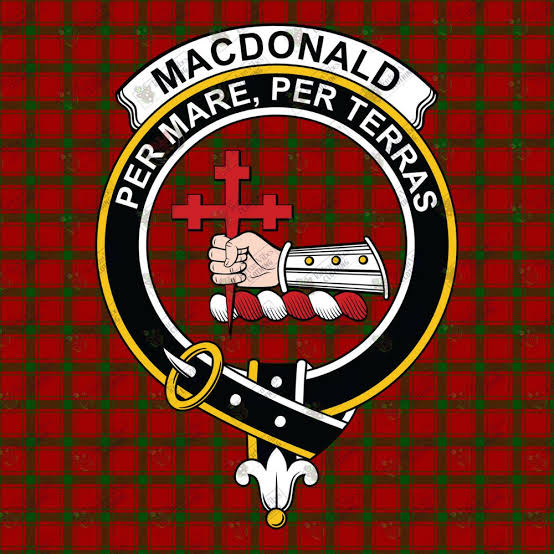
(MacDonald Family Coat of Arms, wiki)
The idea that bloodlines are not just historical but make figurative points is as old as the process itself, which makes sense in the case of Matthew 1 and Luke 3 (the genealogy in Luke may originally have been at the beginning of Luke) as bloodlines of Joseph that can’t be reconciled. It’s unlikely that Matthew and Luke just happened to interject bloodlines of Joseph into the Jesus tradition, and so I think it’s much more likely Luke is responding to Matthew.
With Matthew and Luke we have the two bible traditions I’m always thinking about of (i) substitutionary atonement in Matthew and (ii) moral influence in Luke.
What Matthew seems to have done with tracing his genealogy to Abraham is connecting Jesus to the beginning of the substitutionary tradition with the binding of Isaac. I noted last time around the 2nd temple period Isaac was beginning to be understood as atoning for future Israel’s sins by his willingness to die, not that he actually died. Some commentators have located this in the Jesus tradition whereby again it was not Jesus’ actual death but his willingness to die that fueled the redemption. And so, we read in Hebrews God’s plan could be fulfilled, not because Jesus died, but because he was willing to die: “7 In the days of his flesh, Jesus offered up prayers and supplications, with loud cries and tears, to the one who was able to save him from death, and he was heard because of his reverent submission. (Heb 5:7).”
In Luke, we see a different trajectory of tracing the bloodline back before the initial sacrificial tradition started with the sacrifices of Cain and Abel, to the eyes being opened of Adam to his nakedness and the will of God. Just as one line of thought in the bible focused on the sacrificial tradition, another pointed out that God wanted you to be loving with a contrite heart rather than sacrifices. What good was a burnt offering if you hadn’t undergone repentance and transformation. You would just sin again.
So, we have the two lines of thought as (i) God as a judge who needed a fine payment for sin, and (ii) God as a loving father (like in the story of the prodigal son) who needed no payment but just forgave (e.g., the penitential psalms and the story of Jonah). These two lines emerged as the Jews tried to understand God as a shepherd who loved and cared for his flock but also had absolute control of the flock and what purposed it served. This idea of God emerged as society became more agricultural/farmers.
For my own life, as a MacDonald, I am tied to the folklore around my own family genealogy and coat of arms. The earliest major story I know about my line is Angus Og MacDonald and his soldiers helping Robert the Bruce defend Scotland against the British. Whether there is any truth to this story I have no idea. With the advent of DNA testing many Scots who spent years researching their bloodlines found out they are not Scottish at all.
The “Mac” in MacDonald means “Son of,” and so my family name literally means “Son of Donald,” and so apparently there is an older connection to the “Donald” family. The mottos of the two families, Per Mare Per Terras: “By Sea / By Land,” are the same. I think too Scottish people originally came from Ireland and so the “Mac” was originally the Irish “Mc.” But the point is, don’t get a tattoo of your family coat of arms based on some folklore your parents passed on to you.
On my mom’s side, I’m German (Reiss) and Polish (Moskaliuk). But even here, research reveals Moskaliuk/Moskaluk was just a popular name Polish people adopted like Smith in the North American tradition, so there is no reason to think my Moskaluk family has any connection to the history of that name.
The genealogies in Matthew and Luke are ways of connecting Jesus through adoption to Joseph’s bloodline – connecting Jesus with David despite Jesus virgin birth. The same theme is that Jesus fulfills the prophecy of reestablishing the throne of David even though he died and in history accomplished no such thing. Rome still ruled the world when Jesus died. Matthew makes the brilliant connection to the curse I mentioned last time and so Jesus both fails to reestablish the Davidic throne but because he is not literally tied to the curse will reestablish the throne in the age to come thanks to his redemptive sacrifice in the tradition from Abraham/Isaac as interpreted in the second temple period. Luke on the other hand escapes the curse line all together because for him Jesus’ death was to influences us morally, not as a substitutionary sacrifice, and so Luke did as others had before him and went right back to the will of God that resulted in Adam’s eyes being opened with the idea God wanted you to have a loving contrite heart, not sacrifices.
Psalm 49:7 states that no human being can ransom another person or pay God a price to save someone’s life from death. Verse 8 adds that the price to save a life is too high for any human to pay. Matthew and Luke are going to have different takes on this. For Matthew, while regular humans cannot pay this spiritual ransom, Matthew’s theology views Jesus Christ as the virgin birth unique exception. This teaches that Jesus gave his life as a ransom for many, accomplishing what ordinary human beings could never do for themselves or others. Luke on the other hand is arguing such a sacrifice is meaningless without a repentance / turning around of spirit (think metanoia) and so Jesus’ death shows us the world wrongly turning on sinless Jesus that exposes/makes conspicuous the world’s depravity / opens its eyes as Adam’s eyes were opened to his nakedness.
If you think this all fits together too nicely, you’re right. Matthew and Luke’s genealogies were folklore birthed out of 2 highly technical and sophisticated understandings of scripture. This fits nicely with what we know of genealogies generally such as what I know of my own. The idea that an illiterate peasant Joseph had a highly sophisticated theologically charged bloodline his family had preserved for some reason, is preposterous.