



Ehrman and Goicoechea on Love and Feeling
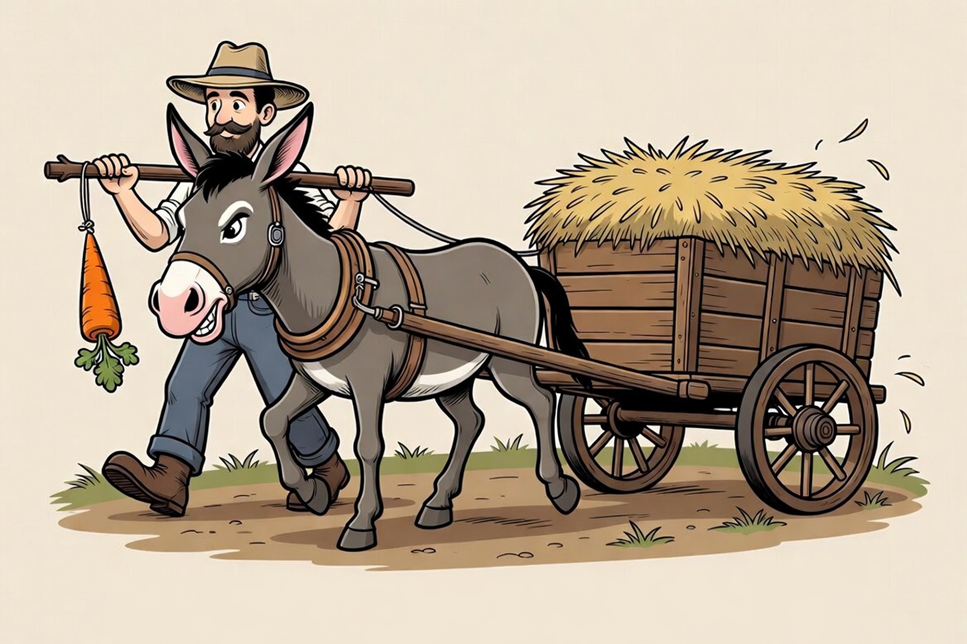
(An AI representation of the donkey-carrot idiom)
As I noted, Ehrman argues that much of what we understand as an altruistic society reflects Jesus’ ethical innovations and how his followers spread a watered-down version of them throughout the Roman empire:
Prior to the spread of Christianity, there were no public hospitals in the Roman world; no orphanages, poorhouses, or old persons’ homes; no government assistance to help those in need or private charities to minister to the poor, homeless, and hungry. These are Christian innovations that evolved from Christian understandings of what it meant to be a good person… Ehrman, Bart D.. Love Thy Stranger: How the Teachings of Jesus Transformed the Moral Conscience of the West (p. 3). Simon & Schuster. Kindle Edition.
This is helping the other in love, charitable giving, and forgiveness regardless of your feelings toward them even to the extreme of harming oneself in the service of an enemy like Luke’s Jesus and Stephen in Acts.
At the heart of Ehrman’s study is the motivation question of Altruism vs Egoism, whether we are motivated out of helping the other for its own sake, or whether we ultimately just want some form of self-benefit. If we are just being helpful to please God and build up rewards in the next life, or because it gives us a warm, fuzzy feeling, is this really moral, or are we just the donkey being led by the carrot where the work we are accomplishing is just a side effect?
Goicoechea argues Paul’s letter to the Thessalonians is motivating them to Universal love,
Saul turned away from his old ways of negativity to his new life and mission of love when he beheld the loving face of the persecuted Stephen, when he was called by the Resurrected Christ and when he was served with love by Ananias and the little Christian community… Paul’s letter to them is written in the form of a prayer for them: “May the Lord be generous in increasing your love and make you love one another and the whole human race as much as we love you” (1 Thess 3:12). This is the new Christian Gospel for which Paul is constantly on a mission and for which he is constantly working and praying with great energy and most passionate urgency. This prayer is his mission statement and it must be a prayer for Paul knows that by himself he would not even have known of this universal love let alone dream that it could become reality. As a Jew and as a Greek with both of those languages as his mother tongue Saul would never have dreamed of loving all other persons as his neighbor and as his own, but this new love is the fulfillment of those old loves which always distinguished Jew and Gentile, and Greek and Barbarian and now for Paul the Roman and Stoic idea of universal love can really happen. Goicoechea, David. Agape and Personhood: with Kierkegaard, Mother, and Paul (A Logic of Reconciliation from the Shamans to Today) (Postmodern Ethics Book 2) (pp. 83-84). Pickwick Publications, an Imprint of Wipf and Stock Publishers. Kindle Edition.
The Stoic idea of “universal love” is not the passionate, romantic, or emotional love we often think of today. Instead, it’s a calm, rational, unconditional benevolence or goodwill toward all human beings—rooted in reason, shared humanity, and the natural order of the universe. The Stoics called this philanthrōpia (love of humanity) and saw it as an essential part of living virtuously.
Stoicism teaches that the universe is governed by a divine, rational principle called logos (reason). All humans participate in this logos, making us fundamentally related—like parts of one great organism or “city.” This leads to cosmopolitanism: we are all citizens of the world (kosmopolitēs), not just our local tribe or nation. True justice and virtue require extending care beyond family or friends to every rational being.
The key mechanism for developing this universal love is oikeiōsis (often translated as “appropriation,” “familiarization,” or “endearment”). It’s a natural, progressive process:
- We start with self-love and instinctual care for our own survival.
- This naturally extends outward in “concentric circles” (as Hierocles described): to immediate family, then relatives, friends, fellow citizens, and—through reason and ethical growth—ultimately to all humanity.
- As we mature rationally, we come to see strangers as “like us” and part of the same whole. Our welfare becomes bound up with theirs.
This isn’t forced sentimentality—it’s the logical outcome of recognizing our interconnectedness. Seneca put it this way: Nature “instilled in us a mutual love and made us compatible… Our fellowship is very similar to an arch of stones, which would fall apart if they did not reciprocally support each other.”
How the Major Stoics Expressed It:
- Marcus Aurelius (the most explicit on this): He repeatedly urged loving fellow humans as brothers and parts of the same whole. “Love mankind. Follow God.” He described the ideal Stoic as “free of passion and yet full of love”—a deep, steady affection untainted by irrational emotion or expectation of return. He saw every person as a neighbor in the “great organism of human beings.”
- Seneca: He claimed no philosophical school showed more “love for human beings” or attention to the common good. He wrote that society thrives only through “mutual protection and love of its parts.”
- Epictetus: True love is a power that belongs only to the wise person—it is a deliberate, reasoned choice, not a compulsion or fleeting feeling.
The Stoic sage’s love is unconditional and godlike: it doesn’t depend on reciprocation (which is an “indifferent” outside our control). It flows from virtue itself.
Stoics were cautious about passions (irrational, disruptive emotions), so universal love isn’t about intense longing, jealousy, or attachment that could disturb inner tranquility. You can (and should) feel natural affection for family, friends, or a spouse—but always with the awareness that these are temporary gifts of fate. The broader universal love is steadier: it’s kindness, justice, patience, and service to the human community.
In practice, it means:
- Treating everyone with fairness and respect, regardless of status, nationality, or behavior.
- Acting for the common good as if you were a hand or foot serving the whole body.
- Loving even difficult people, because they share your rational nature.
This idea remains one of Stoicism’s most radical and enduring contributions: a practical blueprint for humanitarianism long before the term existed. It doesn’t require you to like everyone personally, but to wish them well and act justly toward them as fellow citizens of the cosmos.
Goicoechea argues
Paul distinguishes maternal and paternal affection as self-sacrificing in its nourishment and protection as distinct from guiding, teaching, encouraging and appealing. The criterion for Paul’s paternal ethics is being worthy of God. It is not that we will be virtuous that we might be happy or that we seek the greatest good for the greatest number by subordinating utilitarian to intrinsic value, but rather the ultimate motivational goal that Paul as a fatherly figure aims at for his children is to be worthy of God and the glory of his Kingdom. In that Kingdom there will be the affection of brotherly love. “As for loving our brothers, there is no need for anyone to write to you about that, since you have learned from God yourselves to love one another” (4:9). Prayer for others is a way of cultivating love for them, for Paul does not think we have to love people but not like them. For him love as affection is a joy and pleasure in the other. Some might wonder how we can love unpleasant others on demand. But prayer can cultivate that special atmosphere of love: by praising, adoring, worshiping and loving, by begging for forgiveness, healing, deliverance and salvation; by abiding in a spirit of thanksgiving and gratitude and by asking God to mother, father, brother, sister all of ours and especially enemies. Prayer is always positive and it cultivates positivity in the heart of the one who intones and envisions the other in the heart of God. Paul believes that his prayer will help the Thessalonians to grow in their love of love for one another and the whole human race… Prayer is a loving communication with God who is love and his Thessalonians will cultivate love if they constantly pray even as Jesus and Paul prayed especially for those in need. (Goicoechea, David. Agape and Personhood: with Kierkegaard, Mother, and Paul (A Logic of Reconciliation from the Shamans to Today) (Postmodern Ethics Book 2) (pp. 84-86). Pickwick Publications, an Imprint of Wipf and Stock Publishers. Kindle Edition.
So, Goicoechea is going to emphasize the feeling component that is lacking in Ehrman.
If the whole human race is loveable, how can they be excluded from God even if they sin? What is the role of morality in promoting the Kingdom of Love? On the one hand Paul has a great urgency about personal virtue. The Day of the Lord will come any day and we should be ready for it. But will we be punished to the extent of being excluded from the Kingdom if we are immoral? The answer seems to be no. We will be punished for any immorality but that may just be a natural law for everybody. The Lord did come to save sinners like Saul and Saul was a pretty bad sinner until after he was converted. So Paul urges his loved ones not to be immoral and get punished now because they are supposed to be happy and joyful. He does not want them to suffer the natural punishment that will be the consequence of any sin. However, it could be that no one will be excluded from the Kingdom that is to come. There is no time for all to be converted but we must love them… There is a peculiar paradox in Paul’s thinking about morality and the coming of the Day of the Lord. On the one hand there is a great urgency about being just and avoiding punishment, but on the other hand Paul is complacent concerning social justice. He believes that in Christ Jesus there is no longer master or slave for we are all brothers and neighbors but he will urge the slave to go back and submit to his master even though he does admonish the master to treat the slave like a brother. The point is that it is not Paul’s concern to bring about a social revolution. Christ Jesus will do that very soon when the Day of the Lord comes. In Christ Jesus there is no longer the whole set of customs governing the traditional rituals of male and female. But Paul is not interested in changing the social customs of his day, for the Lord will do that when he comes very soon. Paul is urgent about personal justice and virtue but he is complacent about social justice and virtue because the Lord will take care of that. Paul urges the Thessalonians to mind their own business and to let the Lord take care of his. They should have faith and patience in the face of any persecution and temptation. (Goicoechea, David. Agape and Personhood: with Kierkegaard, Mother, and Paul (A Logic of Reconciliation from the Shamans to Today) (Postmodern Ethics Book 2) (p. 90-91). Pickwick Publications, an Imprint of Wipf and Stock Publishers. Kindle Edition.)
It’s interesting that Paul reassures the Thessalonians should not worry about the salvation of friends and family who have died, getting us to reflect on the standards for salvation. If suffering out of love for one’s enemy realizes what was inconspicuous in the stoic idea of universal love, how can sinners be excluded from the Kingdom? Next time I will press forward with Ehrman’s book and Goicoechea on the letter to the Corinthians in his book.