



(2) Some thoughts on my History Valley Podcast with Jacob Berman Presentation: Pilate
One of my first slides in the presentation I wrote:
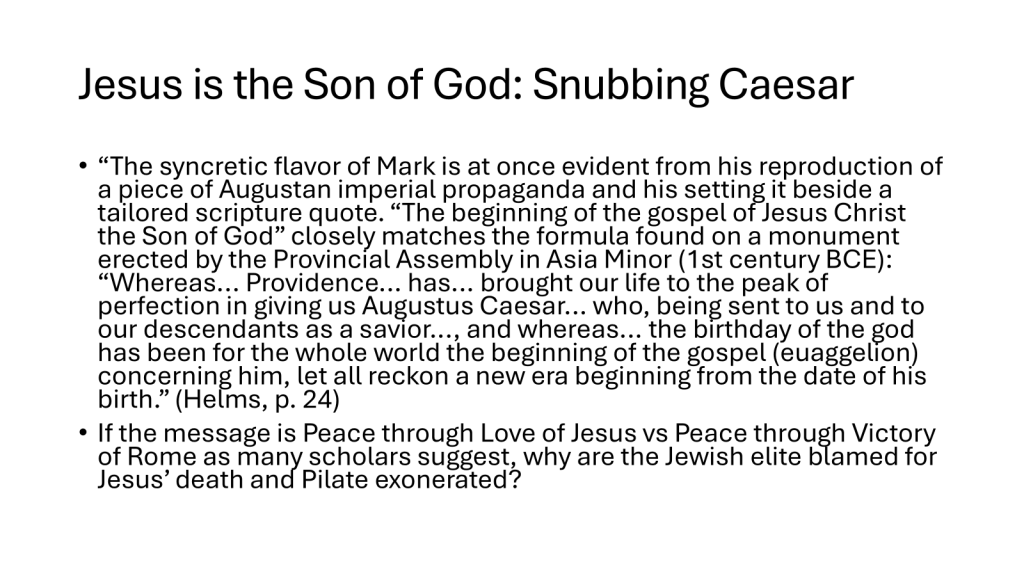
Again, we see the idea of blame for Jesus’ death being transferred to the Jewish elite. Just as we saw the difference between the John the Baptist of Josephus vs the John the Baptist of the gospels, we see the caricature of Pilate in the Gospels vs the cruel Pilate of history.
Depictions of Pontius Pilate Outside the New Testament
Historical sources beyond the New Testament, primarily from Jewish and Roman writers, portray Pontius Pilate—the Roman prefect of Judea from approximately 26 to 36 CE—as a harsh and insensitive administrator who often provoked conflicts with the local Jewish population.
These accounts come mainly from the works of Philo of Alexandria, Flavius Josephus, and a brief mention by Tacitus, none of whom were Christian and who wrote in the 1st century CE.
- Philo of Alexandria: In his work Embassy to Gaius (written around 41 CE), Philo describes Pilate as “a man of a very inflexible disposition, and very merciless as well as very obstinate.” He accuses Pilate of corruption, violence, and insensitivity to Jewish religious customs, such as when Pilate installed gilded shields bearing the emperor’s name in Jerusalem, which offended Jewish prohibitions against graven images and led to protests. Philo further characterizes him as “inflexible, stubborn and cruel,” emphasizing his role in escalating tensions during an embassy to Emperor Caligula. This portrayal aligns with Philo’s broader critique of Roman governance in Jewish territories.
- Flavius Josephus: Josephus, a Jewish historian writing in the late 1st century CE, provides more detailed episodes in Jewish War and Jewish Antiquities. He depicts Pilate as provoking unrest by bringing military standards (with imperial images) into Jerusalem at night, which violated Jewish laws and sparked widespread protests—Pilate eventually relented but only after threatening a massacre. Another incident involved Pilate using sacred temple funds to build an aqueduct, leading to a riot where Roman soldiers, disguised as civilians, killed many demonstrators. Josephus also records Pilate’s suppression of a Samaritan gathering at Mount Gerizim, resulting in numerous deaths, which ultimately led to his recall to Rome by the governor of Syria. mdpi.com While Josephus is somewhat neutral in tone compared to Philo, he presents Pilate as a competent but ruthless enforcer of Roman authority, often resorting to violence.
- Tacitus: The Roman historian Tacitus, in his Annals (written around 116 CE), briefly mentions Pilate in the context of Jesus’ execution: “Christus… suffered the extreme penalty during the reign of Tiberius at the hands of one of our procurators, Pontius Pilatus.” This reference is factual and neutral, confirming Pilate’s role as a Roman official but offering no insight into his character or cruelty.
Archaeological evidence, such as the “Pilate Stone” inscription found in Caesarea Maritima in 1961, confirms his title as “prefect” but does not elaborate on his personality.
Collectively, these sources paint Pilate as a cruel and provocative figure whose actions frequently incited rebellion, leading to his eventual removal from office.
Contrast with the Pilate of the Gospels
The New Testament Gospels (Matthew, Mark, Luke, and John) present a markedly different portrait of Pilate, emphasizing his reluctance and attempts to distance himself from Jesus’ crucifixion—most famously through the act of washing his hands in Matthew 27:24, symbolizing his claim of innocence in the matter (“I am innocent of this man’s blood; see to it yourselves”). In this narrative, Pilate repeatedly declares Jesus innocent of any crime, questions him philosophically (e.g., “What is truth?” in John 18:38), and offers to release him as part of a Passover custom, only yielding to the Jewish crowd’s demands under pressure to avoid a riot. This version depicts Pilate as a somewhat weak, conflicted administrator manipulated by others, more concerned with maintaining order than enforcing cruelty.
In contrast, the external historical sources from Philo and Josephus show no such hesitation or sympathy; instead, Pilate appears proactive in using force and disregarding Jewish sensitivities, with a track record of brutality that aligns poorly with the Gospels’ image of a hand-washing equivocator. Scholars suggest this Gospel portrayal may serve theological purposes, shifting primary blame for Jesus’ death onto Jewish leaders while portraying Roman authority as relatively blameless.
The discrepancy highlights how the Gospels may have softened Pilate’s image compared to the harsher, more aggressive figure in contemporary Jewish accounts.
For example, the Gospel accounts of Pontius Pilate granting Joseph of Arimathea’s request to remove Jesus’ body from the cross shortly after death (e.g., Mark 15:42-47, John 19:38-42) can indeed be seen as contributing to the New Testament’s relatively sympathetic or “gentler” portrayal of Pilate, especially when contrasted with the standard Roman objectives of crucifixion as a method of execution. This episode emphasizes Pilate’s apparent willingness to accommodate Jewish customs and sensitivities, aligning with the broader Gospel narrative that depicts him as reluctant, conflicted, and ultimately yielding to pressure rather than being inherently brutal. Below, I’ll break this down step by step, drawing on historical context for Roman crucifixion practices and scholarly analyses of the event.
The Purpose of Roman Crucifixion: A Prolonged, Public Spectacle
Crucifixion under Roman rule was not merely a means of execution but a deliberate tool of terror, humiliation, and deterrence, reserved primarily for slaves, rebels, and lower-class criminals to send a stark warning to the public.
The process was designed to maximize suffering and visibility:
- Victims were often stripped naked, scourged beforehand, and left hanging for hours or days until death, typically from asphyxiation, shock, or exposure.
- Post-death, bodies were frequently left on the cross to decompose, serving as fodder for scavengers like birds and dogs. This extended the spectacle, reinforcing the message of Roman dominance and the futility of resistance. Disposal often involved dumping remains in mass graves, rivers, or refuse pits rather than allowing proper burial, which would undermine the punishment’s psychological impact.
- Archaeological evidence, such as the remains of a crucified man from 1st-century Jerusalem (Yehohanan), shows that burial could occur in rare cases, but even then, it involved challenges like removing nails without further mutilating the body. Such exceptions were not the norm and often required special permission from authorities.
This practice horrified Jewish sensibilities, as Deuteronomy 21:22-23 mandated that executed bodies not hang overnight to avoid defiling the land, and Jewish custom emphasized prompt burial. Roman governors like Pilate, known from sources like Josephus and Philo for their insensitivity to Jewish traditions, typically prioritized imperial deterrence over local customs.
The Gospel Portrayal: Pilate’s Quick Approval as an Act of Accommodation
In the Gospels, Jesus dies after about six hours on the cross (around 3 p.m.), far shorter than the typical multi-day ordeal, probably emphasizing God is sovereign over death, not Pilate. Pilate expresses surprise at the rapid death and confirms it with a centurion before granting Joseph’s request to take the body down for burial in a nearby tomb—all on the same day, just before the Sabbath (a high holy day during Passover).
Key elements include:
- Pilate’s verification of death and immediate approval, described in Mark 15:45 as “gifting” the body (using the Greek dōreomai, implying generosity without bribe).
- The legs of the other crucified men are broken to hasten their deaths (a practice called crurifragium), but Jesus is spared this since he’s already dead, and his side is pierced instead.
- The removal is motivated by the approaching Sabbath, aligning with Jewish law to avoid leaving the body overnight.
This depiction softens Pilate’s image: rather than enforcing the full brutality of Roman policy, he appears pragmatic, even merciful, by respecting Jewish burial rites and avoiding potential unrest during a major festival. It echoes the “hand-washing” scene (Matthew 27:24), where Pilate symbolically absolves himself, shifting blame to Jewish leaders and portraying Roman authority as reasonable.
How This Contrasts with Historical Expectations and Fits the “Gentler” Narrative
Historically, allowing such a quick removal and burial would have been atypical for several reasons, potentially highlighting the Gospels’ theological shaping of events:
- Deviation from Roman Norms: As noted, bodies were usually left exposed to maximize deterrence. Exceptions might occur for political expediency, such as during holidays to prevent riots, or if requested by influential figures (like Joseph, a Sanhedrin member). Josephus notes that Jews sometimes buried crucified victims before sunset, but this may reflect an ideal rather than routine Roman concession, especially under harsh governors like Pilate.
- Pilate’s Known Character: External sources portray Pilate as stubborn and violent, quick to suppress dissent (e.g., massacring Samaritans, misusing temple funds). Scholars like Bart Ehrman argue that granting the body contradicts Pilate’s intransigence, suggesting the Gospel account may exaggerate his flexibility to make him seem less culpable. This could serve early Christian apologetics, minimizing Roman blame amid efforts to evangelize in the empire.
- Theological Motivations: The quick burial sets up the empty tomb narrative, essential for resurrection claims. Some historians view it as plausible during Passover to maintain order, but others, like John Dominic Crossan, suggest Jesus’ body was more likely discarded in a mass grave, with the burial story developing later.
In summary, while not impossible historically (especially given festival tensions), Pilate’s swift approval in the Gospels deviates from typical Roman brutality and aligns with the New Testament’s effort to humanize him—much like the hand-washing episode. This contributes to a narrative that portrays Roman officials as somewhat fair-minded, potentially aiding Christianity’s spread in a Roman world, while external histories emphasize his cruelty. The blame for the one who actually ordered the death of Christ is shifted to the Jewish elite, as we saw last time where the Herod of Josephus kills John the Baptist for growing too powerful, whereas the Jewish leader Herod in the gospels gives John the Baptist a humiliating death that prefigures Jesus’ more humiliating, tortuous death to cover over Herod’s immorality rather than suppress an uprising from John.