

New Blog Post Series: Jacques Derrida and the Philosophy of Death
In the last series I talked in good Heideggerian fashion about how our stance/being toward death is going to establish the way in which the human condition unfolds for us. For example, I summarized that:
Death is such a wonderful topic in Philosophy, like in Plato’s dialogues or Heidegger’s Being and Time. Of course, most people live their lives “as though” the next moment won’t be denied, though it could be. The most helpful example of Philosophy and Death I can think of is the spectrum of stances toward death one might take embodied in the ancient notions of Carpe Diem at one pole, and Memento Mori at the other pole. In ancient Greco-Roman philosophy, “carpe diem” (“seize the day”), originating from Horace’s Odes around 23 BCE, represents a stance toward death that emphasizes embracing life’s fleeting pleasures and living fully in the present, given mortality’s inevitability and the uncertainty of tomorrow. This approach aligns with Epicurean influences, urging one to pluck the ripe moments of existence without excessive worry about the future. By contrast, “memento mori” (“remember that you must die”) embodies an opposing perspective, rooted in Stoic thinkers like Seneca, Epictetus, and Marcus Aurelius, as well as earlier philosophers such as Plato, who viewed philosophy itself as a preparation for death. This stance uses the constant awareness of death not to indulge in earthly allure but to cultivate virtue, humility, introspection, and restraint—curbing excesses, focusing on moral living, and sometimes preparing for an afterlife or judgment, as seen in Roman triumphal traditions where a servant reminded victorious generals of their mortality to temper hubris. While the two concepts can overlap or complement each other in motivating purposeful action, they are frequently framed as antithetical: “carpe diem” as empowering and savoring, versus “memento mori” as humbling and resistant to life’s temptations. For example, as a secular activist I write on Historical Christianity and so with the apostle Paul we get his idea/claim that if the dead are not raised we might as well be gluttons and drunks for tomorrow we die (1 Corinthians 15:32) – Paul being from the birthplace of the stoic enlightenment.
In this new blog post series, I’m going to look at the philosophy of death by postmodern philosopher Jacques Derrida in his books The Gift of Death and Aporias.
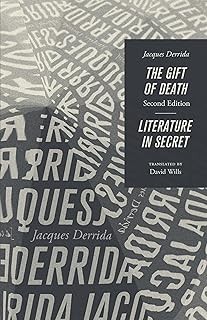
Book Blurb: The Gift of Death, Jacques Derrida’s most sustained consideration of religion, explores questions first introduced in his book Given Time about the limits of the rational and responsible that one reaches in granting or accepting death, whether by sacrifice, murder, execution, or suicide. Derrida analyzes Czech philosopher Jan Patocka’s Heretical Essays in the Philosophy of History and develops and compares his ideas to the works of Heidegger, Lévinas, and Kierkegaard. One of Derrida’s major works, The Gift of Death resonates with much of his earlier writing, and this highly anticipated second edition is greatly enhanced by David Wills’s updated translation. This new edition also features the first-ever English translation of Derrida’s Literature in Secret. In it, Derrida continues his discussion of the sacrifice of Isaac, which leads to bracing meditations on secrecy, forgiveness, literature, and democracy. He also offers a reading of Kafka’s Letter to His Father and uses the story of the flood in Genesis as an embarkation point for a consideration of divine sovereignty.
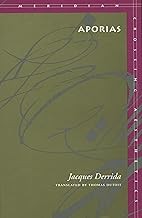
Book Blurb: “My death―is it possible?”
That is the question asked, explored, and analyzed in Jacques Derrida’s new book. “Is my death possible?” How is this question to be understood? How and by whom can it be asked, can it be quoted, can it be an appropriate question, and can it be asked in the appropriate moment, the moment of “my death”? One of the aporetic experiences touched upon in this seminal essay is the impossible, yet unavoidable experience that “my death” can never subject to an experience that would be properly mine, that I can have, and account for, yet that there is, at the same time, nothing closer to me and more properly mine than “my death.”
This book bears a special significance because in it Derrida focuses on an issue that has informed the whole of his work up to the present. For the last thirty years, Derrida has repeatedly, in various contexts and various ways, broached the question of aporia. Making it his central concern here Derrida stakes out a new frontier, at which the debate with his work must take place from now on: the debate about the aporia between singularity and generality, about the national, linguistic, and cultural specificity of experience and the trans-national, trans-cultural law that protects this specificity of experience and of the necessity to continue working in the tradition of critique and of the idea of critique, yet the corresponding necessity to transcend it without compromising it; the aporetical obligation to host the foreigner and the alien and yet to respect him, her, or it as foreign.
The foreign or the foreigner has always been considered a figure of death, and death a figure of the foreign. How this figure has been treated in the analytic of death in Heidegger’s Being in Time is explored by Derrida in analytical tour de force that will not fail to set new standards for the discussion of Heidegger and for dealing with philosophical texts, with their limits and their aporias. The detailed discussion of the theoretical presuppositions of recent cultural histories of death (Ariès, for example) and of psychological theorizations of death (including Freud’s) broaden the scope of Derrida’s investigation and indicate the impact of the aporia of “my death” for any possible theory.
Preparatory thoughts:
One of the great mysteries of philosophy’s contact with religion and death since Kierkegaard is the story of Abraham being told by God to sacrifice his son Isaac. There are 2 major issues here, on the one hand God has promised Abraham a great bloodline and so miraculously gave him a son, and yet has told Abraham to sacrifice Isaac. This shows faith is not a set of beliefs, since Abraham would need to simultaneously hold two contradictory ideas, but rather trusting God regardless of what directives are given. The second problem is the Jews of Abraham’s time did not believe in an afterlife but rather a person lives on through his male bloodline. This doubles the strain on Abraham’s faith, not to mention Isaac’s who is willing to die.
This is a profound take on the Akedah—the binding of Isaac—as explored in Kierkegaard’s Fear and Trembling. It is a cornerstone where philosophy grapples with the absurdities of faith, religion, and mortality. First, the paradox of God’s promise versus command: Kierkegaard casts Abraham as the “knight of faith,” who embraces the infinite resignation of the ethical (losing Isaac forever) but then, through absurd faith, expects the impossible return of his son. It’s not about rational beliefs—Abraham can’t logically reconcile the covenant of descendants (Genesis 17:4-8) with the demand to sacrifice (Genesis 22:2). Instead, faith becomes a passionate, personal leap into the unknown, trusting God’s sovereignty over human understanding. This isn’t blind obedience; it’s a relational trust that suspends the universal ethical norms (what Kierkegaard calls the “teleological suspension of the ethical”). Without this, Abraham would just be a murderer, not a father of faith. The second point amplifies the stakes beautifully. In the patriarchal era (around 2000-1500 BCE), ancient Hebrew thought, as reflected in the early Torah narratives, didn’t emphasize a personal afterlife. Concepts like Sheol—a dim, undifferentiated underworld for all souls—appear later in texts like Psalms but even then, it’s not a place of reward or punishment; everyone fades into shadow regardless of righteousness.
Immortality was indeed tied to progeny and legacy, making Isaac’s sacrifice a potential erasure of Abraham’s entire existence. For Isaac, willingly submitting (as midrashic traditions suggest he did, aware and consenting), it’s an even more radical act—facing oblivion without the comfort of heavenly compensation. This cultural backdrop, absent in later Jewish developments like resurrection in Daniel or rabbinic Olam Ha-Ba (the World to Come), heightens the existential terror Kierkegaard describes. Kierkegaard uses this to critique Hegelian rationalism: faith isn’t systematizable; it’s silent, individual, and terrifying. It echoes themes in existentialism—think Camus’ absurd or Heidegger’s being-toward-death—where confronting mortality without easy answers defines authenticity. Kierkegaard’s Fear and Trembling contrasts Abraham with the “knight of infinite resignation,” who accepts loss stoically but lacks the faith to reclaim joy in the finite. I gave the example in the previous blog series noted above of Paul who lost the luster of the fleshly (gluttony and drunkenness for instance), but precisely because he had faith in his future resurrection and Christ his fulfillment didn’t need these worldly indulgences.
I will begin next time by considering Derrida’s The Gift of Death.