



(Part 7) Blogging Through Richard Carrier’s new book “The Obsolete Paradigm of a Historical Jesus (2025)” – Hermeneutics/Deconstruction and Triangulation: Did Jesus Exist?
Hermeneutics is the idea that we can generate the meaning/sense of a text by considering individual elements as signs that point to or express a larger context, and the context is made manifest in the element. So, Van Gogh’s peasant shoes might express a world of abject poverty and endless toil to which they belong:
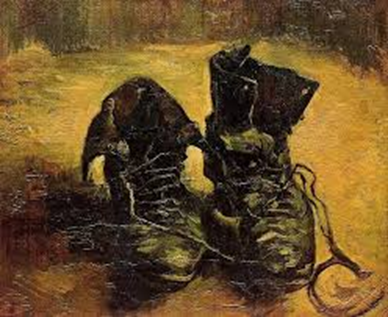
(Source Wiki)
Deconstruction is the idea that such hermeneutic movement from context/world to particular thing emerge in a larger context of the way meaning transfers between competing contexts. A good example of this is the tearing of the veil at the death of Jesus. Does this mean, as Mark seems to indicate, that the veil between man and God in the temple has been removed because of substitutionary atonement, or does it mean with Luke-Acts apparent non-substitutionary atonement cross that the veil tearing before Jesus died means what the Jewish elite did to God’s especially beloved (agapetos) Jesus was so egregious and heinous that no sacrifice could get man right with God again and so God’s response was to, through the Romans, destroy the temple in 70 CE as he previously did with the first temple.? Salvation in this case is not through substitutionary atonement but seeing yourself in the Jewish elite who corruptly had Jesus killed and thereby have that guilt circumcise your heart to reveal the law written on it so your eyes would be opened and you can truly repent. Paul has both these models (paying the sin debt, and participating in Christ’s death) in Romans, one to deal with sin as transgression and the other Sin as a powerful entity that has you brainwashed- think of Satan entering Judas. One model is paying a price, the other is repentance and forgiveness. In the case of deconstruction, we don’t have a singular “the meaning of the tearing of the veil,” but rather the meaning according to Mark, the meaning according to Luke, etc and so we see this in Kierkegaard with his pseudonymous writing.
“Triangulating” can mean a number of different things in interpretive theory, but I’m going to use it here to show how numerous lines of evidence converge on the general idea that the Jewish elite were being blamed for the death of Jesus. This allows us to extrapolate the idea Jesus was a real historical person and not just a mythical figure who was killed by demons as Christ mythicists such as Price and Carrier think. Let’s first provide the context.
Many Jews in the late Second Temple period (roughly 1st century BCE to 70 CE) viewed significant portions of the Jewish elite—particularly the high-priestly families and some of the Jerusalem aristocracy—as corrupt, collaborationist, or religiously compromised. Key evidence and groups that held this view included The Dead Sea Scrolls community (likely Essenes) Their texts (e.g., the Damascus Document, 4QMMT, the Community Rule) repeatedly condemn the Jerusalem Temple priesthood as polluted and illegitimate.
They call the current high priest the “Wicked Priest” (in the Pesharim) and accuse the Sadducean priestly aristocracy of changing the calendar, defiling the Temple with improper rituals, and enriching themselves unjustly.
While the Pharisees were not revolutionaries, later rabbinic literature preserves strong criticism of certain high-priestly families (especially the houses of Annas and Boethus).
Talmudic passages (e.g., b. Pesahim 57a, t. Menahot 13:21) accuse some high priests of violence, simony (buying the office), ignorance of the law, and treating the Temple like a family business. One famous line curses the “House of Boethus” and “House of Annas” for their arrogance and oppression.
With Ordinary people and lower priesthood, Josephus (a 1st-century Jewish historian from a priestly family himself) repeatedly describes popular hatred toward high priests such as Ananus ben Ananus or the later high priests during the First Revolt (66–73 CE).
Crowds sometimes rioted against high priests (e.g., stoning of priests, burning of the houses of Annas and Ananias). The lower-rank country priests were often economically squeezed by the Jerusalem elite, which bred resentment.
The strongest denunciations in the New Testament come from Jesus himself: calling the Temple leadership a “den of robbers” (Mark 11:17), overturning tables, predicting the Temple’s destruction, and repeatedly clashing with “the chief priests and elders.”
The Synoptic Gospels portray the Sadducee-dominated priestly leadership as collaborating with Rome and willing to execute Jesus to protect their own power.
More radical groups saw the entire priestly-Roman arrangement as idolatrous and tyrannical. Judas the Galilean (Acts 5:37; Josephus, Ant. 18.1) rejected paying tribute to Rome and implicitly challenged the legitimacy of a priesthood that cooperated with Roman rule.
In short, large segments of the Jewish population—Essenes, many Pharisees, Galilean and Judean peasants, lower priests, and eventually the revolutionary groups—regarded the ruling high-priestly families and parts of the Sadducean aristocracy as corrupt, greedy, and too cozy with Roman power. This widespread resentment is one of the major factors that fueled the explosive tensions leading to the First Jewish-Roman War in 66–73 CE.
- In this context, Helen Bond argues Jesus’ death in the Gospels because of the corrupt Jewish elite was being interpreted as the reason God poured out his wrath on the temple via the Romans in 70 CE.
- Hamilton notes the satirical nature of Jesus’ trial in the gospels before the Jewish elite (though for Hamilton it’s history) with time after time of the elite transgressing Jewish Law and tradition (e.g., meeting on Passover Eve), but with legal loopholes found every time to maintain surface respectability. This relates to Jesus’ temptation by Satan in Matthew where Satan tries to cite scripture for his own advantage.
- Paul specialist Benjamin White notes Paul says the Jews killed Christ: “14 For you, brothers and sisters, became imitators of the churches of God in Christ Jesus that are in Judea, for you suffered the same things from your own compatriots as they did from the Jews 15 who killed both the Lord Jesus and the prophets and drove us out; they displease God and oppose everyone 16 by hindering us from speaking to the gentiles so that they may be saved. Thus they have constantly been filling up the measure of their sins, but wrath has overtaken them at last (1 Thess 2:14-16).” We know from the Dead Sea Scrolls the various Jewish sects were constantly going after one another about who had the true view of God so it makes sense Paul here talking to gentiles about the Jews he feels killed Christ. This passage is apocalyptic but need not be post 70CE since Paul thought with the resurrection of Christ the end time judgment was underway. This fits with Paul saying God loved the Jews because they were of Abraham, but hated them for rejecting Christ.
- Matthew,25:27 declares the blood of Christ was on the Jews, which makes sense of the idea that the temple was destroyed as God’s wrath for the Jews killing Christ.
- Josephus contends the Jewish elite killed Christ. In both the likely original form and the transmitted text, the accusation and responsibility are placed on “the leading men among us” (τῶν πρώτων ἀνδρῶν παρ’ ἡμῖν) — that is, the Jewish aristocratic elite (chief priests, Sanhedrin members, etc.) — who bring Jesus to Pilate. This is generally accepted as authentic to Josephus, not the part interpolated by a later Christian scribe
- As Ehrman notes, Paul declares Jesus an angel. The point seems to be just as the angels were sent to test Sodom and Gomorrah in Lot’s story, Jesus was sent to test the Jews as the especially beloved messenger sent to restore the Davidic throne, where the Jews rejected him and orchestrated his brutal torture and crucifixion.
We might think of these as different points moving toward a commonality of the idea that the Jewish elite killed Jesus, and so evidence Jesus was a historical person, not a myth. While the interpretation is not definitive, the convergence of these various strands moves toward the historical existence of Jesus.