



Holiday Post Series: Divine/Demonic Possession and the Heart of Christianity
- I’m taking my holiday break from Secular Frontier, but here is my holiday post on something essential!
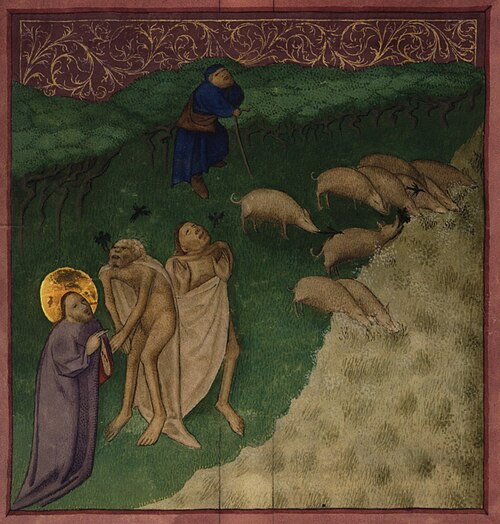
Jesus’ exorcism of the Gerasene Demoniac, wiki
BACKGROUND:
Greek had several terms that could describe a person undergoing divine or demonic possession, though the concepts often overlapped since spirits (daimones) were not always strictly categorized as benevolent or malevolent in pre-Christian contexts. Divine possession typically implied inspiration, ecstasy, or being filled with a god’s presence (Enthusiasmos e.g., in prophecy, poetry, or ritual), while demonic possession leaned toward harmful or uncontrolled influence. Below, I’ll outline key words for a person in such a state, focusing on those directly tied to possession, along with their etymologies.
For Divine Possession: terms often carried positive or ambivalent connotations, associated with gods like Apollo, Dionysus, or the Muses.
- Entheos (ἔνθεος): An adjective meaning “possessed by a god,” “inspired,” or “having the god within.” The person could be called an entheos (one who is possessed) or, in noun form, an enthousiastēs (ἐνθουσιαστής), which directly refers to someone undergoing divine possession or enthusiasm.
- Etymology: From en- (ἐν-, “in” or “within”) + theos (θεός, “god”). This implies the god is inside the person, inspiring them. The modern English word “enthusiasm” derives from this root via enthousiasmos (ἐνθουσιασμός, “divine inspiration”).
- Theolēptos (θεόληπτος): An adjective meaning “seized by a god,” “possessed by divinity,” or “inspired.” It could describe someone in a state of divine ecstasy or superstition.
- Etymology: From theo- (θεο-, “god” or “divine”) + lēptos (ληπτός, from lambanō [λαμβάνω], “to take” or “seize”). Literally “taken/seized by a god,” emphasizing sudden or forceful divine intervention.
- Theophorētos (θεοφόρητος) or Theophoros (θεοφόρος): Meaning “borne by a god,” “god-bearing,” or “carried by divinity,” often implying possession where the person is a vessel for the god.
- Etymology: From theo- (θεο-, “god”) + phorētos or phoros (from pherō [φέρω], “to bear” or “carry”). It suggests the person is “carried” or “borne” by the divine force, or alternatively bears the god within them.
- Katochos (κάτοχος): Meaning “held” or “possessed” (by a god), sometimes used for individuals in a trance-like state or ritually detained in a temple due to divine influence.
- Etymology: From kata- (κατα-, intensifier or “down”) + echō (ἔχω, “to have” or “hold”). Literally “held down” or “restrained,” implying the god’s grip or control over the person.
For Demonic Possession: In ancient Greek, “demonic” possession wasn’t always negative; daimōn (δαίμων) referred to any supernatural spirit, which could be good (eudaimōn) or evil (kakodaimōn). Harmful possession was often described similarly to divine but with a malevolent twist, especially in later texts.
- Daimonizomenos (δαιμονιζόμενος): A participle used as a noun meaning “one who is possessed by a demon” or “demon-possessed.” This is the most direct term for someone under the influence of a (typically harmful) spirit.
- Etymology: From daimonizomai (δαιμονίζομαι, “to be possessed by a daimōn”), derived from daimōn (δαίμων, “deity,” “spirit,” or “power”) + -izomai (-ίζομαι, a verbal suffix indicating a state or process). The root daimōn likely comes from daiō (δαίω, “to divide” or “distribute”), suggesting a spirit that apportions fate or destinies—hence its dual good/evil nature in early usage.
These words appear in classical texts (e.g., Plato’s discussions of “divine madness” or theia mania [θεία μανία], which overlaps with possession) and later in Koine Greek (e.g., the New Testament for daimonizomai). The distinction between divine and demonic often depended on context rather than strict terminology, as ancient Greeks viewed possession as a spectrum of supernatural influence.
In Plato’s philosophy, particularly as articulated in his dialogue Phaedrus, “divine madness” or theia mania (θεία μανία) refers to a state of inspired frenzy or ecstasy induced by the gods, which elevates the human soul beyond ordinary rational constraints and leads to profound benefits, such as prophecy, creativity, purification, or philosophical insight. This idea influenced later thinkers, from Neoplatonists to Romantic poets, who saw creativity and insight as stemming from a “divine spark” rather than pure logic.
This concept is presented as a positive counterpoint to ordinary human madness, which Plato views as a harmful affliction or illness stemming from imbalance in the body or soul.
Instead, theia mania is a divine gift that bestows virtue and excellence upon humanity, often manifesting as unusual behavior attributed to supernatural intervention.
It is in this context the following posts meditate on the cross of Christ overcoming the possession of the evil entity/force Sin. This is the counter concept of Christ in You, the idea that the believer welcomes in the divine possessing spirit of Christ as the battler of satanic temptation par excellence, so it is no longer I who live but Christ who lives in me.
THE POSTS:
The Meaning of Life Through Death
What’s the Point of the Bible?
(2/2) What’s the Point of the Bible: Causing Anagnorisis in the Reader
(CONCLUSION) What’s the Point of the Bible: What is Faith? It’s not What you Think
Breaking the Demonic Spell: A Twofold Interpretation of Sin in Christian Origins