



(Part 1) Blogging Through Richard Carrier’s new book “The Obsolete Paradigm of a Historical Jesus (2025)”
POST UPDATED!
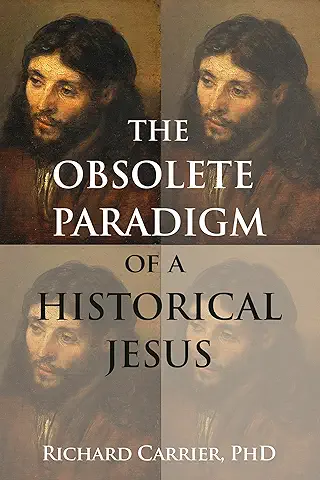
The modern incarnation of the Christ Myth theory, the idea that Jesus was originally thought to be a celestial being who was later Euhermerized or put in stories on earth, is generally thought to be inaugurated by Earl Doherty’s “The Jesus Puzzle,” and dealt with under peer review by Carrier and Lataster. In this new volume, Carrier advances his argument that Jesus was never an historical person. He summarizes his view as follows.
In our model, Christianity began with a sincere belief in a historical Jesus—in the same sense as it began with a sincere belief in a historical Satan. Neither man’s origin story involved visiting Earth. Satan’s rebellion took place in outer space. It was believed to be historical nonetheless. Our proposal is that Christ’s reversal of the spiritual and cosmic effects of Satan’s rebellion, by becoming mortal and undergoing a self-sacrificial death (Philippians 2:5–11), also took place in outer space (or, perhaps, if on Earth at all, then in some distant realm beyond human civilization, like the Garden of Eden in some versions of Jewish lore at the time). That this had happened was then learned of through revelations (whether dreams or visions, or both; and whether real or pretended, or both) and the finding of hidden messages in scripture (in the manner of a Hebrew pesher), exactly as Paul says in Romans 16:25–26: “my gospel and the preaching of Jesus Christ” is “according to the revelation of the mystery which was kept secret for long ages but is now disclosed, and through the prophetic writings is made known to all nations” (RSV). It was only a generation later that a historicization of this cosmic hero as a Galilean preacher came into anyone’s mind—indeed, that idea likely began with the author of Mark, possibly in response to the existential impact of the Jewish War. The other Gospels were just redactions, embellishments, and rewrites of Mark’s contrivance. Within a few generations of that, however, by natural selection or historical happenstance (or both), the original conception was replaced by a more literal adherence to the new one.
Carrier notes this new book of his failed formal academic peer review for publication because the reviewers judged
“it makes no new contributions to the field, is too popular in style, and won’t be “interesting for readers within the discipline of biblical studies” (or for even more trivial reasons like that they just ‘didn’t like’ its findings or the order of its chapters).”
Carrier rebuts this decision HERE. Why are New Testament specialists so sure there was an historical Jesus? One point of interpretation is his death. Both Paul (1 Thessalonians 2) and Matthew note the Jews were considered responsible for Christ’s death. See Carrier’s rebuttal on his blog HERE.
What do New Testament specialists say? Scholars note that ancient interpretations of the cross included the idea that the wrongful crucifixion of God’s especially beloved (agapetos) Jesus resulted in God’s wrath with the destruction of the temple in 70CE, and the Jews getting booted from the land post Bar Kokhba. It was thereby being interpreted analogous to the destruction of the 1st temple, and along the same theological lines of the angels being sent to test the people in Lot’s story, Paul understanding Jesus to be an angel. Helen Bond argues that Mark views Jesus’ death as the reason the temple was destroyed in 70 CE. Bond notes in Mark, Mark thinks the temple was destroyed in 70CE because of sin and the Jewish leadership killing Jesus, like the first temple fell to the Babylonians because of Jewish sin. Many Jews thought the Jewish elite of Jesus’ time were corrupt.
Josephus notes in a plausibly authentic section of the TF that Jesus was executed by Pilate because he was accused “by the leading men among us,” the Jewish elite. Similarly, the Jewish elite enlisted the Romans to deal with the doomsday nuisance of Jesus ben Ananias (62 CE). We see, for instance, the extensive legal loopholes in Mark’s satire of the highly corrupt trial of Jesus in front of the Jewish high council. Jesus was sent by God to test mankind, resulting in, in Paul’s words, “sin becoming sinful beyond measure.” Because of this, the Jews were judged.
Paul specialist Benjamin White does not find reason to dismiss 1 Thessalonians 2:13-16 that blames the Jews for Jesus’ murder as an interpolation. Rather, White sees Paul as an apocalyptic Jew navigating through other Jews like the Pharisees and Essenes, stating that he is not of the Cephas (etc.) group, and the like. And we know from the Dead Sea Scrolls that these groups were always going after one another over who had the rightful claim as the true people of God. It is certainly reasonable of Paul, speaking among Gentiles, to speak badly of Jews that he thought killed Christ. Given his belief that the apocalypse was underway, with the resurrected Christ being the first fruits of the general resurrection harvest of souls at the end of the age, Paul thought that the judgment of the enemies of God had begun in response to the despicable murder of God’s chosen one Jesus, and so need not refer to post-70 CE destruction of Jerusalem. As Joel Marcus relatedly points out, Paul says that the Jews are beloved by God because they come from Abraham, Isaac, and Jacob, but are enemies of God for rejecting Jesus and his message, per Romans 11:28. The first Christians blaming the Jewish elite for killing God’s beloved Davidic Messiah Jesus could be part of the reason why Paul/Saul was persecuting them. This is encapsulated, as Hamilton notes in a different context, by Mark with the wildly illegal Jewish trial of Jesus where there is satire of numerous breaches of Jewish laws and customs, but with clever loopholes found to give surface credibility to the trial. Matthew casts Satan in this light citing God’s word in the temptation of Jesus in a way God didn’t intend.
Another mythicism rebuttal popular among New Testament specialists like Bart Ehrman is the historical Jesus taught repentance and forgiveness, while his disciples re-interpreted him after he died for a substitutionary atonement model of salvation. It should be noted that Ehrman’s argument for a pre-death forgiveness model of salvation from Jesus of course runs at counter purposes to Mark’s gospel of propaganda of the cross/resurrection, “propaganda”” being what the Roman word “gospel” means. So, for example, we have the disciples armed and attacking the arresting party as though no one had a clue Jesus was supposed to die. Mark deals with this inconvenient truth by having Jesus repeatedly predict his crucifixion/resurrection, but the disciples don’t understand.
Ehrman argues central to Jesus’s teaching was the need to repent in preparation for the coming Kingdom of God. Those who returned to God would be graciously forgiven for their transgressions, with no penalty or payment required. After Jesus’ death his followers reversed his teaching, maintaining that God did not freely forgive sins but required an atoning sacrifice.
John the Baptist practiced a baptism for the remission of sin which was needed because a day of judgment was imminent (the axe was at the tree). People needed to repent and turn back to God. Temple sacrifice was not needed. Jesus’ first message is repent because the Kingdom is near. Evil forces and people will be destroyed.
The lord’s prayer suggests we will be forgiven, a debt that does not need to be paid. This is reflected in the parable of the unforgiving slave in Matthew. There is the story of the rich young man who will be saved by giving everything to the poor, and the story of the sheep and goats – not atonement. Jesus taught God forgives sins. His followers taught God required atonement. Jesus taught for sinners to repent and be forgiven. The story of the prodigal son is about God forgiving if we repent and turn back to him.
Ehrman says Paul doesn’t talk about forgiveness, but atonement. Mark 10:45 also sees his death as an atonement. The temple curtain rips, suggesting access to God without a further atoning sacrifice. Luke does not have atonement and has the curtain tearing beforehand indicating the destruction of the temple for what the Jewish elite did to Jesus. Luke-Acts also has the forgiveness of sins. The followers of Jesus experienced their master crucified, but he was seen after death and so there must have been reason Jesus died.
So, lots of different ideas to consider. Join me next time as I continue blogging with Part 2 on this book!