



(Part 2/2) Come See Me on History Valley Podcast with Jacob Berman – All Things Paul! MY NOTES AND SLIDES FOR THE PRESENTATION
Previously, I posted the video. Now, the conclusion
SLIDES:

RESEARCH NOTES:
History Valley talk with Jacob Berman: Issues With Dating the Pauline Epistles
- The Creation of Paul
Nina Livesey suggests Paul was created in the second century in Acts and the letters are fictive correspondence based on that figure.
Fictive correspondence was often in collections and so we find that with Paul. For example, in Galatians Paul refers to 1 Corinthians without saying he is doing so thereby assuming the reader has the whole collection of letters: In Marcion’s Galatians 5:21 we have a reference to: “the flesh is not inheriting the kingdom of heaven as I have said before.” Though Paul does not say, the reference is to 1 Corinthians 15:50.
Paul seems to be a type of the one prophesied in the Hebrew Bible to bring the message of God to the pagans in the end times, as a literary pair of Jesus who was a type of failed messianic claimant popular at the time whose message was to the Jews, Jesus being exceptional because unlike the other failed messianic claimants he was specially chosen by God. The expectation of someone like a Paul is prominent in prophetic books like Isaiah, Micah, and Zechariah, portraying a universal expansion of God’s covenant beyond Israel.
Helen Bond argues that Mark views Jesus’ death as the reason the temple was destroyed in 70 CE. Bond notes in Mark, Mark thinks the temple was destroyed in 70CE because of sin and the Jewish leadership killing Jesus, like the first temple fell to the Babylonians because of sin. Josephus notes in a plausibly authentic section of the TF that Jesus was executed by Pilate because he was accused “by the leading men among us,” the Jewish elite. Similarly, the Jewish elite enlisted the Romans to deal with the doomsday nuisance of Jesus ben Ananias (62 CE).
These interpretations were shaped by the belief that God actively governed history, using tragedies to discipline and restore His people. With the destruction of the Temple in 70 CE and the loss of their homeland after Bar Kokhba, it was ‘as though‘ God was punishing them for a horrific crime like torturing and killing God’s beloved innocent Son. Jesus was thus analogous to the two angels’ visit to Lot in Genesis 19, which serves as both an investigation and a catalyst/test for the people’s vileness to become conspicuous.
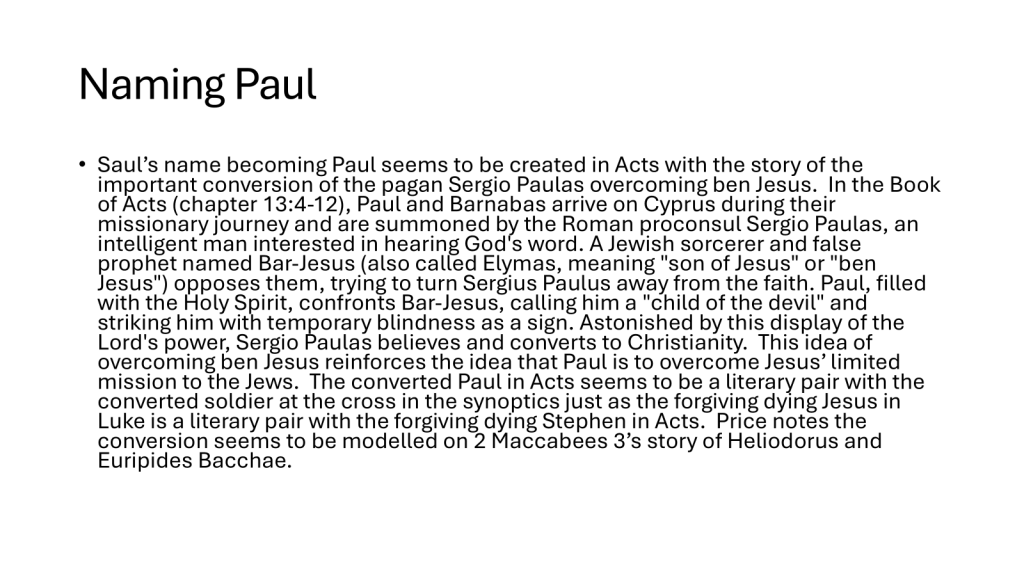
Saul’s name becoming Paul seems to be created in Acts with the story of the important conversion of the pagan Sergio Paulas overcoming ben Jesus. In the Book of Acts (chapter 13:4-12), Paul and Barnabas arrive on Cyprus during their missionary journey and are summoned by the Roman proconsul Sergio Paulas, an intelligent man interested in hearing God’s word. A Jewish sorcerer and false prophet named Bar-Jesus (also called Elymas, meaning “son of Jesus” or “ben Jesus”) opposes them, trying to turn Sergius Paulus away from the faith. Paul, filled with the Holy Spirit, confronts Bar-Jesus, calling him a “child of the devil” and striking him with temporary blindness as a sign. Astonished by this display of the Lord’s power, Sergio Paulas believes and converts to Christianity. This idea of overcoming ben Jesus reinforces the idea that Paul is to overcome Jesus’ limited mission to the Jews. The converted Paul in Acts seems to be a literary pair with the converted soldier at the cross in the synoptics just as the forgiving dying Jesus in Luke is a literary pair with the forgiving dying Stephen in Acts. Price notes the conversion seems to be modelled on 2 Maccabees 3’s story of Heliodorus and Euripides Bacchae.
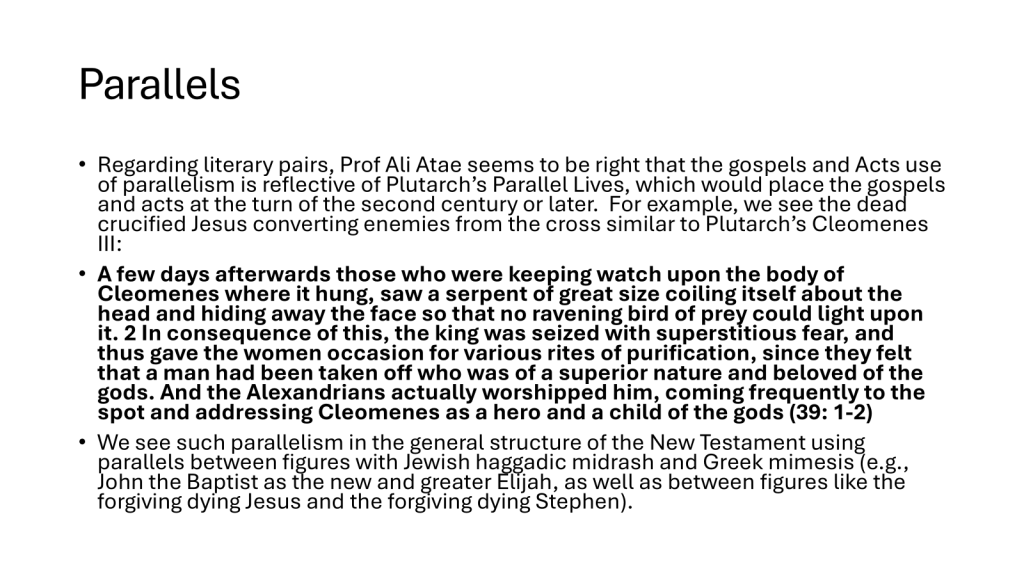
Regarding literary pairs, Prof Ali Atae seems to be right that the gospels and Acts use of parallelism is reflective of Plutarch’s Parallel Lives, which would place the gospels and acts at the turn of the second century or later. For example, we see the dead crucified Jesus converting enemies from the cross similar to Plutarch’s Cleomenes III:
A few days afterwards those who were keeping watch upon the body of Cleomenes where it hung, saw a serpent of great size coiling itself about the head and hiding away the face so that no ravening bird of prey could light upon it. 2 In consequence of this, the king was seized with superstitious fear, and thus gave the women occasion for various rites of purification, since they felt that a man had been taken off who was of a superior nature and beloved of the gods. And the Alexandrians actually worshipped him, coming frequently to the spot and addressing Cleomenes as a hero and a child of the gods (39: 1-2)
We see such parallelism in the general structure of the New Testament using parallels between figures with Jewish haggadic midrash and Greek mimesis (e.g., John the Baptist as the new and greater Elijah, as well as between figures like the forgiving dying Jesus and the forgiving dying Stephen).
- Non-Pauline Hebrews Letter as a clue to what is going on in the Pauline Epistles.
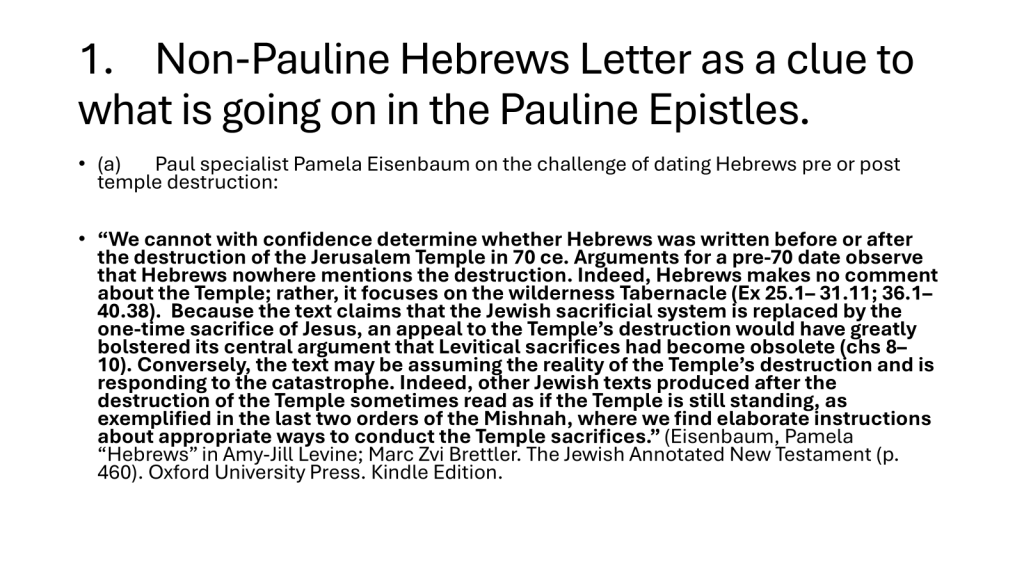
- Paul specialist Pamela Eisenbaum on the challenge of dating Hebrews pre or post temple destruction:
“We cannot with confidence determine whether Hebrews was written before or after the destruction of the Jerusalem Temple in 70 ce. Arguments for a pre-70 date observe that Hebrews nowhere mentions the destruction. Indeed, Hebrews makes no comment about the Temple; rather, it focuses on the wilderness Tabernacle (Ex 25.1– 31.11; 36.1– 40.38). Because the text claims that the Jewish sacrificial system is replaced by the one-time sacrifice of Jesus, an appeal to the Temple’s destruction would have greatly bolstered its central argument that Levitical sacrifices had become obsolete (chs 8– 10). Conversely, the text may be assuming the reality of the Temple’s destruction and is responding to the catastrophe. Indeed, other Jewish texts produced after the destruction of the Temple sometimes read as if the Temple is still standing, as exemplified in the last two orders of the Mishnah, where we find elaborate instructions about appropriate ways to conduct the Temple sacrifices.” (Eisenbaum, Pamela “Hebrews” in Amy-Jill Levine; Marc Zvi Brettler. The Jewish Annotated New Testament (p. 460). Oxford University Press. Kindle Edition.
- Resolving the Apparent Gethsemane Contradiction between Hebrews and Mark as Hebrews presupposing Mark. We read:
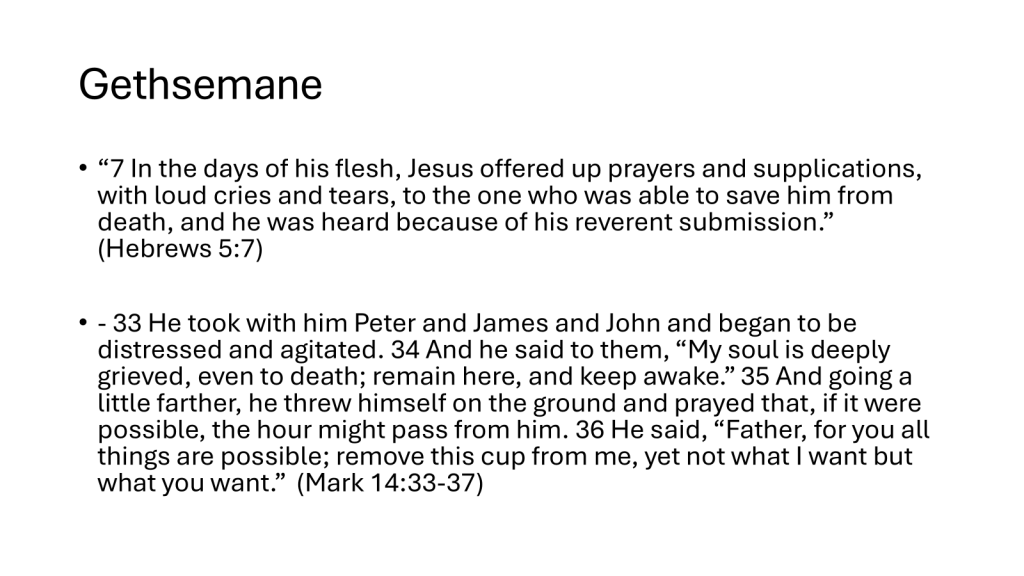
– “7 In the days of his flesh, Jesus offered up prayers and supplications, with loud cries and tears, to the one who was able to save him from death, and he was heard because of his reverent submission.” (Hebrews 5:7)
– 33 He took with him Peter and James and John and began to be distressed and agitated. 34 And he said to them, “My soul is deeply grieved, even to death; remain here, and keep awake.” 35 And going a little farther, he threw himself on the ground and prayed that, if it were possible, the hour might pass from him. 36 He said, “Father, for you all things are possible; remove this cup from me, yet not what I want but what you want.” (Mark 14:33-37)
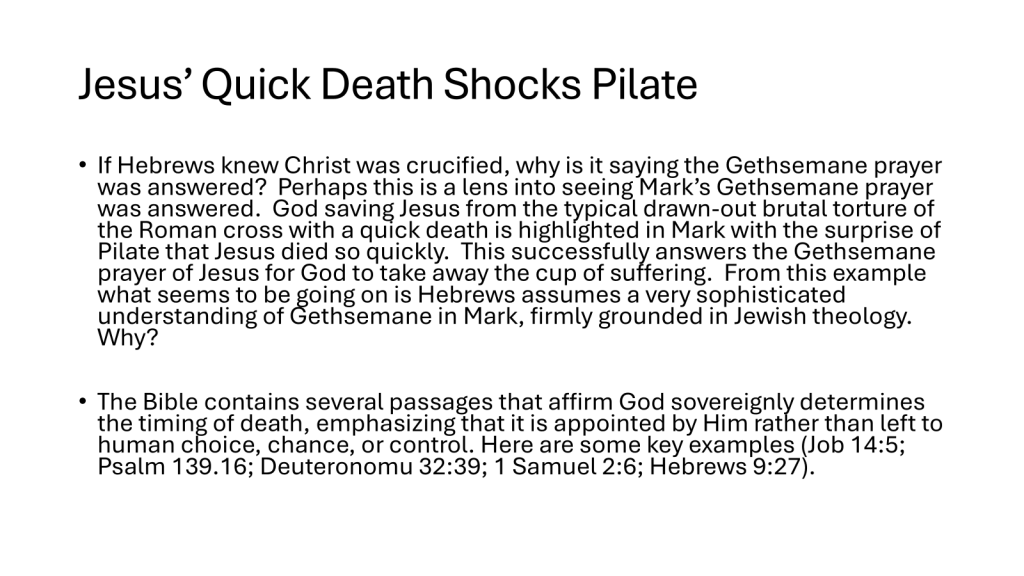
If Hebrews knew Christ was crucified, why is it saying the Gethsemane prayer was answered? Perhaps this is a lens into seeing Mark’s Gethsemane prayer was answered. God saving Jesus from the typical drawn-out brutal torture of the Roman cross with a quick death is highlighted in Mark with the surprise of Pilate that Jesus died so quickly. This successfully answers the Gethsemane prayer of Jesus for God to take away the cup of suffering. From this example what seems to be going on is Hebrews assumes a very sophisticated understanding of Gethsemane in Mark, firmly grounded in Jewish theology. Why?
The Bible contains several passages that affirm God sovereignly determines the timing of death, emphasizing that it is appointed by Him rather than left to human choice, chance, or control. Here are some key examples (Job 14:5; Psalm 139.16; Deuteronomu 32:39; 1 Samuel 2:6; Hebrews 9:27).
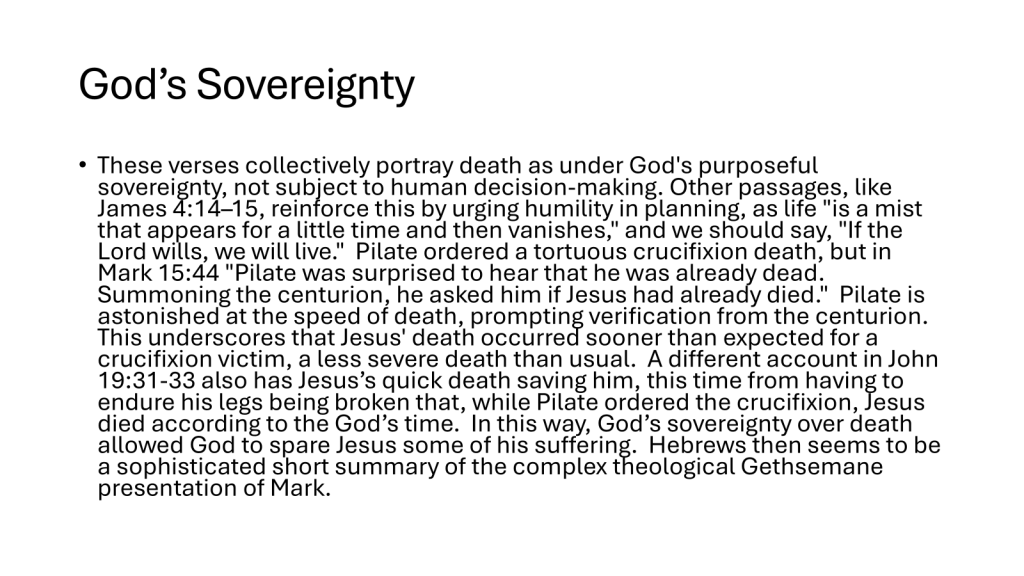
These verses collectively portray death as under God’s purposeful sovereignty, not subject to human decision-making. Other passages, like James 4:14–15, reinforce this by urging humility in planning, as life “is a mist that appears for a little time and then vanishes,” and we should say, “If the Lord wills, we will live.” Pilate ordered a tortuous crucifixion death, but in Mark 15:44 “Pilate was surprised to hear that he was already dead. Summoning the centurion, he asked him if Jesus had already died.” After Joseph of Arimathea requests Jesus’ body, Pilate is astonished at the speed of death, prompting verification from the centurion. This underscores that Jesus’ death occurred sooner than expected for a crucifixion victim, a less severe death than usual. A different account in John 19:31-33 also has Jesus’s quick death saving him, this time from having to endure his legs being broken that, while Pilate ordered the crucifixion, Jesus died according to the God’s time. In this way, God’s sovereignty over death allowed God to spare Jesus some of his suffering. Hebrews then seems to be a sophisticated short summary of the complex theological Gethsemane presentation of Mark.
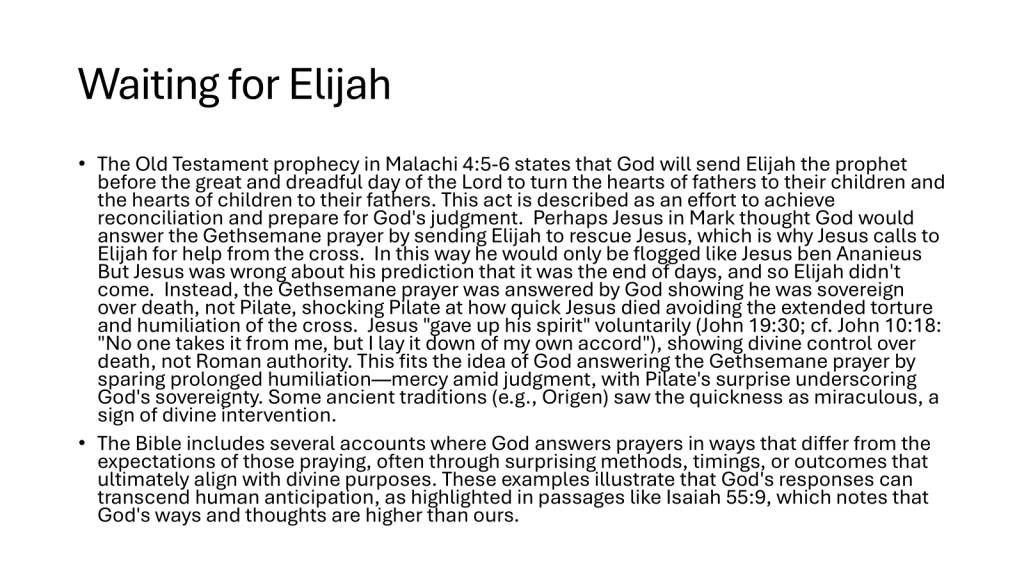
The Old Testament prophecy in Malachi 4:5-6 states that God will send Elijah the prophet before the great and dreadful day of the Lord to turn the hearts of fathers to their children and the hearts of children to their fathers. This act is described as an effort to achieve reconciliation and prepare for God’s judgment. Perhaps Jesus in Mark thought God would answer the Gethsemane prayer by sending Elijah to rescue Jesus, which is why Jesus calls to Elijah for help from the cross. But Jesus was wrong about his prediction that it was the end of days, and so Elijah didn’t come. Instead, the Gethsemane prayer was answered by God showing he was sovereign over death, not Pilate, shocking Pilate at how quick Jesus died avoiding the extended torture and humiliation of the cross. Jesus “gave up his spirit” voluntarily (John 19:30; cf. John 10:18: “No one takes it from me, but I lay it down of my own accord”), showing divine control over death, not Roman authority. This fits the idea of God answering the Gethsemane prayer by sparing prolonged humiliation—mercy amid judgment, with Pilate’s surprise underscoring God’s sovereignty. Some ancient traditions (e.g., Origen) saw the quickness as miraculous, a sign of divine intervention.
The Bible includes several accounts where God answers prayers in ways that differ from the expectations of those praying, often through surprising methods, timings, or outcomes that ultimately align with divine purposes. These examples illustrate that God’s responses can transcend human anticipation, as highlighted in passages like Isaiah 55:9, which notes that God’s ways and thoughts are higher than ours.
(2) We seem to see the same sort of thing going on with the scripture allusion in the Corinthian Creed/Poetry and the real purpose of the Law in Paul. Would the average reader have a clue what Paul was talking about unless they had the gospels as a background?
– “For I handed on to you as of first importance what I in turn had received: that Christ died for our sins in accordance with the scriptures and that he was buried and that he was raised on the third day in accordance with the scriptures (1 Corinthians 15:3-4).” Of course, as sophisticated readers of the gospels we know this means Mark has rewritten 2nd Isaiah and Psalms to create the crucifixion narrative, and Matthew has added the Wisdom of Solomon. Why 3 days? Matthew seems to have rewritten/repurposed the reference to Jonah and repentance in Q to create a burial/resurrection paralleling the 3 days Jonah spent in the belly of the big fish.
– “13 Did what is good, then, bring death to me? By no means! It was sin that was working death in me through what is good, in order that it might be shown to be sin, so that through the commandment sin might become sinful beyond measure (Rom 7:13).” We know that the commandment helps us see when we sin, but what does it mean that that through it sin becomes sinful beyond measure? How would the average reader make sense of this? As sophisticated readers of the gospels we might immediately recognize this with Mark rewriting Deuteronomy 17:12-13 as the corrupt Jewish trial of Jesus where for every gross corruption of the trial (e.g., the Jewish high council meeting on Passover Eve) the crafty perpetrators find a loophole in the law/tradition, showcasing Jesus being condemned by the letter of the law even though it is not the spirit of the law that Jesus should die (1 Cor 3:19-29; 2 Corinthians 4:2; John 18:31). Hamilton comments that:
- However, the Synoptic chronology is not impossible, for as [Josef] Blinzler says, the prohibition of legal proceedings on feast days was less strictly enforced than that of holding courts on the Sabbath, ‘therefore it is quite thinkable that it did not seem to the Sanhedrists an infringement of an important rule to start a legal trial even on the night of the Pesach’. It is the argument of this article that all the Gospels witness to such a trial which, while viable in its date, contravened accepted practice as subsequently enshrined in the Mishnah at many points, as Blinzler shows. For example, the proceedings took place in the house of Caiaphas, not in the Temple, and though Jesus had not actually pronounced the Name of God, he was condemned as a blasphemer. He was not offered an advocate; the witnesses were not warned before being examined; nor were they called to account for false witness. The members of the Sanhedrin, although witnesses of the alleged blasphemy, took part in the passing of the sentence, though it was not legal for them to do so. As Blinzler says, one is not able ‘to spare the Sanhedrin the reproach of very serious infringement of the law’. The question is, why did they do this?‘ It will not do to suggest that the occasion was a sham—the proceedings were undoubtedly carried through before a competent bench of judges’. Nor can their contraventions of the Mishnaic code be simply dismissed by saying that it was not yet in force. It is true that it was not codified until about 200 AD, and reflects conditions which obtained then, but it certainly enshrines earlier practice to a considerable extent. For example, Segal says that in describing Temple ritual, it may be employed with confidence. May not the same apply to legal practice?… Before the Feast of the Passover Caiaphas is reported to have said in council: ‘It is expedient for you that one man should die for the people, and that the whole nation should not perish’ (Jn. 11:50). Expediency was the factor which determined his conduct. When the opportunity unexpectedly presented itself to secure Jesus’ death, he and the priests avidly took it. Spurred on by their hatred of him; persuaded that as he was a false teacher, his execution on a feast day would be appropriate; and pressurized by shortage of time, they held his trial on the paschal night. In this trial they contravened normal legal practice at many points. The fact that they could do this in the legal sphere makes it likely that they could, because of the exceptional circumstances, also contravene ritual practice. For the exigencies of the case demanded that they work through the night. Early next morning therefore, they still had not eaten their paschal meal [emphasis mine]. (Hamilton, 1992, pp. 335-336)
- Certainly therefore, an execution would have been contrary to the sabbatical nature of the first paschal day. However, Deut. 17: 12-13 prescribes the death penalty for anyone who opposes the decisions of the priests, to be carried out so that ‘all the people shall hear and fear’, and the Mishnah (Sanhedrin 11:4) gives special instructions for the execution of a rebellious teacher: ‘He was kept in guard until one of the three feasts, and he was put to death on one of the three feasts’. This shows that in certain circumstances executions were permitted on feast days. Moreover, [Paul] Billerbeck says that where an example is required ‘to protect the Torah from wilfully severe transgressions, an execution may, as an exception, supersede a feast day’. (Hamilton, 1992, p. 335)
In this way, we see Paul seems to expertly summarize the allusions of the crucifixion/resurrection and Jesus’ corrupt trial pointing to Paul’s knowledge of the gospels as a background, and so Paul seems to postdate Mark. Some argue Mark made a narrative out of Paul, but for instance it seems unlikely Mark could have erected such a sophisticated scripture allusion edifice out of Paul’s one narrative detail of scriptural allusion. Rather, like Hebrews, Paul seems to be commenting on Mark.
- We also see Paul’s letters being post 70 CE as Jacob Berman notes. First Thessalonians talks about the wrath of God on Judea, but why would it do this prior to the Jewish war? Paula Fredriksen thinks this is an interpolation, but maybe the whole letter is written later. The only time Epaphroditus is mentioned with Clemens outside of Philippians is in Seutonius’s Life of Domitian, and so suggests a date of minimum 90s CE. The letter to the Corinthians notes God shouldn’t be worshipped in buildings as they will be brought to the flames, which is odd to say prior 70 CE. 1 Corinthians 3:10-18 suggests physical temples are subject to the flame but man himself is the temple of God, which makes more sense post 70 CE. The spirit is in you, not the temple. Similarly with a late date of 1 Corinthians, Price says:
Though it is a patchwork quilt drawn from many sources and has suffered numerous interpolations and redactional glosses, the book as a whole is an attempt to provide a church order, much like the Didache, or Teaching of the Twelve Apostles to the Nations. Titus and 2 Timothy are likewise not real letters but church manuals with Paul’s name attached. Walter Schmithals (Gnosticism in Corinth, 1971) observed how virtually everything in the document would make sense if the unifying thread of the issues addressed in 1 Corinthians was Gnosticism. Christian Gnosticism was a second-century phenomenon, but Schmithals argued that it must have begun already in Paul’s day, since 1 Corinthians seems to refer to it. But it seems more likely to me that 1 Corinthians itself stems from the late first or early second centuries. (Price, Robert M.. The Amazing Colossal Apostle: The Search for the Historical Paul (p. 324). Signature Books. Kindle Edition.)
Of course, we should not assume that just because a writing is not earlier than a certain date it is nonetheless close to that early date, and so Mark 13 is not earlier than 70 CE and the temple destruction, but could refer to Bar Kokhba in the 130’s.
- Price notes:
- In 1 Corinthians, it is always arguing against itself: can women speak in the public assembly? Sure, as long as they’re veiled / no, they should keep quiet and ask their husbands at home. Should there be speaking in tongues? Yes, (e.g., ch 12) I (Paul) do it more than you do / no (e.g., ch 14), it’s a cause of stumbling for outsiders who think you’re crazy and is nothing much compared to love, go in that direction. Can you eat food originally sacrificed to idols? Yes, because if you’re as smart as I (Paul) am you know it’s just steak / no, even though these gods aren’t real demons are, and this food is demon steak and God killed thousands of people for doing that. Is it good to be celibate because the time is so urgent? Paul says yes, but he then says it’s good to be married. The resurrection discussion in chapter 15 seems to have 3 different agendas.
This seems to reflect the Jewish notion of a school where numerous voices are being brought together. Price comments:
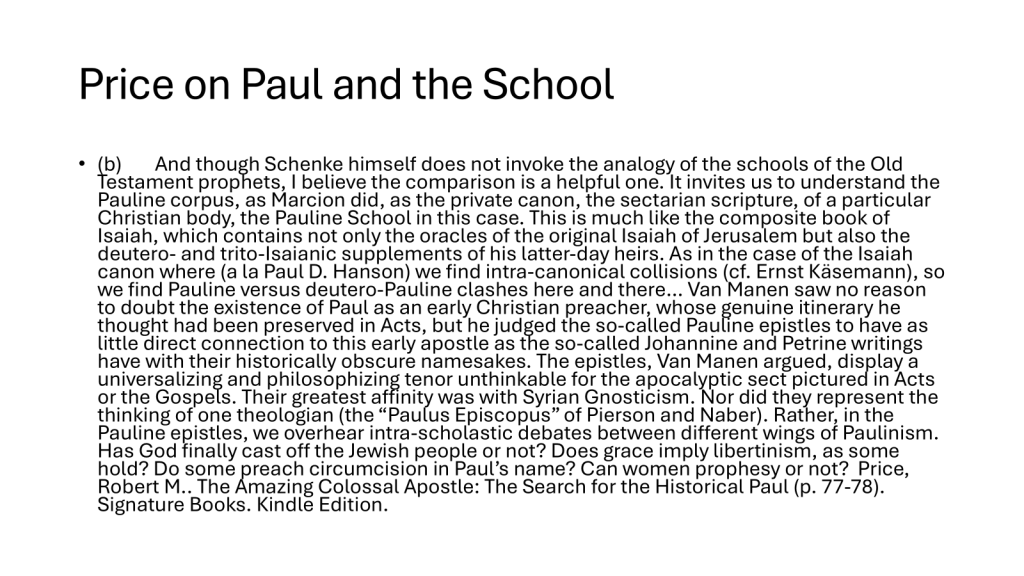
- And though Schenke himself does not invoke the analogy of the schools of the Old Testament prophets, I believe the comparison is a helpful one. It invites us to understand the Pauline corpus, as Marcion did, as the private canon, the sectarian scripture, of a particular Christian body, the Pauline School in this case. This is much like the composite book of Isaiah, which contains not only the oracles of the original Isaiah of Jerusalem but also the deutero- and trito-Isaianic supplements of his latter-day heirs. As in the case of the Isaiah canon where (a la Paul D. Hanson) we find intra-canonical collisions (cf. Ernst Käsemann), so we find Pauline versus deutero-Pauline clashes here and there… Van Manen saw no reason to doubt the existence of Paul as an early Christian preacher, whose genuine itinerary he thought had been preserved in Acts, but he judged the so-called Pauline epistles to have as little direct connection to this early apostle as the so-called Johannine and Petrine writings have with their historically obscure namesakes. The epistles, Van Manen argued, display a universalizing and philosophizing tenor unthinkable for the apocalyptic sect pictured in Acts or the Gospels. Their greatest affinity was with Syrian Gnosticism. Nor did they represent the thinking of one theologian (the “Paulus Episcopus” of Pierson and Naber). Rather, in the Pauline epistles, we overhear intra-scholastic debates between different wings of Paulinism. Has God finally cast off the Jewish people or not? Does grace imply libertinism, as some hold? Do some preach circumcision in Paul’s name? Can women prophesy or not? Price, Robert M.. The Amazing Colossal Apostle: The Search for the Historical Paul (p. 77-78). Signature Books. Kindle Edition.
- Of key interest is Romans, whose backstory is a church Paul did not create, and so he is at his most systematic. Paul claims elsewhere (1 Cor 9:20) to modify his theology to fit any group he is addressing, and so this is on full display here. Ehrman has also noted contradictory accounts of salvation in Romans. Salvation in Romans is understood in different ways throughout Romans. In Romans, the topic is human beings are alienated from God because of their sinful lives, and the death and resurrection of Jesus can fix the relationship. This is like a RAFT writing prompt that has been given to students who solve it in completely different ways. Paul in Romans has different models for expressing this which appear to contradict each other with completely opposed views to what sin is (human transgressions vs a cosmic power). Romans is important because it simply lays out moral influence salvation beside substitution salvation blending the two major salvation paths in the Jesus tradition as though a Roman church that Paul didn’t create would simply understand this as though it was the most obvious thing in the world. Recall that all Paul really “required” of a convert was “if you confess with your mouth that Jesus is Lord and believe in your heart that God raised him from the dead, you will be saved (Romans 10:9).” Ehrman notes:
- There is the judicial model in Romans 1-4. God is a law giver. He also judges criminal cases. Everybody breaks God’s laws, so there is a penalty and it’s the death penalty. Everyone sins, so everyone dies. Put differently, you’ve incurred a fine and it must be paid. Jesus pays it for you. Jesus being raised from the dead shows the penalty has been paid because he’s no longer dead. We see this kind of substitutional view in 4 Maccabees. It’s long been debated whether if Christ paid the penalty everyone is saved. For Paul, you have to believe in Christ and accept the payment because if you don’t agree with Christ to pay your fine he can’t. It would be like your mom offering to pay your fine in court but you say no. Salvation comes when you believe and trust Christ’s payment works. This fits in with the ancient notion of sacrifice satisfying a god’s wrath.
- Applying Ehrman a bit there is also a participation model in Romans 5-8. Sin brings about separation from God. Sin in this model is not a transgression but a cosmic power in the universe. It has imprisoned, trapped, and enslaved people: think of Satan entering Judas in the gospels (Luke 22:3, John 13:27), which is where Paul might be getting this model from. It controls people and forces them to do things against God’s will. Readers being implicated in the world turning on Christ / Christ’s death breaks the spell of Sin and opens people’s eye to their vileness. Sin is a power that forces you to do wrong even if you want to do right, and the power of Sin hands you over to the power of Death. Being implicated in Jesus’ death solves the problem of alienation from God here with your metanoia/renewal of mind/repentance, but not as a payment as with the judicial model. It’s not that you’re breaking the law, but that you’ve been enslaved, so you have to be liberated. The reader shocked at seeing themselves in the world that brought about Christ’s wrongful death interrupts the power of sin/breaks the spell, and you then desire that the resurrected Christ indwells within you, uniting you with him as buried and raised when baptized, to combat Satan’s temptations. You participate in Christ’s death because when his death convicts you, your fleshly is crucified / circumcising your heart, revealing the Law written on it (Romans 2:14-15). Christ’s resurrection shows he nullified the Power of Death, which is important because the bible says if the dead are not raised we might as well be gluttons and drunks for tomorrow we die (1 Corinthians 15:32; Isaiah 22:13). By contrast, Paul urges “So, whether you eat or drink, or whatever you do, do everything for the glory of God (1 Corinthians 10:31).” Paul says “If Christ has not been raised, your faith is futile and you are still in your sins (1 Cor 15:17).”
Thus in Romans we have 2 models of sin. One is consciously disobeying God, and the other is enslavement to the power of sin, each having different paths to salvation. What seems to have happened here is that we have the school setting noted previously where different students have proposed different models for Christians dealing with the problem of the human condition of alienation from God because of Sin. A teacher/editor then seems to have taken these disparate images of salvation and interweaved them. And there are more models in Paul. Another model in Paul is the reconciliation model where God and man are like 2 estranged friends and Jesus acts as mediator. Yet another model is that of a slave, not paying a fine like in the judicial model, but a ransom being paid to release the slave.
Analogously, modern biblical scholarship has proposed that the Gospel of John may have multiple layers of composition, potentially involving different authors or sources, with a final editor (or redactor) integrating them. A Pauline editor could do so here according to the pagan notion of a sophist who tries to argue in sometimes contradictory ways and say whatever they want to win the day (1 Corinthians 9:20-22).
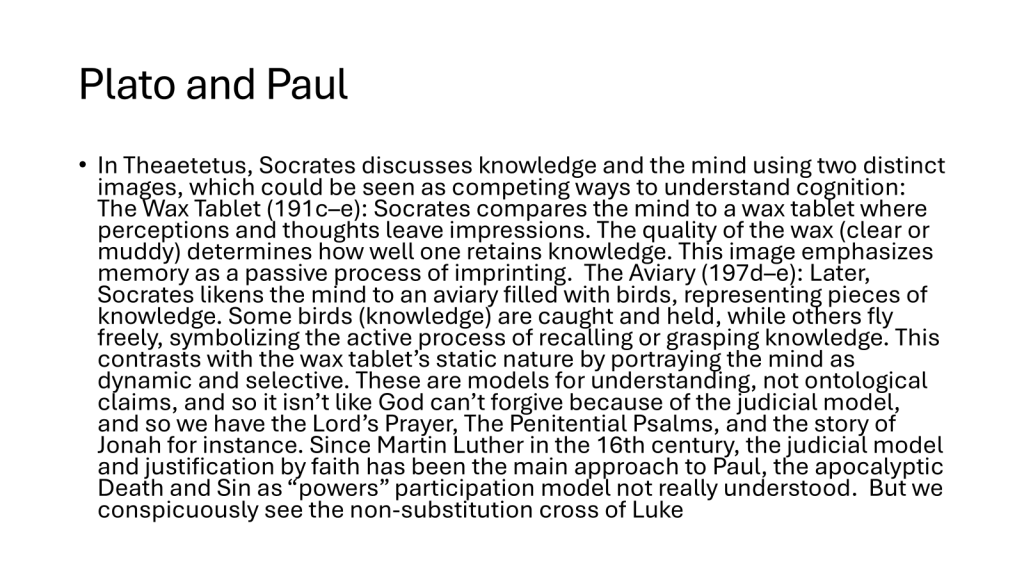
This fits well with Greek thought, which Gamaliel and Paul are thought to have connection to. Plato with his school/Academy frequently employs vivid imagery and metaphors to explore complex philosophical concepts, including the nature of the mind, soul, and human behavior like Paul does with the competing judicial model and participation model outlined above. Plato’s dialogues often feature characters using multiple, sometimes competing images to describe the same concept, reflecting different perspectives or aspects of a single idea. This technique is particularly evident in dialogues where characters grapple with abstract notions like the soul, knowledge, or justice. This may reflect Plato incorporating ideas from Socrates, himself, and his students into the dialogues. For example, In Theaetetus, Socrates discusses knowledge and the mind using two distinct images, which could be seen as competing ways to understand cognition: The Wax Tablet (191c–e): Socrates compares the mind to a wax tablet where perceptions and thoughts leave impressions. The quality of the wax (clear or muddy) determines how well one retains knowledge. This image emphasizes memory as a passive process of imprinting. The Aviary (197d–e): Later, Socrates likens the mind to an aviary filled with birds, representing pieces of knowledge. Some birds (knowledge) are caught and held, while others fly freely, symbolizing the active process of recalling or grasping knowledge. This contrasts with the wax tablet’s static nature by portraying the mind as dynamic and selective. These images are not explicitly in conflict, but Socrates uses them to highlight different problems: the wax tablet addresses perception and memory, while the aviary tackles the act of recalling knowledge. Theaetetus and Socrates explore these images sequentially, testing each to probe the nature of knowledge. Coming back to Romans, the models are educational in nature, not literal or the only ways of thinking about the problem, as though the Judicial model implies God is unable to forgive, despite the story of Jonas, the penitential psalms, and the Lord’s Prayer. Since Martin Luther in the 16th century, the judicial model and justification by faith has been the main approach to Paul, the apocalyptic Death and Sin as “powers” participation model not really understood. But we conspicuously see the non-substitution cross of Luke, for instance. Ehrman says:
– It is easy to see Luke’s own distinctive view by considering what he has to say in the book of Acts, where the apostles give a number of speeches in order to convert others to the faith. What is striking is that in none of these instances (look, e.g., in chapters 3, 4, 13), do the apostles indicate that Jesus’ death brings atonement for sins. It is not that Jesus’ death is unimportant. It’s extremely important for Luke. But not as an atonement. Instead, Jesus death is what makes people realize their guilt before God (since he died even though he was innocent). Once people recognize their guilt, they turn to God in repentance, and then he forgives their sins. Jesus’ death for Luke, in other words, drives people to repentance, and it is this repentance that brings salvation. But not according to these disputed verses which are missing from some of our early witnesses: here Jesus’ death is portrayed as an atonement “for you.”
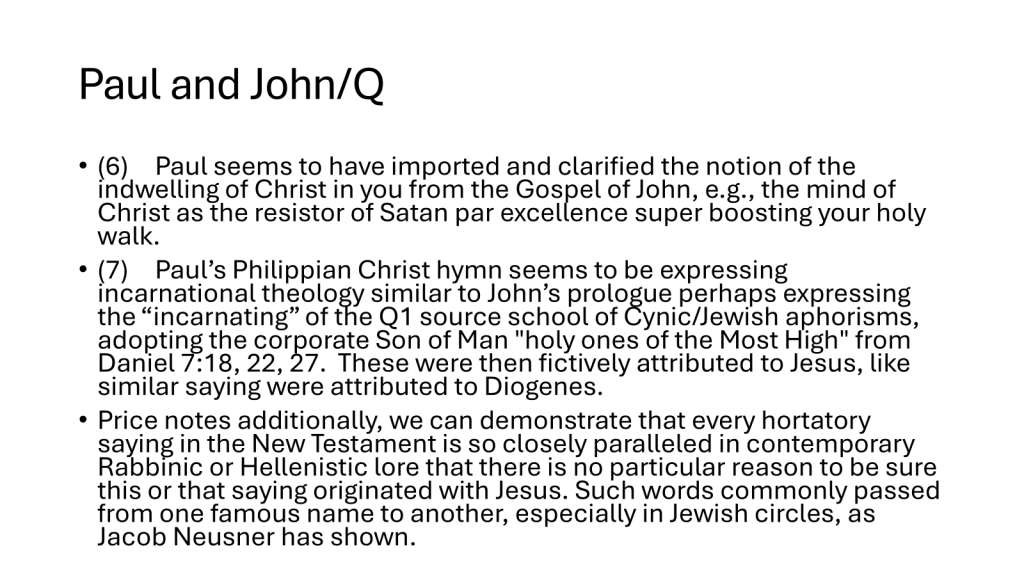
- Paul seems to have imported and clarified the notion of the indwelling of Christ in you from the Gospel of John, e.g., the mind of Christ as the resistor of Satan par excellence super boosting your holy walk.
- Paul’s Philippian Christ hymn seems to be expressing incarnational theology similar to John’s prologue perhaps expressing the “incarnating” of the Q source school of Cynic/Jewish aphorisms, adopting the corporate Son of Man “holy ones of the Most High” from Daniel 7:18, 22, 27. The Drew University review of Price’s Deconstructing Jesus relates:
. Regarding Q’s oldest stratum Q1, the Drew University review of Price’s “Deconstructing Jesus” helpfully summarizes:
Price gives us ten pages [151-160] of parallels between the sayings of Q1 (the apparent bedrock layer of the Q document) and Cynic-style pronouncements of famous sages like Epictetus, Seneca, or of those reporting on Cynic philosophers, such as Diogenes Laertius. There seems little doubt of the ultimate provenance of the core teachings of the Gospel Jesus — and it isn’t a Jewish one. This makes exceedingly ironic the modern appeal on the part of religious conservatives to a Christianity that preserves a so-called Judaeo-Christian tradition: something which in actuality constitutes an ethic that is Greek and a philosophy and ritual of salvation derived from the thoroughly Hellenistic ethos of the mystery cults. Price suggests that Q1, “far from allowing us access for the first time to the historical Jesus, is instead inconsistent with an historical Jesus” [p.150]. While people like Burton Mack detect (quite rightly) a pronounced character to the Q1 sayings, one of sly humor and wise common sense, supposedly implying a definite personality, the same features can equally be found in the body of Cynic sayings to which they have been compared, sayings which identifiably “stem from many different Cynic philosophers over several centuries.” If the latter sayings do not need to have come from a single person, Price reasons, neither do those attributed to Jesus…He further observes that with virtually all other sayings collections of the ancient world attributed to a prominent figure (such as the many to Solomon or the collections of psalms ascribed to David), such attribution is fictive, the figure himself legendary. Price notes that attributing anonymous or traditional sayings to an authority figure is a fundamental shift on the part of a “canonical mindset.” Rather than let the inherent wisdom of such sayings stand on their own, self-evident and proverbially established from experience, their legitimacy becomes grounded in the fact that they were spoken by some respected or glorified figure, whose pipeline to a higher divinity is emphasized. By imposing theology, the sayings shift to the realm of revelation and prophecy. As “proverbs (that) enshrine wisdom, not revelation,” the attribution of Q1 to a Jesus is uncharacteristic of the proverb genre and suggests a later development. Price postulates that this Q Cynic root entered the Jewish Kingdom movement by way of the Godfearers, those gentiles attached to Judaism. He agrees (with myself) that the Q base of sayings had no narrative settings, no controversy stories. In the Gospels, the apparent point of a saying itself often makes a less-than-perfect fit with the set-up situation the evangelists provide for it, as though the exact significance of the original saying was lost or confused when adapted to its new milieu. The controversy stories, with Jesus as the star character, are consequently later additions, offering a singular, heroic originator who is simply an ideal figure.
I think the reviewer overstates the monopoly of pagan cynic thought on Q1, ignoring how Q1 is also fused with Jewish tradition. For example, Serge Ruzer, in particular, has explored this in detail, arguing that the “love your enemy” precept emerges from Jewish exegetical trends during the Second Temple period, where interpretations of Leviticus gradually challenged community-bound ethics (as in the halakhic midrash Sifra on Lev. 19:18, which permitted revenge against outsiders) to include outsiders or enemies. The core of these Q1 sayings is firmly grounded in Jewish ethical trajectories, making them an extension of Torah-based love and a fusion with cynic pagan ideas.
Price notes additionally, we can demonstrate that every hortatory saying in the New Testament is so closely paralleled in contemporary Rabbinic or Hellenistic lore that there is no particular reason to be sure this or that saying originated with Jesus. Such words commonly passed from one famous name to another, especially in Jewish circles, as Jacob Neusner has shown. Jesus might have said it, sure, but then he was just one more voice in the general choir. Is that what we want to know about him? And, as Bultmann observed, who remembers the great man quoting somebody else?
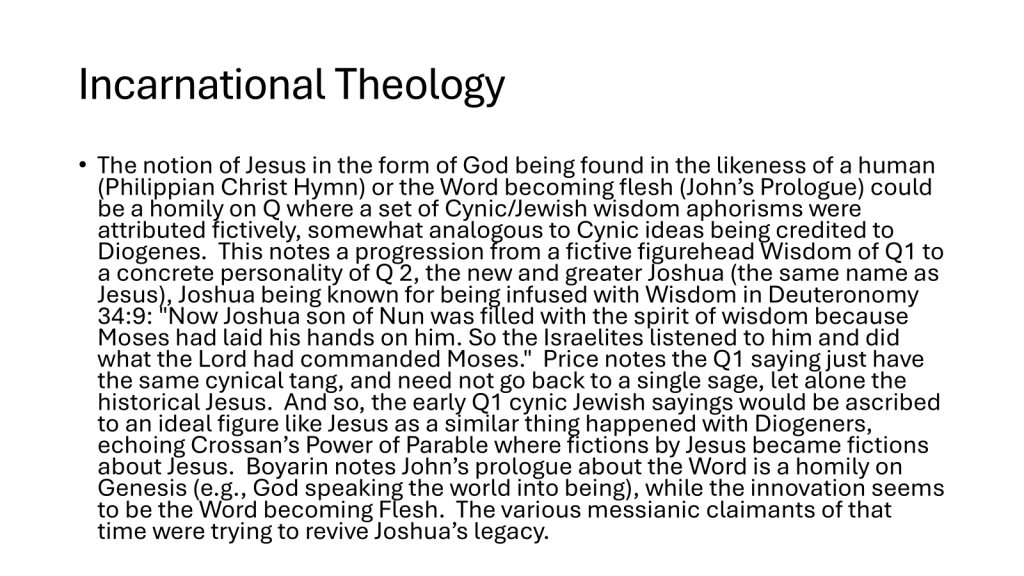
The notion of Jesus in the form of God being found in the likeness of a human (Philippian Christ Hymn) or the Word becoming flesh (John’s Prologue) could be a homily on Q where a set of Cynic/Jewish wisdom aphorisms were attributed fictively, somewhat analogous to Cynic ideas being credited to Diogenes. This notes a progression from a fictive figurehead Wisdom of Q1 to a concrete personality of Q 2, the new and greater Joshua (the same name as Jesus), Joshua being known for being infused with Wisdom in Deuteronomy 34:9: “Now Joshua son of Nun was filled with the spirit of wisdom because Moses had laid his hands on him. So the Israelites listened to him and did what the Lord had commanded Moses.” Price notes the Q1 saying just have the same cynical tang, and need not go back to a single sage, let alone the historical Jesus. And so, the early Q1 cynic Jewish sayings would be ascribed to an ideal figure like Jesus as a similar thing happened with Diogeners, echoing Crossan’s Power of Parable where fictions by Jesus became fictions about Jesus.
Bibliography
Carrier, Richard. Jesus from Outer Space: What the Earliest Christians Really Believed about Christ. Pitchstone Publishing, 2020
Ehrman, Bart. Did Luke Have a Doctrine of the Atonement? Mailbag September 24, 2017
Eisenbaum, Pamela “Hebrews” in Amy-Jill Levine; Marc Zvi Brettler. The Jewish Annotated New Testament. Oxford University Press. Kindle Edition.
Hamilton, John. “The Chronology of the Crucifixion and the Passover.” Churchman Vol. 106, No. 4: 323-338. 1992
Price, Robert M.. The Amazing Colossal Apostle: The Search for the Historical Paul. Signature Books. Kindle Edition.