



THE QUEST FOR THE HISTORICAL PAUL (Part 1/8 with Prof Nina E. Livesey)
Previously:
Announcing A New Blog Series: THE QUEST FOR THE HISTORICAL PAUL
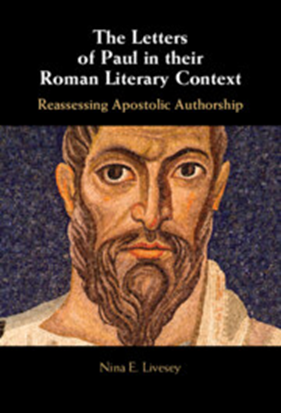
The Letters of Paul in their Roman Literary Context: Reassessing Apostolic Authorship (by Nina E Livesey, Peer Reviewed Cambridge Press, 2024)
(INTRODUCTION TO THIS SERIES OF POSTS ON THE QUEST FOR THE HISTORICAL PAUL WITH PROF NINA E. LIVESEY)
Critical New Testament scholars have long sought after the historical Jesus. Now, another journey is underway to determine the historical nature of another prominent New Testament figure: The Quest for the Historical Paul. How do we sift legendary material away to get to the historical man? Did he even exist? Prof. Nina Livesey in her recent book (peer reviewed by Cambridge University Press, 2024) rejects the authenticity of the seven letters traditionally attributed to Paul and even doubts the historicity of Paul himself, placing her in the hermeneutic tradition of the Dutch Radical Critics and later scholars like Detering and Price. Her argument can be mapped out in this way:
The modern use of the Pauline letters to establish historical information about Paul or Jesus, like the “James the brother of the lord passage” in Galatians 1:19 or “Jesus as the seed of David” passage in Romans 1:3 used contra Jesus mythicism, with other issues such as authenticity of the letters was not the original way the letters were interpreted and utilized. They were understood as authoritative and scripture like. Whether their writer was pseudonymous or didn’t exist or if they were genuine correspondence, were not issues.
“Later in the enlightenment period questions of the authenticity of Pauline authorship came into view. The Enlightenment scholar de Wette’s concerns differed radically from the older readers… While scholars such as Evanson and de Wette represent a shift in the understanding of the Pauline letters from authoritative teachings to that of historically relevant documents, Ferdinand Christian Baur – described as “the most important NT scholar of his time” and as one of “the most resolute advocates of the development of historical-critical research in the nineteenth century”– significantly advanced and seemingly entrenched the understanding of Pauline letters as historically reliable. (43)”
Livesey argues Baur’s circular reasoning of assuming an original rift between Christians and torah followers and finding that in the “authentic” epistles brings the result that he “posits a great rift between Judaism and Christianity from reading the Hauptbriefe, and then relies on those same letters to confirm his historical reconstruction.” (46) For Bauer, the differences between what he saw as the four authentic letters of Paul and Acts was the epistles were reliable, and Acts wasn’t, which is the perspective still today – except with seven authentic letters instead of four.
Later commenters who looked at the letters often authenticated them through the general lens of a rift between Judaism and Christianity. Scholars have also appealed to what they saw as Paul’s style, “scholars assessed Pauline style subjectively, according to what they thought it was and according to their particular preferences… Whether or not statements were sincere is, of course, a matter of authorial intent, something that is unknown to later readers. Moreover, similarities of style and language across letters do not provide evidence of the Apostle Paul as author (52).” Another criterion appealed to is later citations by authors like Clement, though we will see this perhaps does not point to authenticity. Time and again Livesey argues when we try to apply criteria to reveal Pauline letters as authentic runs into stumbling blocks, analogous to when Heidegger famously failed to authenticate 2 Thessalonians. Heidegger wrote:
There are those in the congregation who have understood Paul, who know what is crucial. If the Parousia depends upon how I live, then I am unable to maintain the faith and love that is demanded of me; then I approach despair. Those who think this way worry themselves in a real sense, under the sign of real concern as to whether or not they can execute the work of faith and of love, and whether or not they will hold out until the decisive day. But Paul does not help them; rather he makes their anguish still greater (II Thess. 1:5: [evidence of the righteous judgment]). Only Paul himself could have written this. The overburdened nature (plerophory) of expression in the second letter has an entirely particular motivation, and is a sign of its authenticity.
A final questionable lens is deeming a letter authentic when confirmed by Acts, “Thus, Hilgenfeld assessed Thessalonians and Philippians historically reliable due to confirmation of Paul’s journeys into those regions as found in Acts (53).” Parallel with this research was the quest to determine if the letters of Paul were genuine correspondence and not literary fictions like the letters of Plato, employing such techniques of comparing Paul’s letters to other known ancient letters, though the result was Paul’s letters did not conform to those other letters, for example Philemon – e.g., “While ancient Greco-Roman letters evince standard opening and closing formulae– as Exler’s findings confirmed none of the extant Pauline letters conform to that standard (69).”
Livesey further contends against a historical Paul:
“there is no evidence of the historical Paul. That the historical Paul was active in the mid-first century is likewise a characterization found largely in Acts and Pauline letters. Similarly, there is a distinct lack of archaeological evidence of ancient Pauline communities. The chapter argues that internal references to communities in home settings within well-known regions are best assessed rhetorically rather than historically. With the letters read together as a collection, distantly spaced regions function effectively to signify the far-reaching spread of the message into prominent areas. The lack of extant evidence for and references to Pauline letters as unities, as one would expect in the case of genuine correspondence, casts doubt on their status as genuine correspondence. In addition, sightings of Pauline letters in later sources indicate a mid-second century date of the collection. These combined arguments add to the thesis that the letters were from the start pseudonymous and fictional.”
For Livesey the Pauline communities are thus perhaps interesting fiction correspondence partners to provide the reader with a lively context for experiencing the letter. The great distance between the communities might then reflect the “far-reachingness” of Paul’s message, or if Marcion is the author Marcion’s proclivity to travel. A supposed connection to the addresses in the 7 genuine Pauline letters in Marcion’s ten letter collection also points to fictionality, since Marcion, who was known for his ship, originated as a neighbor to Galatia, and all the other cities were port cities he could have traveled to.
One possible objection to the fictive letter collection theory of Livesey could be there are lost Pauline letters such as in 1 Corinthians 5:9, Paul writes, “I wrote to you in my letter not to associate with sexually immoral people.” This implies a prior letter to the Corinthian church, sent before 1 Corinthians, which is not preserved in the New Testament canon. The context suggests it addressed moral conduct, but no manuscript of this letter exists. In 2 Corinthians 2:3-4 and 7:8-9, Paul refers to a letter written “with many tears,” meant to correct the Corinthians and express his anguish. This letter, distinct from 1 Corinthians, is often called the “severe” or “tearful” letter. It could be debated whether this could be part of 2 Corinthians (e.g., chapters 10–13, which have a sharper tone), but most conclude it was a separate letter that is now lost, as the tone and content don’t fully align with 1 or 2 Corinthians.
Given such a situation, it “seems” unlikely as some think Marcion penned the 7 letters and forgot about or lost the 2 extra Corinthian letters, although perhaps this is assuming too much. We do have an historical analogy for such lost fictive letters in a collection of Seneca’s Moral Epistles. There is compelling evidence that Seneca wrote moral epistles beyond the 124 preserved in the Epistulae Morales, primarily based on Aulus Gellius’ quotation of a lost letter and the incomplete nature of the manuscript tradition. Internal references and Seneca’s prolific output further support the possibility of additional letters, though their exact number and content are unknown. The loss of these epistles is consistent with the challenges of ancient text preservation. And, inauthentic Pauline letters can get lost, such as some speculate about a letter to the Laodiceans mentioned in the forged Colossians 4:16.
The communities of the letters may be idealized as to the length of Paul’s reach, like the seven communities of Revelation represents universality, not literal places. For example, let’s consider Corinth as a literary entity:
Corinth’s portrayal as a corrupt place in Paul’s letters likely involves at least some literary exaggeration to serve rhetorical and pastoral purposes, identifying it as an especially corrupt place. Paul may have leaned on the city’s stereotype as a decadent hub and used strong language to urge reform, emphasizing the contrast between Christian ideals and certain behaviors. The depiction is a strategic blend of historical context, cultural trope, and pastoral urgency.
The idea that Corinth’s reputation as a corrupt place in the New Testament, particularly in Paul’s letters (1 and 2 Corinthians), might involve literary exaggeration is a plausible hypothesis. It’s questionable whether Corinth as a morally decadent city completely reflects historical reality, rhetorical strategy, or a combination of both.
Corinth was a major commercial hub in the 1st century AD, strategically located on the Isthmus of Greece, connecting trade routes. Its wealth and cosmopolitan nature attracted diverse populations, including merchants, sailors, and travelers. The city was known for the Isthmian Games, a major cultural and religious event, and had a temple to Aphrodite, the goddess of love, which some ancient sources associate with ritual prostitution (e.g., Strabo, Geography 8.6.20, writing about an earlier period). However, Strabo’s claim of 1,000 temple prostitutes is questionable, as it refers to pre-Roman Corinth (destroyed in 146 BC) and may be exaggerated for effect.
Roman Corinth, rebuilt as a colony in 44 BC, was a melting pot of Roman, Greek, and Eastern influences, with significant social stratification and economic disparity. The term “to Corinthianize” (Greek: korinthiazomai) was used in some Greek literature to mean living licentiously, suggesting a stereotype of moral laxity. Aristophanes and other writers used Corinth as a shorthand for decadence, often tied to its wealth and port-city status. However, this stereotype may reflect Athenian bias or literary trope rather than historical reality. Not all sources portray Corinth as uniquely corrupt; it was one of many bustling Mediterranean cities.
Paul’s letters to the Corinthians address specific issues in the church, including: Factionalism (1 Cor 1:10-17); Sexual immorality, including a case of incest (1 Cor 5:1-13); Lawsuits among believers (1 Cor 6:1-11); Misuse of spiritual gifts (1 Cor 12-14); Confusion about the resurrection (1 Cor 15); Disorderly worship and social divisions (1 Cor 11). These issues contribute to the perception of Corinth as a morally troubled church in a corrupt city. However, several factors suggest possible literary exaggeration or rhetorical framing.
Paul uses strong language to correct and exhort the Corinthian believers. Describing their behavior as scandalous (e.g., “such immorality as is not even among pagans,” 1 Cor 5:1) amplifies the urgency of reform, a common technique in ancient moral discourse. By framing Corinth’s issues as particularly egregious, Paul may be employing hyperbole to shame or motivate the church to align with Christian ethics, contrasting their behavior with the ideal of holiness (1 Cor 6:19-20). The portrayal of Corinth as a corrupt backdrop could serve to highlight the transformative power of the Gospel in a challenging environment, a theme Paul emphasizes (1 Cor 6:9-11). Paul’s letters address specific problems reported to him (1 Cor 1:11; 7:1), which may not represent the entire church or city. The focus on scandals like incest or lawsuits could exaggerate the perception of widespread corruption. Other churches Paul wrote to (e.g., Galatians, Thessalonians) also faced issues, but Corinth’s letters are longer and more detailed, possibly giving a skewed impression of unique depravity.
A fictive Paul, portrayed as a well-educated Jew familiar with Greco-Roman culture, may have drawn on Corinth’s existing literary reputation as a decadent city to contextualize his critique. This would resonate with readers familiar with the stereotype, even if the reality was less extreme. The temple of Aphrodite and associated prostitution, while possibly overstated in earlier sources, could have lingered as a cultural trope, which Paul implicitly engages when addressing sexual sin (1 Cor 6:12-20). This all could imply the Corinth communications attributed to Paul are fictive.
Livesey notes the earliest collection of Paul’s letters is Marcion’s in the mid second century, which is odd: “While scholars have offered various collection theories to account for how the letters– addressed to communities widely dispersed among regions of the Ancient Eastern Mediterranean and Asia Minor– managed to be found together as a collection, many strain the realm of historical likelihood (74).” It is odd our earliest sources are collections of Paul’s letters and not individual letters given the great distance between the supposed destinations of the letters. The fact that the declared writer of a letter is Paul does not imply he actually was the writer: We have, for instance, the pseudonymous letters of Plato. Fictive letters tend to appear in collections.
Writing in role, such as composing letters or speeches in the persona of historical or mythical figures like Plato, was an aspect of ancient education, particularly in Greek and Roman rhetorical training. This practice, often called ethopoeia or prosopopoeia, was a key exercise in the progymnasmata—a series of preliminary rhetorical exercises used in ancient schools.
Students were tasked with crafting speeches, letters, or dialogues that captured the voice, style, and perspective of a specific character, such as a philosopher, mythological figure, or historical person. This honed their skills in rhetoric, persuasion, and understanding of character, while also deepening their engagement with philosophical ideas, historical contexts, and literary traditions. For example, a student might write a letter as Plato addressing a contemporary issue, requiring them to mimic his dialectical style and ideas.
This method was especially prominent in the Hellenistic and Roman periods, as seen in the works of educators like Libanius or in the training of orators like Cicero. It fostered creativity, empathy, and intellectual versatility, aligning with the broader goals of ancient education to produce well-rounded, persuasive communicators. Livesey notes Paul’s autobiographical claims need not be authentic due to how such statements functioned in ancient letters, “The major interest of most ancient biographers and autobiographers was not historical reality but human potentiality and idealization. (Livesey citing George Lyons).” The voice of the author doesn’t necessarily point back to the author, but “Epistolary discourse entails the construction of a self based on an assumption of what might interest the intended addressee, not on some unchanging vision of one’s ‘true’ self. (Livesey citing Patricia Rosenmeyer).”
There is reason to think Paul is Fictional. Livesey thinks Acts precedes the letters, and so “his absence from contemporaneous Hebraic, Greek, and Roman sources is nonetheless telling. The Roman name “Paulus,” from which the name “Paul” likely derives is also largely unattested as a cognomen (a nickname) in the ancient world. As a nomen gentilicium (family name), it belongs to noble patrician families inside Italy. From the way in which we come to know Paul in canonical sources, there is reason to believe that he, like other characters named in Acts, is fictional (83).” Fictive letters as a genre suppose the pseudonymous writer is known, like the pseudonymous letters of Plato, and where do we know the character of Paul from? Acts. Goodspeed noted a general unawareness of Paul and the Pauline letters prior to 90 CE, but later Paul was everywhere, which makes sense if the publication of Acts was the catalyst. Livesey pushes this further back to post Bar Kokhba given recent scholarship later dating such sources (e.g., 2 Peter).
Livesey argues there are extensive parallels between the letters and Acts, which suggests borrowing, but the antagonism between Paul and Judaism in the letters suggests a later Christian writer, and pseudonymous letter collections usually followed on what was already thought about an ancient character. The Paul of Acts adhered to Judaism and its beliefs: “the topics Pauline letters address, namely, negative assessments of Jewish law and circumcision, appear for the first time only in the second century (91).” Livesey elsewhere qualifies this that the negative view of circumcision is most conspicuous second century, though present earlier. This gives us a new sense of dating the letters of Paul as post-Acts.
2 Cor 11:32-33 and Acts 18:1-18 have traditionally been used to establish Paul at particular places and times in history, but Livesey argues they are literary fiction: “By contrast, when understood as literary fiction rather than history, references to known historical figures function effectively for narrative effect, adding a sense of importance and verisimilitude. (99).” We see something similar with apologists who argue a gospel story is real because it includes real people and places, and hence ignore the possibility of historical fiction. An analogous fallacy is seeing a source can’t be earlier than a date (e.g., 70 CE for Mark with the temple destruction), but then assume it is not much layer than that date because an early date is needed for history mining (e.g., Mark as post Bar Kokhba).
With the overall content of Paul’s letters “the topics adopted in Pauline letters make better sense in a social setting in which the Jerusalem Temple is no longer standing, in a post-Bar Kokhba era. (101).” Also, Paul’s churches as taking place in homes likewise reflects a literary device: “That “Christian” disciples gather in homes for safety and rituals, and that special knowledge and insight takes place in homes suggests that the author of Acts was likewise exploiting positive associations related to the home for persuasive purposes, and to advance the narrative. (106).”
The places listed in the letters also occur in Acts as regions Paul traveled to, suggesting intertextuality. Yet, the Paul of Acts was not a letter writer, perhaps suggesting the letter writing Paul came about post-Acts. The places were well known and far apart, suggesting a literary device indicating the far reach of the message. Though the letters were supposedly sent far and wide, we have no letter transmitted to us individually, but only in collections. We have early attestations to the Pauline letters such as 1 Clement, the Ignatian letters, The Letter of Polycarp to the Philippians, and 2 Peter, but Livesey points out recent research has reimagined these sources to be in the mid second century: “A mid-second century date of these early witnesses allows for the assessment that the collected Pauline letters themselves emerge only later, with Marcion’s 144 CE Apostolikon (128).” For example, 1 Clement is unsigned and talks about the apostles being killed for jealousy, which seems to point to the Apocryphal Acts of the Apostles from the 2nd and 3rd centuries. These late documents are the only place by which scholars can try to date the death of Paul.
The writer of the Pauline epistles leaves clues to their fictional letter genre, such as Paul claiming to be able to be a paradigmatic sophist, able to argue as a Jew to win the Jews, and as a pagan to win the pagans (1 Corinthians 9:20-22),
“Fictional or literary letters– our interest here– grew in popularity from approximately 100 BCE to 250 CE , a period marked by the presence of sophists, rhetors, and professional teachers. Fictional letters and the rise in freestanding pseudonymous letters collections appear to be “the product of sophistic schools.” C. Costa comments that fictional letters were “extremely popular” in the Greco-Roman world. Their popularity is attributed to early educational methods, as rhetors and their students practiced rhetorical exercises using the letter form. Michael Trapp comments that “the composition of stylish and/or contentful ‘fictitious’ letters was felt both as a stimulating challenge to a writer’s abilities and as a source of educated pleasure to the knowledgeable reader.” Patricia Rosenmeyer reviews in detail the late-second and early-third centuries collected fictional letters of Alciphron, Aelian, and Philostratus. The letters of these collections sketch short emotive scenes, invent scenarios, and provide “brief glimpses into the lives of (mostly) ordinary people dealing with momentary crises.” Philostratus, for instance, indicates that he can argue two sides of an issue, one of the hallmarks of the sophistic enterprise (Livesey, 138).”
Livesey notes the fictional letter format is common to Seneca and Paul’s authors, and is an ideal teaching tool, which is why it’s being employed:
“the letter genre is in many ways an ideal medium for the advancement of disciplinary teachings by an authoritative instructor. The benefits of adopting the letter genre for persuasive teachings include its friendly and trustworthy domain, its appeal to external readers naturally drawn to incidents seemingly meant for others, and that it easily permits and even anticipates the promotion of self. It likewise highlights the versatility of the genre, its historic use in philosophical teachings, and its easy accommodation to a wide range of subgenres, including biography, autobiography, dialog, and narrative. Similarity in the use of epistolary features across the two collections contributes to the book’s thesis that Pauline authors, like Seneca’s (Moral Epistles to Lucilius), exploited the genre for teachings to secondary readers (Livesey, Ch 3 Summary).”
The historical analogy of the authors of Paul’s literary fiction epistles with Seneca’s is a powerful argument provided by Livesey and so nudges us to update our historical probabilities in favor of her thesis. Rather than oral discussions, Seneca wants his letters to inform not only current readers but later philosophical communities. The context of friendship in letters provides a context from which to narrow focus on something more important than friendship:
“letter components– addressee, letter content, and addressor– … show ways in which Seneca and the authors of Pauline letters exploit many of the known characteristics of the genre for the advancement of their teachings. I indicate how these authors fashion, deploy, and maintain sender–recipient engagement, construct plausible and engaging situational scenarios, and strategically employ the discourse of self for the promotion of their teachings (144).”
Livesey argues “Like Seneca who with enargeia brings Lucilius to life (Ep. 49.1), the Pauline author of Philippians likewise deploys the same rhetorical technique, reifying the community with a vivid image of the Apostle and the Philippians holding each other in their hearts (Phil 1.7). (155).” Though fictive, Paul’s presence (parousia) shines through the letter, as I noted above with Heidegger. Interestingly, Berman notes the only two places where the names Epaphroditus is mentioned with Clemens is in Philippians and Suetonius’s Life of Domitian, whereby if there is intertextuality here Philippians would have to be post 95 CE.
Philippians was traditionally thought written during Paul’s imprisonment in Rome (60–62 CE), likely under Nero, when Christians faced sporadic persecution. Suetonius’ Life of Domitian describes Domitian’s later reign (81–96 CE), marked by harsher measures against perceived threats, including Jews and possibly Christians via the fiscus Iudaicus tax and charges of “atheism” (Life of Domitian 12.2). Both texts thus touch on environments hostile to certain religious groups, though Philippians focuses on Christian endurance and joy, while Suetonius details imperial cruelty.
Both texts are set partly in Rome. Philippians references Paul’s house arrest and interactions with the Praetorian Guard (Phil. 1:13), and Epaphroditus travels to Rome to aid Paul. Suetonius’ Epaphroditus and Flavius Clemens are figures in Rome’s imperial court. This shared setting ties them to the Roman world, though their spheres (Christian mission vs. imperial politics) differ.
Philippians emphasizes selflessness, humility, and devotion to Christ, as seen in Epaphroditus’ near-death service (Phil. 2:25–30). Suetonius, conversely, portrays Domitian’s moral decline, with the executions of Epaphroditus and Flavius Clemens illustrating his paranoia and cruelty (Life of Domitian 14–15). While Philippians uplifts sacrificial service, Suetonius critiques tyrannical governance, offering contrasting ethical lenses which might suggest intertextuality.
Beyond this, there is also literary cohesion between the communities by referring to members as brothers and the body of Christ, and the re-emergence of characters across long divides such as Timothy, Barnabas and Titus: “These instances of intertextuality, found by way of reference to a collection, instantiate a network of communities (157).” The occasional nature of the letters seemingly crafted to address specific needs and issues of the communities actually “appear instead to be cleverly crafted hooks and springboards for theological teachings. (158).” Romans, though, is highly impersonal and thus represents poor use of a fictive letter for teaching. The letters are not by Paul but are him incarnate, reflecting especially Plato’s use of the term “Parousia (presence). And as for the communities, for instance “Like Seneca’s treatment of Lucilius in Letter 32, the “Galatian community” is instantiated as an exemplum of improper behavior (182)… That Pauline letters are primarily occasional in content– an underlying assumption that signals genuine correspondence– is a mistaken notion, a desiratum, that is not borne out by evidence of the letters (183). … Rosenmeyer notes that the inscribed sender functions as a hero character: “The epistolary genre implies a focus on the inner life of the ‘hero,’ and the reader is then invited to identify with the ego of the letter (184).”
Paul suffers in imitating Christ just as the community is to suffer imitating the Apostle: “As mentioned, the discourse of self attracts external readers, who are drawn to the sender as a hero figure. In Pauline letters, the hero figure’s status is augmented, to make him more attractive to receptive readers (192).” Given his fame and ability, Seneca speaks self-deprecatingly as a teaching exemplar, and “It merits mention that the majority (if not all) of Seneca’s teachings of Stoic philosophy and all Pauline theological teachings are conducted through letters. (196).”
Livesey notes it is in the wake of the Bar Kokhba revolt that the issues Paul addresses and the takes he has on them make the most sense:
“The Bar Kokhba revolt (132–135 CE) had tremendous social and political consequences for Jews and Romans…During this period, writer-intellectuals immigrated to Rome, established schools, and produced various religious writings, some of which directly reflected on the consequences of the recent Jewish revolt. Marcion’s Evangelion, considered by some as the first gospel, stems from this social-political context. At this same time, political and religious discourse attests to the reassessment of the Jewish rite of circumcision. The devaluation and non-necessity of circumcision for gentiles found within Pauline letters parallels discussions in writings of the post-Bar Kokhba period. Marcion is known in sources for having a singular interest in the Apostle Paul. He is also credited with the earliest known collection of ten Pauline letters (the Apostolikon). These combined factors contribute to the sense in which Marcion’s second-century Roman school is the likely location of the origination of Pauline letters.”
Livesey zeroes in on the context for the Pauline letters most likely being mid second century. “Van Manen had thought the Pauline letters were the product of a Pauline school following the 70CE revolt, but Livesey argues Paul’s letters with such themes as necessity of Jewish law and practices reflect the later Bar Kokhba revolt period. There is no evidence of a school focusing on Marcion prior to the last revolt, and “Christian” teachers and schools emerge in Rome around the mid-second century CE, after the Bar Kokhba revolt, and as a consequence of it (200).” A climate of animosity to the Jewish scriptures and circumcision flourished after 100 CE: “Comparably dismissive and/or derogatory assessments of circumcision and Jewish law do not surface in texts dated prior to the end of the first century. Discussions of the rite of circumcision dated at or after the Bar Kokhba revolt parallel those found in Pauline letters. (202-203).” The Olivet discourse too in the synoptics seems to point to the apocalypticism of The Bar Kokhba era.
Mark 13, often called the “Little Apocalypse,” describes a series of eschatological events, including wars, desolation, and the coming of the Son of Man. Detering argues that the chapter’s imagery and predictions align more closely with the Bar Kokhba revolt (132–136 CE) than the First Jewish-Roman War (66–73 CE), which is the traditional dating anchor for Mark (circa 65–70 CE). The Bar Kokhba revolt was a major Jewish uprising against Roman rule, triggered by Emperor Hadrian’s establishment of Aelia Capitolina on Jerusalem’s ruins and possibly a ban on circumcision. It led to catastrophic consequences, including mass killings and the near-depopulation of Judea. Detering points to Mark 13:14, which mentions the “abomination of desolation” (often linked to Daniel’s prophecy). He suggests this could refer to Hadrian’s plan to erect a temple to Jupiter on the Temple Mount, a key trigger for the Bar Kokhba revolt. The verse’s call to “flee to the mountains” might reflect the rebels’ retreat to caves in the Judean Desert, as documented in archaeological findings like the Cave of Letters.
The revolt was led by Simon bar Kokhba, whom Rabbi Akiva hailed as the Messiah, based on Numbers 24:17 (“a star shall come out of Jacob”). Detering argues that Mark 13’s eschatological fervor, particularly the expectation of a divine figure (the Son of Man, Mark 13:26), mirrors the messianic hopes surrounding Bar Kokhba, suggesting the text was written in or after this period to address those expectations. Detering contends that the Synoptic Gospels, including Mark, are not clearly attested in early Christian writings. He notes that Justin Martyr (mid-2nd century) refers to “Memoirs of the Apostles” but does not explicitly cite Mark, suggesting the Synoptics may not have been widely circulated or authoritative by 150 CE. The first clear references to the Synoptic Gospels appear in Irenaeus (late 2nd century), supporting a later composition date for Mark, potentially post-136 CE. Detering highlights the word “first” (prōton) in Mark 13:10 (“the gospel must first be preached to all nations”), arguing it lacks context in Mark’s narrative. He suggests this implies a later editorial layer or dependence on a source shared with Matthew, pointing to a post-136 CE composition when Christian mission activity was more developed.
Detering questions full Markan priority, suggesting parts of Mark 13 may depend on Matthew or a shared source. Matthew 24, which expands and clarifies Mark 13, includes more detailed eschatological predictions and a stronger emphasis on the destruction of Jerusalem. For example, Matthew 24:15 explicitly references “Daniel the prophet,” which Detering might argue shows a later, more refined theological reflection on the “abomination of desolation,” possibly postdating the Bar Kokhba revolt’s failure. Matthew’s additions, such as warnings about false messiahs (Matthew 24:23–26), could be seen as a response to the Bar Kokhba revolt, where Simon was proclaimed the Messiah but ultimately failed. This suggests Matthew was written after the revolt, with Mark as its source or contemporary, composed in a context aware of the revolt’s outcome. The increased clarity and specificity in Matthew might reflect a community grappling with the aftermath of 135 CE, when messianic hopes were crushed, and Judaism shifted toward rabbinic, non-revolutionary forms. Matthew’s emphasis on judgment and the end of the age (Matthew 24:3, 36) could be interpreted as a reaction to the catastrophic failure of the Bar Kokhba revolt, reinforcing Detering’s view that both Gospels were shaped by this event, with Mark as a slightly earlier but still post-136 CE text.
Mark can’t be later than 175-180 CE because Irenaeus is the first writer to show he knows the four gospels. Marcion was writing early in the second century. Our earliest references to Jesus by the church fathers are sayings they seem to recite from memory, not narratives. Students of Bultmann thought the gospels seemed apocryphal in nature. As I said Detering notes that in the Olivet discourse heralding the end Mark may have taken his apocalypse by revising some leaflets (as Eusebius notes) handed out before the second fall of Jerusalem from the Bar Kokhba revolt, a Jewish uprising against the Roman Empire that took place from 132–135 CE, which Matthew also had and so revised Mark thinking the leaflets more original. They said there would be famines, pestilences, nations would go to war, earthquakes, etc. Mark and Matthew would then be late.
Price notes it’s possible that the socio-political tensions reflected in the Matthew’s Gospel could resonate with the circumstances leading to the revolt. Matthew’s emphasis on Jesus as the fulfillment of Jewish prophecy can be seen in light of the messianic fervor surrounding Bar Kokhba. The Gospel of Matthew contains themes of persecution (like in the Beatitudes, Matthew 5:10-12), which could resonate with the experiences of Jews and Christians during and after the Bar Kokhba Revolt. The revolt led to severe repercussions for Jews, including Christians, in Judea. The failure of the Bar Kokhba Revolt might have been seen by some Christians as divine judgment or as a sign pointing to Christian interpretations of eschatology and messianic prophecy, themes prevalent in Matthew.
Galatians vehemently argues against a group who wants to adopt Jewish Law, especially circumcision: “According to the arguments in Galatians, justification/righteousness comes from faith/trust (ἐκ πίστεως), construed as hierarchically superior and positively, and not from works of law (ἐξ ἔργων νóμου; Gal 2:15-16), assessed consistently negatively. The assessment of Jewish law found in Galatians finds no parallels in primary sources dated up through Josephus. (100 CE)” Circumcision is overwhelmingly seen as favorable in the Hebrew Bible and central to the covenant between man and God. Though there are also hints of this earlier, things change significantly in Christian writings post Bar Kokhba where circumcision is debased such as with Justin’s Dialogue with Trypho:
“Among these writings, Justin’s assessment is the most incendiary. According to him, circumcision is a sign (σημεῖον) of suffering and alienation, whose purpose was to separate Israelites from other nations. The reference to the land becoming desolate and cities ruined by fire unproblematically pertains to the aftermath of the Bar Kokhba revolt. Justin is clearly aware of the revolt, as he alludes to it here and elsewhere. Moreover, according to Justin, Jews suffer justly. It was “predicated by Scripture” and took place “by divine providence…. In Barnabas and the Dialogue a metaphorical circumcision of the heart is assessed as superior to a literal circumcision of the flesh (219).”
The author of Paul argues against circumcision and devalues Abrahams circumcision, indicating circumcision to be a form of slavery: “The devaluation of circumcision found in the later writings resonates in a Bar-Kokhba context, in which Jews sorely suffered the loss of their lives, their temple, and their territory; when many were sold into captivity; and, importantly, when Roman legislation prohibited the practice of circumcision. (223).”
It seems during the Antonine period circumcision would be a liability. Christian schools emerged in Rome post revolt and Paul’s letters and the gospels likely had their origination there for Livesey. The Christian schools were understood as philosophical schools. Justin’s work employs the strategy of friendly exchange noted earlier. Livesey thinks Paul’s letters come from the school of Marcion, which I will address later. The Bar Kokhba revolt played a significant role in Marcion’s relocation to Rome. Marcion published a gospel similar to abridged Luke and 10 abridged letters of Paul as our first New Testament. “Marcion’s Evangelion, while very similar to the Gospel of Luke, lacks the latter’s birth narrative and begins only at canonical Luke 3:1, “In the fifteenth year of Tiberius Caesar, when Pilate was governing Judaea. (243)” Luke is generally seen as the basis for Marcion’s gospel. But there is no evidence of earlier gospels and so Vinzent points to post revolt Rome: “oldest firm witnesses for the first Christian writings we can attain surface during the time after that war [Bar Kokhba]– Marcion’s collection of Paul’s letters, his Gospel, and with it those gospels ‘that have been ascribed to Apostles and disciples of Apostles,’ hence Matthew and John, Mark and Luke”(245). Livesey argues Marcion did not receive earlier gospels but created the first one.
There is no evidence for a Pauline Collection prior to Marcion’s in 144, “If, as argued, Marcion created a gospel, anew literary genre, he– with the help of those in his school– could certainly have crafted and overseen the composition of mock letters in the name of the Apostle Paul, deploying a known and popular literary genre (248).”
Conclusion
I hope that is a helpful context for the debate taking place with Livesey. Next time I will delve deeper.
NEXT:
THE QUEST FOR THE HISTORICAL PAUL (Part 2: Jesus, Paul, and Plutarch)