

The Unreliability of the 4th Gospel – Part 7: More One-On-One Dialogues
WHERE WE ARE
In Part 1, Part 2, Part 3, and Part 4 of this series, I presented evidence sufficient to show it is probable that the Gospel of John is a historically unreliable account of the life and teachings of the historical Jesus. (For a summary of those posts, see “WHERE WE ARE” in Part 5 of this series.)
In Part 5 and Part 6, I began to present further evidence that the Gospel of John provides a historically unreliable account of the life and teachings of the historical Jesus.
In Part 5 of this series, I began to show that the sermons or discourses of Jesus in the Gospel of John are historically dubious compared with the sayings and parables of Jesus in the Gospel of Mark, and the Gospel of Matthew, and the Gospel of Luke.
I argued that the following three sermons/discourses of Jesus in the Gospel of John are either fictional or are inaccurate and unreliable representations of the words of Jesus:
- The Bread of Life Discourse (John 6:35–58)
- The Good Shepherd Discourse (John 10:1–18)
- The True Vine Discourse (John 15:1-17)
In Part 6 of this series, I began to argue that a close examination of the following one-on-one dialogues of Jesus in the Gospel of John shows that they are also probably either fictional or are unreliable:
- Dialogue between Jesus and Nicodemus (John 3:1-21)
- Dialogue between Jesus and the Samaritan Woman (John 4:1-42)
- Dialogue between Jesus and Pilate (John 18:28-19:16)
- Dialogue between Jesus and Mary Magdalene (John 20:11-18)
- Dialogue between Jesus and Doubting Thomas (John 20:24-29)
I showed that it is likely that either the dialogue between Jesus and Pilate (John 18:28-19:16) is purely fictional or that even if it has some basis in testimony or memory, the account is historically unreliable and inaccurate.
In this current post, I will argue that the dialogue between Jesus and Doubting Thomas (John 20:24-29) and the dialogue between Jesus and Mary Magdalene (John 20:11-18) are historically unreliable.
THE ALLEGED DIALOGUE BETWEEN JESUS AND DOUBTING THOMAS
As with the alleged dialogue between Jesus and Pilate, I’m confident that the dialogue between Jesus and his disciple Thomas is a fictional story. The words of Jesus and Thomas were invented by the author of the Gospel of John.
Before we examine any specific details about this alleged dialogue, we already have good reasons to doubt its historical reliability. First, we already have good reason to believe that the Gospel of John provides an unreliable account of the life and teachings of the historical Jesus (see Part 1 through Part 4 of this series). Second, we have good reason to believe that at least three discourses of Jesus in the Gospel of John are historically unreliable accounts of the words and teachings of Jesus (see Part 5 of this series), and we have good reason to believe that the dramatic account of the alleged dialogue between Jesus and Pilate is probably either completely fictional or is historically unreliable.
The main problem with the alleged dialogue between Jesus and his disciple Thomas, is that it is probably the case that there were no appearances of the risen Jesus to his male disciples in Jerusalem on Easter Sunday nor a week after that. The account of this alleged dialogue between Jesus and Thomas indicates that Jesus appeared to his male disciples (minus Thomas) on Easter Sunday (John 20:19-23), just two days after he was crucified, and that Jesus appeared to all eleven remaining male disciples, including Thomas, the following Sunday (John 20:24-29). This clearly conflicts with the Gospel of Mark and the Gospel of Matthew.
According to both the Gospel of Mark and the Gospel of Matthew, the first alleged appearances of the risen Jesus to his remaining eleven disciples (“The twelve disciples” minus Judas Iscariot) took place in Galilee (see Mark 16:1-7 and Matthew 28:1-10 & 16-20). Since the disciples had to walk back to Galilee from Jerusalem, that means that the first alleged appearances of the risen Jesus to his male disciples took place in Galilee a week or more after Jesus was crucified.
If the Gospel of Mark and the Gospel of Matthew are wrong on this point, then two of the earliest Gospels give us false information about the first alleged appearances of Jesus to his male disciples. If two of the earliest Gospels give us false information about the first alleged appearances of Jesus to his male disciples, then there is no hope of anyone being able to construct a solid argument for the resurrection of Jesus. Thus, no reasonable Christian apologist will admit that the Gospel of Mark and the Gospel of Matthew give us false information about the first alleged appearances of Jesus to his male disciples. But that means that the account in the Gospel of John of the alleged dialogue between the risen Jesus and Thomas is a fictional story.
Given that we already had good reasons to believe that the account of the alleged dialogue between Jesus and Thomas would be historically unreliable, this powerful evidence that this account is a fictional story makes it very likely that the alleged dialogue between Jesus and Thomas is either fictional or is historically unreliable.
Furthermore, the dialogue between Jesus and Thomas refers to an alleged wound in Jesus’ side:
24 But Thomas (who was called the Twin), one of the twelve, was not with them when Jesus came. 25 So the other disciples told him, “We have seen the Lord.” But he said to them, “Unless I see the mark of the nails in his hands and put my finger in the mark of the nails and my hand in his side, I will not believe.”
26 A week later his disciples were again in the house, and Thomas was with them. Although the doors were shut, Jesus came and stood among them and said, “Peace be with you.” 27 Then he said to Thomas, “Put your finger here and see my hands. Reach out your hand and put it in my side. Do not doubt but believe.” (John 20:24-27, New Revised Standard Version Updated Edition, emphasis added)
But there are good reasons to doubt that the historical Jesus had a wound in his side.
The Gospel of John includes a chain of several events and details related to an alleged wound in Jesus’ side. However, NONE of those events and details are mentioned or confirmed by ANY of the other three Gospels. Here is a list of those alleged events and details:
- Jesus’ “beloved disciple” was present at the crucifixion of Jesus.
- Jewish leaders asked Pilate to have the legs of the crucified people broken (to speed their deaths).
- Roman soldiers broke the legs of two other crucified men.
- Roman soldiers decided not break the legs of Jesus, because they believed he was already dead.
- Jesus’ “beloved disciple” saw a Roman soldier stab a spear in Jesus’ side.
- Jesus’ “beloved disciple” saw blood and water come out of the wound in Jesus’ side.
- Jesus’ disciple Thomas believed Jesus had a wound in each hand from being nailed to the cross.
- Jesus’ disciple Thomas believed Jesus had a wound in his side (after being crucified).
- Jesus appeared to ten of his eleven disciples (not including Thomas) in Jerusalem on Sunday, just two days after his crucifixion.
- Jesus appeared to Thomas in Jerusalem on Sunday one week after appearing to ten of his eleven disciples.
- When Jesus appeared to Thomas, he had a wound in each hand.
- When Jesus appeared to Thomas, he had a wound in his side.
- Jesus told Thomas to touch the wounds in his hands.
- Jesus told Thomas to touch the wound in his side.
- Thomas became convinced that God raised Jesus from the dead as a result of this experience in Jerusalem one week after Jesus appeared to the other ten remaining disciples.
NONE of the other three Gospels confirm ANY of the above points. This casts serious doubt on the claim that Jesus had a wound in his side that was inflicted on him during the crucifixion. If the above alleged events or details in the Gospel of John were actual historical events or details, then we would reasonably expect that SOME of these events or details would be confirmed by SOME of the other three Gospels.
Furthermore, there is good reason to suspect that the author of the Gospel of John invented these events and details (related to the alleged wound in Jesus’ side and the decision of the soldiers to not break Jesus’ legs) on the basis of Old Testament passages that were viewed as prophecies about the messiah. According to the author of the Gospel of John, the decision of the Roman soldiers to not break Jesus’ legs fulfilled an Old Testament prophecy:
32 Then the soldiers came and broke the legs of the first and of the other who had been crucified with him. 33 But when they came to Jesus and saw that he was already dead, they did not break his legs. … 36 These things occurred so that the scripture might be fulfilled, “None of his bones shall be broken.” (John 19:32-33 & 36, New Revised Standard Version Updated Edition)
According to the author of the Gospel of John, the spear wound to Jesus’ side also fulfilled an Old Testament prophecy:
33 But when they came to Jesus and saw that he was already dead, they did not break his legs. 34 Instead, one of the soldiers pierced his side with a spear, and at once blood and water came out. … 36 These things occurred so that the scripture might be fulfilled, “None of his bones shall be broken.” 37 And again another passage of scripture says, “They will look on the one whom they have pierced.” (John 19:33-34 & 36-37, New Revised Standard Version Updated Edition)
Thus, both of these events might well be examples of “prophecy historicized”, where the author of a Gospel bases an event or detail on an alleged prophecy from the Old Testament rather than on the basis of testimony or memory or actual historical evidence.
Given that even before considering specific details about the account of the alleged dialogue between Jesus and Thomas we have good reason to believe that this account is historically unreliable (because the Gospel of John provides a historically unreliable account of the life and teachings of Jesus), and given that the Gospel of Mark and the Gospel of Matthew clearly conflict with the account of the alleged dialogue between Jesus and Thomas in the Gospel of John, and given that there are good reasons to doubt that the historical Jesus received a wound in his side while being crucified, it is very likely that either the story of the dialogue between Jesus and Thomas is completely fictional or that it is historically unreliable.
THE ALLEGED DIALOGUE BETWEEN JESUS AND MARY MAGDALENE
Once again, even before we examine specific details about the alleged dialogue between Jesus and Mary Magdalene, we have good reason to believe that this account is probably either fictional or historically unreliable: the Gospel of John is probably a historically unreliable account of the life and teachings of Jesus. Thus, it is not necessary to have powerful or conclusive evidence for the historical unreliability of this alleged dialogue found in the Gospel of John.
The alleged dialogue between Jesus and Mary Magdalene occurs in verses 11 through 18 of Chapter 20 of the Gospel of John. This dialogue takes place in the context of the alleged discovery of the empty tomb of Jesus, which is covered in verses 10 through 17 of Chapter 20 of the Gospel of John. So, if the story of the discovery of the empty tomb of Jesus in this chapter is fictional or historically unreliable, then that would be sufficient reason to conclude that the dialogue of Jesus with Mary is also fictional or historically unreliable.
There are significant doubts about the alleged discovery of the empty tomb of Jesus, even though all four Gospels agree that some such discovery took place on the first Easter Sunday. But I will not lean on those general doubts here. Instead, I will point out conflicts between the account of the discovery of the empty tomb in the Gospel of John and the account of this alleged event in the Gospel of Mark.
Given that we already have good reason to believe that the Gospel of John provides a historically unreliable account of the life and teachings of Jesus, conflicts between the account of the discovery of the empty tomb in the Gospel of John and the account of this alleged event in the Gospel of Mark would cast significant doubt on the historical reliability of the account of this event found in the Gospel of John.
There are a dozen conflicts between the account of the discovery of the empty tomb in the Gospel of Mark and the account of this event in the Gospel of John:
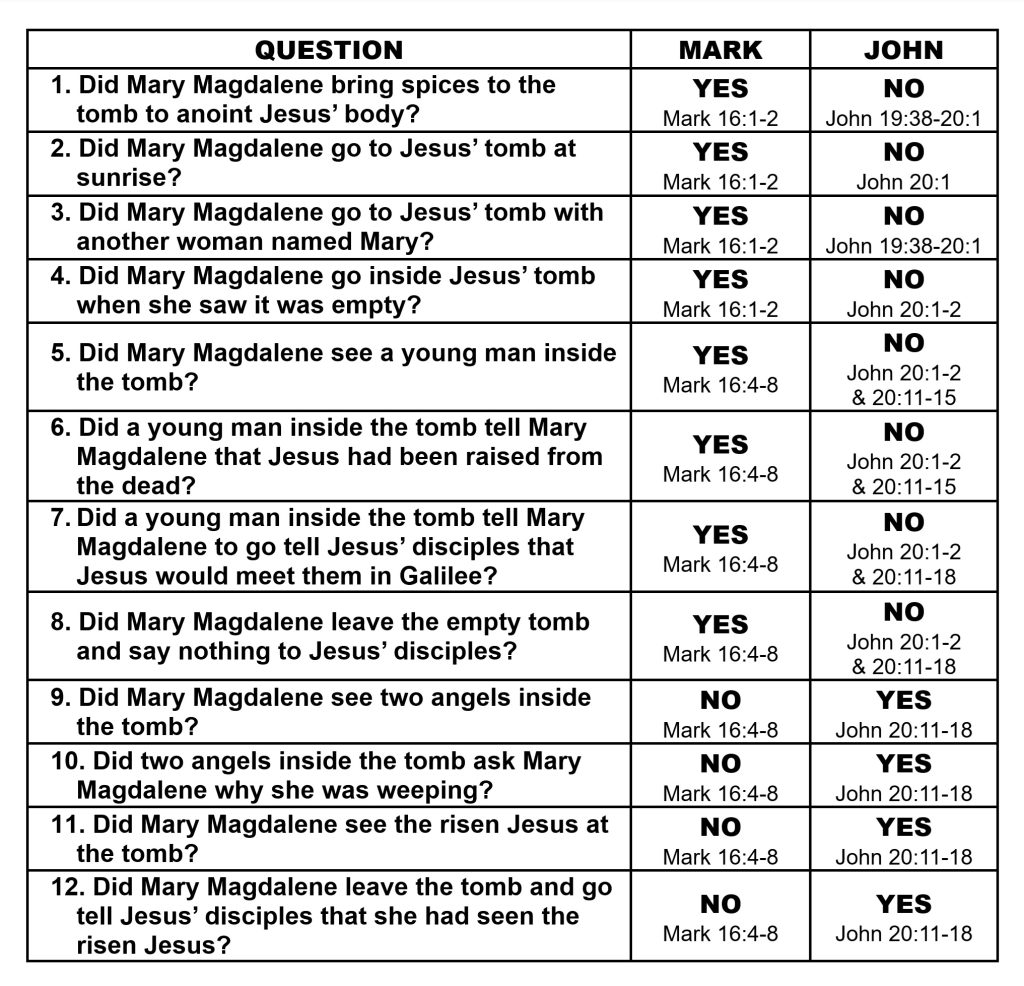
Given that the Gospel of Mark was probably written about three decades before the Gospel of John, and given that we have good reason to believe that the Gospel of John provides a historically unreliable account of the life and teachings of Jesus, and given that we have seen that a number of specific discourses and dialogues of Jesus in the Gospel of John are probably either completely fictional or are historically unreliable, these several conflicts between the account of the alleged discovery of the empty tomb in the Gospel of Mark and the account of the empty tomb in the Gospel of John cast significant doubt on the historical reliability of the account of the alleged discovery of the empty tomb found in the Gospel of John.
But the account of the alleged discovery of the empty tomb in Chapter 20 of the Gospel of John provides the context for the alleged dialogue between Jesus and Mary Magdalene in Chapter 20 of the Gospel of John. Because we have good reason to believe that the account of the discovery of the empty tomb in the Gospel of John is historically unreliable, that is sufficient reason to conclude that the alleged dialogue between Jesus and Mary Magdalene in the Gospel of John is also probably either completely fictional or is historically unreliable.
There are also about a half-dozen conflicts between the Gospel of Matthew and the Gospel of John about the alleged discovery of the empty tomb, and about a half-dozen conflicts between the Gospel of Luke and the Gospel of John about this alleged event.
The Gospel of Matthew agrees with the Gospel of Mark against the Gospel of John on these points:
#2, #3, #9, and #10
The Gospel of Matthew partially agrees with the Gospel of Mark against the Gospel of John on the message given to the women at the tomb of Jesus:
#6 and #7
The Gospel of Matthew partially agrees with the Gospel of Mark in having only one person or one angel at the tomb as contrasted with there being two angels at the tomb in the Gospel of John:
#5
The Gospel of Luke agrees with the Gospel of Mark against the Gospel of John on these points:
#1, #2, #3, #4, and #10
The Gospel of Luke partially agrees with the Gospel of Mark that the message given to the women included the claim that Jesus had risen from the dead:
#6
Thus, the Gospel of Matthew and the Gospel of Luke confirm or support the Gospel of Mark on a number of points against the account of the alleged discovery of the empty tomb found in the Gospel of John:
#1 (Luke agrees with Mark)
#2 (Matthew & Luke agree with Mark)
#3 (Matthew & Luke agree with Mark)
#4 (Luke agrees with Mark)
#5 (Matthew partially agrees with Mark)
#6 (Matthew & Luke partially agree with Mark)
#7 (Matthew partially agrees with Mark)
#9 (Matthew agrees with Mark)
#10 (Matthew & Luke agree with Mark)
Because all four Gospels give different and conflicting accounts of the alleged discovery of the empty tomb, we cannot confidently conclude that the account in the Gospel of Mark is completely correct and that the account in the Gospel of John is completely wrong.
However, given that the Gospel of Mark was probably written about three decades before the Gospel of John, and given that we already have good reason to believe that the Gospel of John is historically unreliable, and given that the account in the Gospel of Mark conflicts with the account in the Gospel of John on a dozen points, and given that both the Gospel of Matthew and the Gospel of Luke each conflict with the account of the alleged discovery of the empty tomb found in the Gospel of John on about a half-dozen points, we have good reason to conclude that this account in the Gospel of John is probably historically unreliable.
We have now seen that at least three of the one-on-one dialogues in the Gospel of John are probably either fictional or are historically unreliable:
Dialogue between Jesus and Pilate (John 18:28-19:16)
Dialogue between Jesus and Mary Magdalene (John 20:11-18)
Dialogue between Jesus and Doubting Thomas (John 20:24-29)
In the next two posts in this series, I will examine two more alleged one-on-one dialogues in the Gospel of John:
Dialogue between Jesus and Nicodemus (John 3:1-21)
Dialogue between Jesus and the Samaritan Woman (John 4:1-42)