



The Unreliability of the 4th Gospel – Part 6: One-On-One Dialogues
WHERE WE ARE
In Part 1 of this series, I showed there was good reason to believe that the Gospel of Mark was written about three decades before the Gospel of John (70 C.E. vs. 100 C.E.).
In Part 2 of this series, I showed that there was a significant conflict between the Gospel of Mark and the Gospel of John over this question:
Was “the kingdom of God” a central focus of the teachings of Jesus?
In Part 3 of this series, I showed that there was a significant conflict between the Gospel of Mark and the Gospel of John over this question:
Was casting out demons a key focus of the ministry of Jesus?
In Part 4 of this series, I showed that there was a significant conflict between the Gospel of Mark and the Gospel of John over this question:
Were religious statements by Jesus of the form “I am the …” a key focus of his teachings?
Because the Gospel of Mark was probably written about three decades before the Gospel of John, that gives us good reason to accept the view of the Gospel of Mark that “the kingdom of God” was a central focus of the teachings of Jesus, and that casting out demons was a key focus of the ministry of Jesus, and that religious statements by Jesus of the form “I am the …” were NOT a key focus of his teachings, all of which is contrary to the Gospel of John.
Furthermore, the Gospel of Matthew agrees with the Gospel of Mark on all three of these significant questions, and the Gospel of Luke also agrees with the Gospel of Mark on all three questions. So, we may conclude that the Gospel of Mark is probably correct on these three significant points and of that the Gospel of John is incorrect on these significant questions. This evidence is sufficient to show that the Gospel of John provides a historically unreliable account of the teachings and ministry of Jesus.
THE SAYINGS VS. THE SERMONS OF JESUS
In Part 5 of this series, I began to show that the sermons or discourses of Jesus in the Gospel of John are historically dubious compared with the sayings and parables of Jesus in the Gospel of Mark, and the Gospel of Matthew, and the Gospel of Luke.
I argued that the following three sermons/discourses of Jesus in the Gospel of John are either fictional or are inaccurate and unreliable representations of the words of Jesus:
- The Bread of Life Discourse (John 6:35–58)
- The Good Shepherd Discourse (John 10:1–18)
- The True Vine Discourse (John 15:1-17)
In this current post, I will begin to argue that a close examination of the following one-on-one dialogues of Jesus in the Gospel of John shows that they are also probably either fictional or are inaccurate and unreliable:
- Dialogue between Jesus and Nicodemus (John 3:1-21)
- Dialogue between Jesus and the Samaritan Woman (John 4:1-42)
- Dialogue between Jesus and Pilate (John 18:28-19:16)
- Dialogue between Jesus and Mary Magdalene (John 20:11-18)
- Dialogue between Jesus and Doubting Thomas (John 20:24-29)
I will start with the third example because it is clearly a fictional account created by the author of the Gospel of John.
THE ALLEGED DIALOGUE BETWEEN JESUS AND PILATE
First, I should mention that my view is that the alleged interactions between Jesus and Pilate in ALL four Gospels are fictional, for one good reason, as stated by the Jesus scholar Marcus Borg:
About the events reported between arrest and execution, including trials before Jewish and Roman authorities, I have little historical confidence. The reason: whatever happened was not witnessed by Jesus’ followers; they had fled and were not there.[1]
So, in addition to the fact that an extended conversation between Pilate and Jesus was probably not something that anyone would have a clear and accurate memory of six or seven decades after this happened, there is also the serious problem that Jesus’ followers were in hiding when the alleged trial of Jesus before Pilate took place, so they did not hear this conversation or interrogation.
There are other reasons that cast significant doubt on this alleged one-on-one dialogue:
- The trial before Pilate in the Gospel of John is constructed as a short play
- According to the Gospel of John, this conversation took place inside of a palace
- According to the Gospel of John, this conversation took place away from the Jewish leaders
- Jesus uses the expression “my kingdom” in this dialogue
- This account of the alleged trial of Jesus before Pilate in the Gospel of John conflicts with the account in the Gospel of Mark in at least seven different ways
The trial of Jesus before Pilate is presented as a short play in the Gospel of John, as indicated by the NT scholar Gail O’Day:
John 18:28-19:16a is the supreme example in the Fourth Gospel of the the Fourth Evangelist’s use of dramatic structure, irony, and symbolism in the service of theological interpretation. Jesus’ trial before Pilate is the theological and dramatic climax of the story of Jesus’ hour.
Like the Pharisees’ interrogation of the blind man in John 9, Jesus’ trial before Pilate is structured as a drama. The trial narrative opens with an introductory verse (18:28) that establishes the time and location for the drama. This introduction is followed by seven scenes.[2]
The NT and Jesus scholar Raymond Brown agrees with O’Day on this point:
All the Gospels have Jesus led from/by the high priest to be tried by the Roman governor, but in John this trial is a much more developed drama than in the Synoptics [Mark, Matthew, & Luke]. Careful stage setting is supplied, with “the Jews” outside the praetorium and Jesus inside. Seven episodes describe how Pilate shuttled back and forth trying to reconcile the two adamant antagonists…[3]
The author of the Gospel of John has produced a short play about the alleged trial of Jesus before Pilate in order to make some significant theological points. But the carefully constructed drama indicates that historical accuracy was not the primary purpose of this account. Speeches of famous people in ancient historical works were often invented by the writer of the “historical” account. The fact that the author of the Gospel of John puts this alleged dialogue of Jesus into the form of a play is a strong indication that we are being presented with a fictional account created by the author.
Another strong indication that this account is fictional, is that the account portrays the conversation between Pilate and Jesus as taking place inside of the “praetorium”, the palace where Pilate stayed when he was in Jerusalem, while the Jewish leaders remained outside of the palace. Thus, not only were Jesus’ followers not present (because they were in hiding), but the general public and the Jewish leaders were outside of the palace, so they could not hear what was being discussed by Pilate and Jesus inside of the palace. Thus, if that part of this account was correct, then it would be very unlikely that the followers of Jesus had any accurate information about what, if anything, Pilate and Jesus talked about when Pilate interrogated Jesus.
In the conversation between Pilate and Jesus, Jesus refers to “my kingdom” three times (John 18:36). But Jesus never utters the phrase “my kingdom” anywhere in the Gospel of Mark. Also, Jesus never utters the phrase “my kingdom” anywhere in the Gospel of Matthew. In the Gospel of Luke, Jesus does use the phrase “my kingdom” but just once (in Luke 22:30) and not during the trial before Pilate. There is a parallel passage in the Gospel of Matthew to the passage in the Gospel of Luke where Jesus allegedly used the phrase “my kingdom”, but in the Gospel of Matthew, but Jesus does not refer to “my kingdom” in that passage (Matthew 19:28). It thus is unlikely that the historical Jesus would use the phrase “my kingdom” three times in a conversation with Pilate, when Jesus never (or almost never) used that expression when preaching or teaching or talking with his disciples.
There are at least seven conflicts between the account of the alleged trial of Jesus before Pilate given in the Gospel of Mark and the account given in the Gospel of John:
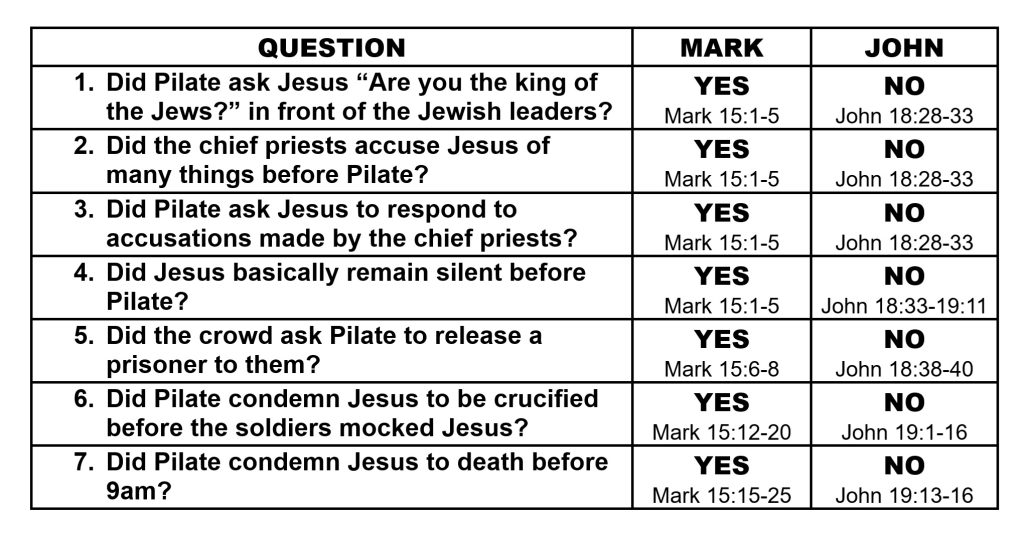
Because of these various conflicts, we may reasonably conclude that at least one of these two accounts of the trial of Jesus before Pilate is historically unreliable (and they might both be unreliable accounts). Because the Gospel of Mark was probably written about three decades before the Gospel of John, and because the Gospel of Mark has previously been shown to be more reliable than the Gospel of John (in Parts 1 through 5 of this series), it is likely that the account of Jesus’ trial before Pilate in the Gospel of John is historically unreliable.
In view of the above good reasons to doubt the historical reliability of the account in the Gospel of John of the trial of Jesus before Pilate, we may conclude that it is likely that either the dialogue between Jesus and Pilate is purely fictional or that even if it has some basis in testimony or memory, the account is historically unreliable and inaccurate.
In the next post of this series, I will continue to examine alleged one-on-one dialogues between Jesus and individuals presented in the Gospel of John.
END NOTES
1. Marcus Borg, “Chapter 5: Why Was Jesus Killed?” in The Meaning of Jesus (San Francisco, CA: HarperCollins Publishers, 1999), p.87.
2. Gail R. O’Day, “The Gospel of John” in The New Interpreter’s Bible, Volume IX (Nashville, TN: Abingdon Press, 1995), p.813.
3. Raymond Brown, An Introduction to the New Testament (New York, NY: Doubleday,1997), p.357.